
To plan a home poker tournament blind structure, choose the starting stack and opening big blind together, set the length of each level, and write an increasing sequence of blinds that your physical chips can support. Add breaks to the timeline and prepare later levels before anyone sits down.
A tournament structure controls the pace of rising blinds. It cannot promise an exact finishing time: the number of entries, speed of dealing, eliminations, and pauses all affect how long the game lasts. Plan for a reasonable playing window and leave room beyond it.
This guide builds an original example for a small home tournament: 5,000 chips per entry, opening blinds of 25/50, eight 20-minute levels, and one 10-minute break. It is a starting point to adapt to your group, not a preset or a prediction from Tells.
What should you decide before choosing the blinds?
Start with the evening you can actually host. Write down the intended start time, number of tables, likely number of players, available chip denominations, and whether players may enter again after elimination. Decide the registration cutoff before announcing the structure.
Separate the playing window from the whole event. Seating players, explaining rules, distributing stacks, and handling final results take time outside the levels. A schedule that fills every available minute leaves no space for a late start or a long final match.
Choose a clear rule for level transitions and announce it before play. For example, your house rule can apply a new blind level starting with the next hand. The important operational point is that everyone follows the same definition of when the change takes effect.
How many chips should each player start with?
Judge the starting stack relative to the opening big blind. Divide starting chips by the big blind to express the stack in big blinds. A 5,000-chip stack at 25/50 starts at 100 big blinds; the same stack at 50/100 starts at 50 big blinds.
Changing the printed chip total alone does not create more room to play. A 10,000-chip stack with a 100 big blind has the same opening depth as 5,000 chips with a 50 big blind. Choose the ratio first, then denominations you can count and distribute conveniently.
For this example, each stack contains eight 25 chips, eight 100 chips, four 500 chips, and two 1,000 chips. Those values add to 200 + 800 + 2,000 + 2,000 = 5,000, using 22 physical chips per player. Ten starting players therefore need 220 chips for their initial stacks, plus a reserve for change and any permitted additional entries.
How do blind increases change stack depth?
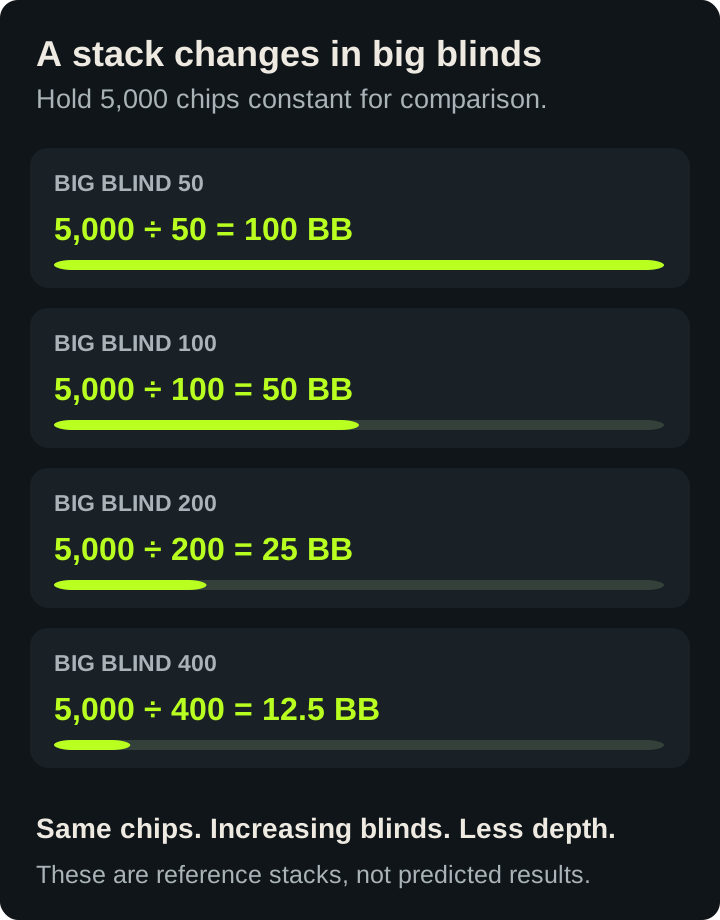
A rising big blind reduces the number of big blinds represented by an unchanged chip stack. To inspect your schedule, hold one example stack constant and divide it by each new big blind. This shows the pressure created by the structure independently of hands won or lost.
Our unchanged 5,000-chip reference stack represents 100 big blinds at 50, 50 big blinds at 100, 25 big blinds at 200, and 12.5 big blinds at 400. This is a comparison of units, not a forecast that any player will hold exactly 5,000 at those levels.
Check the size of each jump as well. Going from a 100 big blind to 150 increases it by half; going from 100 to 200 doubles it. Repeated large jumps compress stack depth quickly, even if the clock gives every level the same number of minutes.
What is an example home tournament blind schedule?
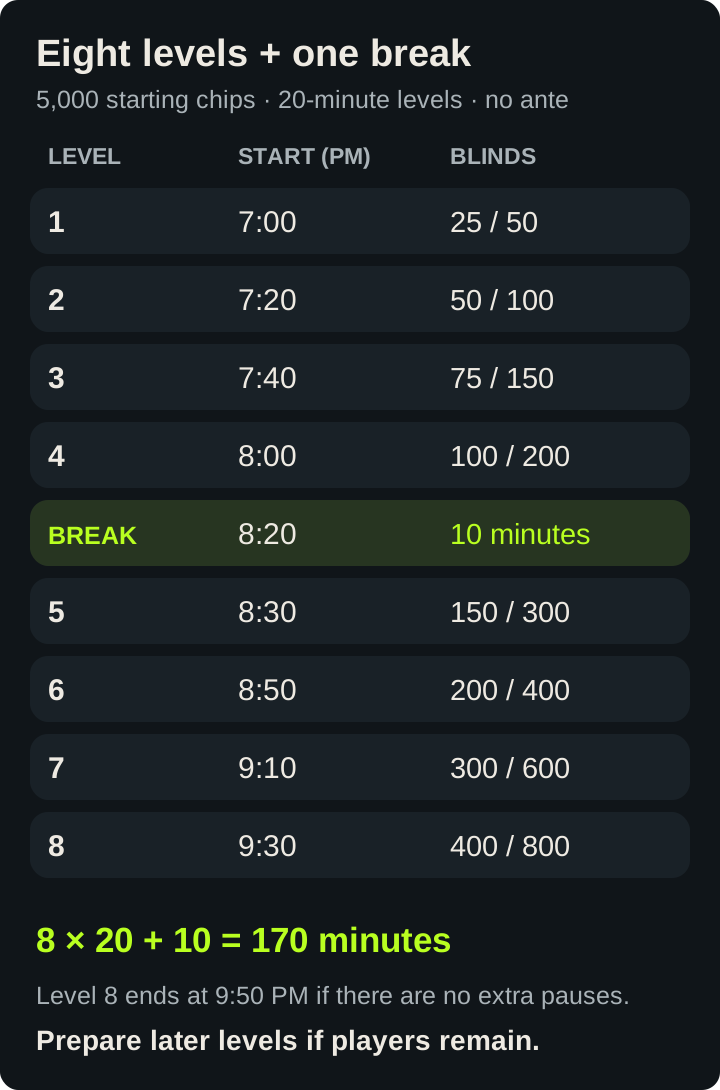
For the 5,000-chip example, use 25/50, 50/100, 75/150, and 100/200 for the first four levels. Pause for 10 minutes, then continue with 150/300, 200/400, 300/600, and 400/800. Each playing level lasts 20 minutes and this example uses no ante.
Eight levels contribute 160 minutes of play. The break adds 10 minutes, making a 170-minute schedule through level eight. If the clock starts at 7:00 p.m. and there are no additional pauses, the break begins at 8:20 p.m., play resumes at 8:30 p.m., and level eight ends at 9:50 p.m.
Have continuation levels ready if players remain. For example, 500/1,000 and 750/1,500 at the same 20-minute length extend the written schedule to 210 minutes including the break. These are additional planned levels, not permission to change the structure unexpectedly because a particular player is ahead.
Should the tournament use antes?
For a straightforward first event, a no-ante structure reduces the number of forced contributions the group must track. That is why the worked schedule leaves antes at zero. It also keeps the stack-depth illustration focused on changes in the big blind.
If you include an ante, state both the amount and who posts it. An individual ante paid by each player and a single ante paid by the big blind are different collection methods. A number labeled ante does not explain the method by itself.
Antes put additional chips into the pot before voluntary action. Introducing them changes the structure's pace, so decide when they begin and communicate that alongside the blinds. Do not silently add an ante to this no-ante example and expect the same experience.
Where should you put breaks and chip exchanges?
Put breaks in the ordered schedule so players can see them coming. In this example, four levels provide 80 minutes of play before the 10-minute pause. A break is useful for refreshments, a registration check, and any planned chip exchange.
Check future blinds before removing a denomination. The second half of this schedule still contains a 150 small blind, so 25-value chips remain useful. Removing every 25 chip without replacing its ability to make 150 would create a problem at the first hand after the break.
If you plan to remove small chips, prepare the replacement denominations and announce a procedure for any leftover amounts. Keep the exchange separate from changing the total tournament chips. A convenient-looking tray is not worth leaving players with different stack values.
How do extra entries affect tournament pacing?
An extra entry normally introduces another starting stack under the rules you selected. That increases the chips in play even when the number of occupied seats stays the same. Record each new stack issued so you can explain the total field and chip supply later.
With ten 5,000-chip entries, the tournament has 50,000 chips. If five players remain, the average stack is 10,000 chips. At a 400 big blind, that average is 25 big blinds. Two additional 5,000-chip entries would bring the total to 60,000, making the average with five remaining players 12,000 chips, or 30 big blinds at the same level.
Average stack is a planning reference, not a description of each player. One player may hold most of the chips. The example explains why the same blind schedule can feel different after extra entries; it does not estimate the exact number of hands until the tournament ends.
How do you enter the blind structure in Tells?
Open your hosted tournament in Tells Poker and select Blind levels. Set the playing-level length to 20 minutes. Edit the small blind and big blind on each row to match the example, and leave the ante blank or zero for this no-ante structure.
Add a 10-minute break and move it after the fourth playing level. The editor supports adding, removing, and reordering playing levels and breaks. Save the schedule, then check the sequence from the beginning through the continuation levels before starting the clock.
Review each newly added level rather than assuming its suggested values match your plan. The current editor initially doubles the last big blind when adding a row; you can change the amounts to build the progression you want.
The tournament clock displays the current blinds, remaining time, and next scheduled item. Use the host's pause and level controls when a correction is needed, and announce the correction to the room. Plan the schedule before play; these organizer controls manage the event rather than advise anyone on a live poker decision.
What should you review before using the structure again?
After the event, compare your planned timeline with the actual start, breaks, registration close, and finishing level. Record which delays came from organization and which came from the length of play. A late start calls for a different adjustment than a structure with unnecessarily abrupt blind jumps.
Change one major pacing choice at a time for the next event. You might shorten the level length, revise one jump, or change the re-entry window. Keeping the other choices stable makes it easier to understand what the revision changed.
Keep the final schedule with the event record. A host who can explain the opening depth, total scheduled minutes, and next level has a much stronger plan than one who only knows that the timer is running.
Frequently asked questions
Does a 170-minute blind schedule guarantee a tournament ends in 170 minutes?
No. It specifies how long those levels and breaks take without extra pauses. Players may finish earlier or still be playing afterward, so prepare continuation levels and allow extra time.
How many big blinds is a 5,000-chip starting stack?
Divide 5,000 by the opening big blind. At 25/50 it is 100 big blinds; at 50/100 it is 50 big blinds.
Can I change the blind levels and breaks in Tells?
Yes. The tournament's Blind levels editor lets you edit blind and ante amounts, set the playing-level length, and add, remove, or reorder levels and breaks.