To track a home poker game cleanly, keep one player list, record every buy-in when chips are issued, enter each cash-out when a player leaves, and compare total money in with total money out before settling. If those totals do not match, pause and find the missing stack or entry.
A notes app can hold names and numbers, but it does not know which number is a rebuy, which player has cashed out, or whether the final totals balance. By the end of a long night, a tidy list can become crossed-out amounts, duplicate names, and arithmetic nobody wants to reconstruct at the table.
Tells Organizer gives the host a structured cash-game record for players, repeat buy-ins, cash-outs, the amount still on the table, and settlement. It does not move money or replace the rules of your game; it keeps the record organized so the host can close the night with numbers everyone can inspect.
Why does a notes app get messy during a home poker game?
Traditional notes are free-form. One host writes “Ben 100 + 100,” another changes it to “Ben 200,” and a third adds “paid 160” several lines later. The arithmetic may be correct, but the meaning depends on remembering who edited what and when.
Notes also mix different kinds of information in the same space. Buy-ins, cash-outs, chip counts, payment reminders, and table changes can look like one stream of numbers. When the total is short, the host first has to decode the note before checking the money.
Start one hosted cash game before the first buy-in
Create one game record with a clear name and stakes. Tells attaches the date and live status, and you add each player to that game instead of keeping separate notes or message threads. The goal is simple: every chip issued and every cash-out belongs to one player in one record.
Tells separates hosted games from personal sessions inside Ledger. The Hosted games view shows which games are live, each game's total buy-ins and player count, and how much remains on the table. That keeps the host's operational record distinct from an individual player's results.
Record every buy-in when chips are issued
Treat a rebuy as a transaction, not a memory. If a player starts for $100 and buys another $100, record the second buy-in before handing over the new chips. Waiting until the end creates the most common disagreement: the player remembers one amount while the note implies another.
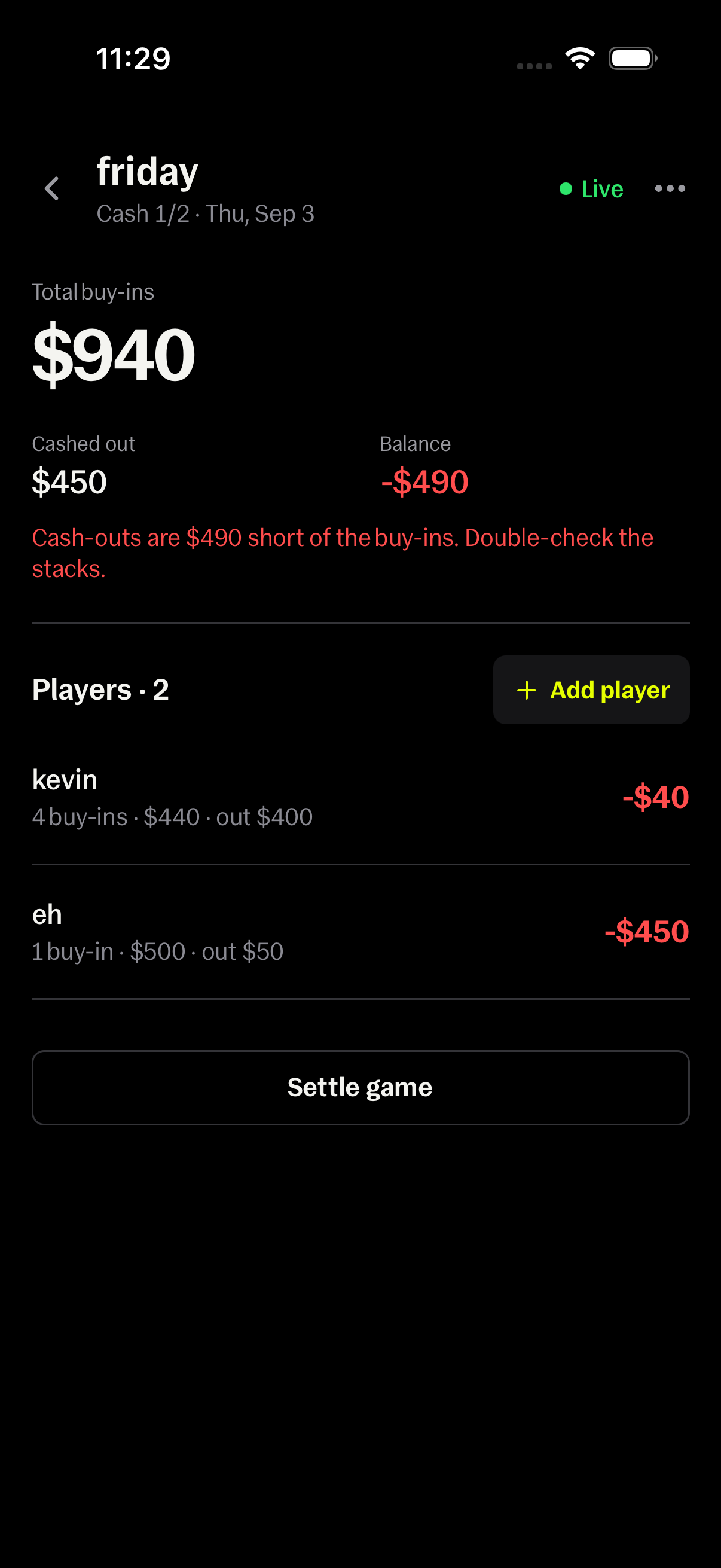
In Tells, each player row keeps the buy-in count and total buy-in together. You can see that someone had two buy-ins totaling $200 without interpreting a chain of crossed-out numbers. The game total updates from the player records, so the host does not need a separate calculator total.
Keep cash-outs separate from buy-ins
A cash-out is not an edit to the original buy-in. It is the amount returned when a player leaves. Record it on that player's row and keep the buy-in history intact. This preserves both sides of the result: how much entered the game and how much came back out.
The player row can then show the buy-in count, total buy-in, cash-out, and net result in one place. A positive or negative result is derived from those inputs instead of typed as another loose number that could disagree with them.
How do you reconcile a home poker game?
Suppose five players account for $600 in total buy-ins. Their cash-outs are $140, $160, $90, $110, and $100. Those cash-outs also total $600, so the game balances. The individual results are +$40, -$40, -$10, +$10, and $0, which add to zero.
If cash-outs total only $590, do not force the record to look finished. Check uncounted chips, a missed rebuy, an incorrect cash-out, or money still on the table. Tells displays Total buy-ins, Cashed out, and Balance together and warns when cash-outs are short of or exceed the buy-ins, giving the host a concrete difference to investigate.
Settle only after every player is accounted for
Before settling, scan the player list from top to bottom. Confirm the number of buy-ins, the total paid in, and the cash-out for each person. If someone has not cashed out, the Organizer identifies that player as still on the table; settling anyway requires an explicit confirmation and records a zero cash-out for that player.
The confirmation step does not make an imbalance correct. It makes the host acknowledge the state of the record instead of closing it accidentally. If the Balance is not zero, use the displayed difference as the starting point for the final chip and transaction check.
A practical home-game closing checklist
Use the same order every night: stop issuing chips, record the last cash-outs, confirm every player row, compare total buy-ins with total cash-outs, resolve any balance, and then settle the game. A repeatable close is easier to trust than a new spreadsheet or note format each week.
Keep payment confirmations separate from the game ledger if your group uses cash or a payment app. Tells Organizer records the poker-night accounting; it is not a bank or payment processor. Follow the laws and house rules that apply to the game you host.
How does Tells make the next home game easier to run?
Open Ledger, switch to Hosted games, and choose Host a game. Select Cash, add the game name and stakes, then add players as they arrive. During the night, manage each player from the same game detail screen to record repeat buy-ins and cash-outs.
The screen keeps Total buy-ins, Cashed out, Balance, player results, and settlement connected. Instead of asking a notes app to behave like a ledger, the host gets a workflow built around the exact events that make home-game bookkeeping difficult.
Frequently asked questions
What should a home poker game host track?
Track the game name, date, stakes, every player, each player's buy-in count and total buy-in, every cash-out, and the final difference between total money in and total money out.
How should rebuys be recorded?
Record each rebuy when the chips are issued and increase both the player's buy-in count and total buy-in. Do not overwrite the starting buy-in or wait until the end of the night.
What if cash-outs do not equal total buy-ins?
Pause settlement and check for chips still on the table, a missing rebuy, or an incorrect cash-out. Tells shows the exact shortfall or excess so the host knows what amount must be reconciled.
Does Tells handle payments between players?
No. Tells Organizer records players, buy-ins, cash-outs, totals, and settlement. It does not transfer money or replace a bank or payment service.