
Implied odds estimate whether a call that is too expensive on the current pot can become worthwhile because you may win more money on a later street. Start with the direct pot odds, estimate your equity, calculate the extra future winnings needed, then ask whether the effective stack and the opponent's likely response make that amount realistic.
Future money is not already in the pot. Implied odds are a scenario built from assumptions about clean improving cards, remaining stacks, position, future action, and which worse hands will continue. A large stack creates capacity to win more; it does not guarantee that any of it will be paid.
Use implied odds for post-session study, not as a precise prediction. The useful conclusion is often conditional: the call works if the draw is clean and a worse hand pays at least a stated amount, but fails when either assumption is reduced.
What do implied odds mean in poker?
Implied odds describe the additional money you expect to win after making a call and improving later. They extend the current price into a future action tree. If the immediate pot odds do not justify the call, credible later winnings can sometimes close the gap.
The word expected matters. The relevant amount is not the opponent's whole stack or the largest river bet you can imagine. It is the future contribution a worse hand is likely to make when you improve, adjusted for the times the opponent folds, the draw is not clean, or the action develops differently.
Implied odds are most useful before the river because at least one betting street remains. On the river, a call normally has no later street from which to collect extra value, so the current price and the betting range carry the decision.
How are implied odds different from pot odds?
Pot odds use only the money already committed and the amount you must call now. Implied odds add a carefully estimated future amount. Pot odds are a known price once the pot is reconstructed; implied odds depend on assumptions that should be written down and tested.
Suppose the pot is $120 after an opponent's wager and calling costs $40. The final pot after your call would be $160, so the immediate required equity is $40 divided by $160, or 25 percent. If you estimate only 20 percent equity, direct pot odds do not support the call. Implied odds ask whether later winnings can make up that shortfall.
Keep the two stages separate. First calculate the current price without future money. Then add one plausible future branch. Starting with an imagined payoff can disguise a call that needs an unrealistic amount of cooperation from the opponent.
How do you estimate the future money a call must win?
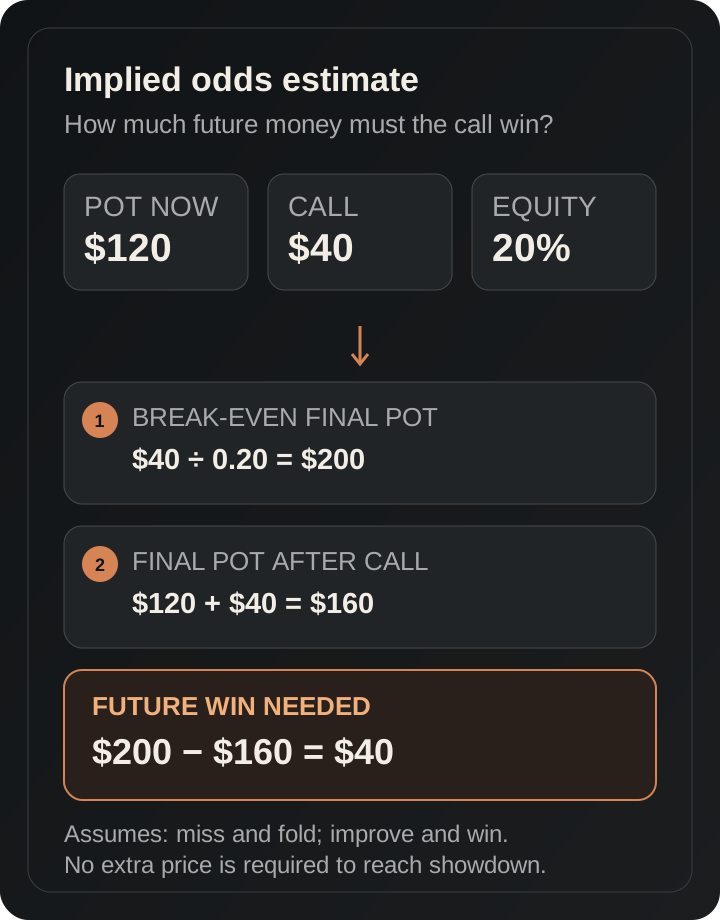
For a simplified draw that misses and folds or improves and wins without paying another price, calculate break-even final pot = call divided by estimated equity. Then subtract the final pot that would exist immediately after your current call. The remainder is the minimum additional amount you need to win from the opponent later.
Using the same $120 pot, $40 call, and 20 percent equity estimate, the break-even final pot is $40 divided by 0.20, or $200. The current final pot after calling is $160. The call therefore needs at least $40 of future winnings from the opponent under those simplified assumptions.
This is a threshold for the scenario, not a universal implied-odds formula for every tree. If you may face another bet before reaching showdown, sometimes improve and still lose, split the pot, or continue on several different rivers, include those branches separately rather than forcing them into one clean number.
What does a complete implied-odds example look like?
On the turn, the pot is $80 and an opponent bets $40. The pot is now $120, calling costs $40, and the final pot after a call would be $160. Your immediate pot odds require 25 percent equity. For this review, you estimate that your draw wins 20 percent of the time and that a miss can fold without another payment.
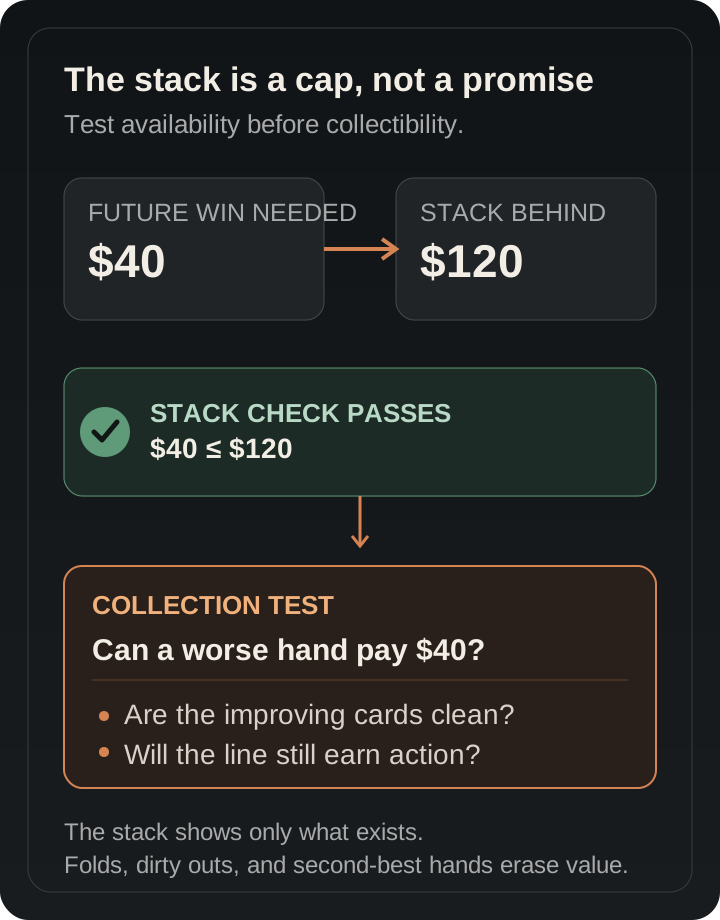
The break-even final pot is $200, so you need $40 more from the opponent on the rivers where you improve and win. Now inspect the stacks. If the opponent has only $25 behind after your call, the scenario cannot supply the required $40 even if every remaining chip goes in. The stack cap rules out the implied-odds justification.
If the opponent has $120 behind, the amount is available but not promised. Ask which worse hands reach the turn this way, whether your improving card makes the draw obvious, who acts first, and what size those worse hands would realistically pay. If the expected contribution on winning rivers is only $20, the call still misses its threshold. If a reasonable action tree collects at least $40, implied odds can support the call within that model.
Change one assumption at a time. Reduce the equity estimate, discount one questionable out, or lower the future payment. A conclusion that flips easily is assumption-sensitive and should be saved that way rather than turned into a rule to chase every draw.
How does the effective stack cap implied odds?
The effective stack after your call is the most the relevant opponent can contribute later. Compare that cap with the future amount your calculation requires. If the required win exceeds the opponent's remaining effective stack, no story about later action can make the simplified call work.
Passing the cap is only the first test. An opponent with $120 behind can still fold to the river bet, check back, or hold a range that rarely pays a large amount with worse hands. Treat the stack as available inventory, then estimate how much of that inventory the action can realistically collect.
In a multiway pot, preserve each player's remaining stack and eligibility for the pot. One deep player does not automatically create implied odds against a short player, and a possible side pot may change which future contribution the hero can actually win.
Which draws tend to have stronger implied odds?
A draw has stronger implied odds when its improving cards are likely to produce the best hand, enough chips remain, and worse hands can continue after the improvement. Position can help because seeing the opponent's river action first may make value easier to size and protect you from paying an unexpected additional price.
The shape of the draw matters as much as its label. A draw to a high flush can have a cleaner payoff path than a draw to a small flush that may finish second. A disguised straight card may earn more action than a card that makes the completed draw obvious, although the earlier ranges and board determine whether that story is plausible.
Do not award implied odds simply because the opponent appears strong. A strong made hand may pay, but it may also fill up on a paired board, improve beyond your draw, or stop investing when the river changes the board. Name both the hands that pay and the hands that still beat you.
What are reverse implied odds?
Reverse implied odds are the future losses that can follow an apparently helpful card. You may improve to a pair, straight, or flush and still hold the second-best hand, or you may face another wager with a hand that is difficult to release. Those branches reduce the value of calling now.
For example, drawing to a small flush deserves a discount when higher flushes fit the opponent's range. Pairing a dominated kicker can also create an expensive second-best pair. The problem is not merely that an out can fail to help; it is that the card can encourage additional money to enter when you are behind.
Review implied and reverse implied odds together. Write the clean winning cards, the ambiguous cards, the future amount a worse hand may pay, and the future amount you may lose with a second-best hand. A one-sided estimate nearly always makes the call look easier than the full tree does.
What are the most common implied-odds mistakes?
The first mistake is counting the opponent's full stack as future winnings. The second is skipping direct pot odds, which hides how much future value the call actually needs. The third is treating every apparent out as clean without checking stronger draws, paired boards, splits, or redraws.
Another mistake is assuming that improvement guarantees payment. Some river cards stop the opponent from betting, make your value obvious, or leave you out of position with no easy way to collect. Estimate the line a worse hand will take, not just the amount you hope to put into the pot.
Finally, avoid false precision. Equity and future-payment estimates come from a range model, not observed cards. Use round, explainable scenarios and record when the decision changes. The goal is to expose the assumption carrying the call, not to decorate uncertainty with extra decimal places.
How should you review implied odds after a hand?
First, reconstruct the pot, call amount, effective stack, board, and action at the decision. Second, calculate the immediate pot odds. Third, estimate equity against a plausible range and identify clean, ambiguous, and dangerous improving cards. Fourth, calculate the minimum future win needed under one stated scenario.
Next, compare that target with the opponent's remaining stack and describe a realistic payment path. Ask who acts first, which worse hands continue, what size they can call, and which better hands remain. Then stress-test the conclusion by reducing the future payment or discounting a questionable out.
Save the result as a conditional cue. For example: “When direct odds miss, calculate the future amount required before using the stack as justification.” That cue is more portable than “call because the opponent was deep,” and it makes the same reasoning available in a future review.
How can Tells help with implied-odds review?
After a completed hand, Tells Poker keeps the cards, positions, actions, pot, and remaining stacks together in Replay. Move to the decision before the river and record the current price and effective stack before imagining any later payoff.
The Analysis tab can provide deterministic spot math such as Pot Odds and SPR alongside a graded street-by-street debrief, an alternative line, and a what-if branch when available. Those checked inputs give the implied-odds estimate a cleaner starting point, while the future payment remains an assumption for you to challenge.
Treat the analysis as a structured second opinion, not perfect or definitive play. Tells is designed for completed-hand review after the session, not assistance while a hand is in progress.
Frequently asked questions
Are implied odds an exact number?
No. The current pot and call can be exact, but future winnings depend on ranges, remaining stacks, position, improving cards, and later action. Use a stated scenario and test how the answer changes.
Do implied odds matter on the river?
Normally no, because no later betting street remains after a river call. Evaluate the current price against the opponent's river range and account for any players still left to act.
Can a short stack offer good implied odds?
Only within the amount still available. If the future win required exceeds the opponent's effective stack after your call, the stack cannot supply enough value under the simplified model.
What reduces implied odds?
Short stacks, obvious improvement cards, folds from worse hands, dirty outs, second-best made hands, and another price before showdown all reduce the useful future value of a call.