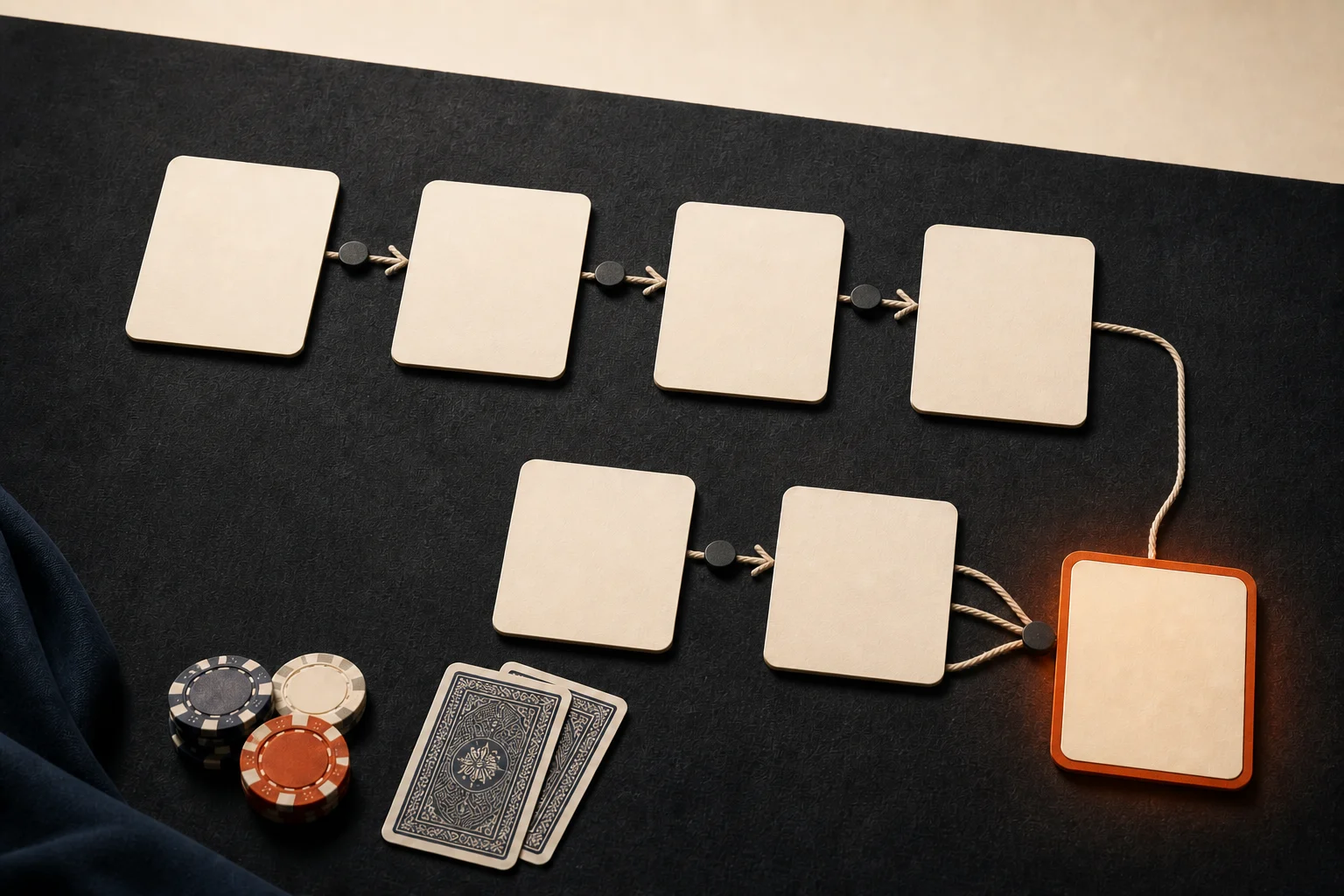
To review a poker hand, reconstruct the spot exactly, hide the result, and evaluate each decision with only the information available at that moment. Work street by street, estimate both players' ranges, check the price of each call, compare realistic alternatives, and finish with one lesson you can apply later.
A useful hand review is not a verdict on whether you won the pot. It is a repeatable way to test your reasoning after the session, when the cards are no longer moving and there is time to ask better questions.
Use this seven-step checklist on hands that felt confusing, close, or strategically important. One carefully reviewed decision is more useful than scrolling through a session looking only for the largest loss.
1. Capture the complete hand before you analyze it
Start with the facts: game format, blinds or stakes, positions, effective stack, hole cards, board cards, exact action, and every bet size. Add any opponent read you genuinely had at the time, but label it as an observation rather than a fact about their cards.
Write the hand so another player could replay it without asking a follow-up question. If one detail is missing, mark it as unknown instead of filling the gap with what probably happened. A clean uncertainty is easier to work with than a confident detail that may be wrong.
2. Hide the result and restate the decision
Before looking at showdown, pause at the decision you want to study. Write the question in neutral language: “Facing a half-pot river bet, should the big blind call, raise, or fold?” Do not write “How could I have avoided losing this pot?” The second version has already let the result choose the answer.
Run a result-blind test: imagine the river card, showdown, and final pot were never revealed. Would you still defend the same reasoning? Poker makes it easy to reward a poor choice that got lucky or condemn a sound choice that lost. Your review should judge the choice before the cards finished the story.
3. Replay the hand one street at a time
Begin preflop and stop at every choice you made. For each street, state what changed: the pot, the effective stack, the board texture, the likely ranges, and the purpose of your action. Then ask whether your next decision follows from that updated picture.
At each stop, finish the sentence: “I chose this action because…” “Bet turn” is not an analysis. “Bet turn for value from worse pairs while charging the available draws” is a claim you can test against the range and sizing. If you cannot explain the action, you have found the part of the hand worth studying.
4. Build ranges instead of guessing one exact hand
List the hands each player could reasonably reach the decision with, then narrow those ranges as the action develops. Position, stack depth, sizing, and previous actions all remove or reduce combinations. Keep value hands, draws, bluffs, and medium-strength hands visible until the line gives you a reason to discount them.
Avoid starting with the opponent's showdown hand and working backward. That produces a story about one result, not a review of the decision you faced. The useful question is how your action performs against the range you could reasonably assign before seeing the cards.
5. Check the pot odds and the assumptions behind them
For a call, divide the amount you must call by the final pot after your call. If the pot is $100 and an opponent bets $50, you call $50 to contest a final pot of $200. The break-even equity is $50 divided by $200, or 25 percent.
The calculation gives you the required equity; it does not tell you your actual equity. That still depends on the opponent range you assigned, how often that range is betting for value or bluffing, and whether future action remains. Write those assumptions beside the number so the math does not create a false sense of precision.
6. Compare realistic alternatives
Now compare your chosen action with the options you actually had. What does checking accomplish? Which worse hands call a bet? Which better hands fold? If you change the size, which part of the opponent's range changes its response? A useful comparison explains the tradeoff instead of declaring one action correct without context.
Analysis tools can provide a strategic baseline, but their answer is only as relevant as the inputs. Stack depth, positions, action, sizing, rake, and assumed ranges all matter. Use the output to pressure-test your reasoning, then separately consider whether a known opponent tendency supports a deliberate adjustment.
7. Save one portable lesson and share the spot
Finish with one sentence that can travel to another hand. Make it specific enough to use and narrow enough to trust: “Against a half-pot river bet, calculate the 25 percent break-even threshold before deciding whether this bluff-catcher reaches it.” Avoid rules built from a single result, such as “never call the river in this game.”
Then keep the hand, reasoning, and feedback together. In the Tells Poker iOS app, you can capture a completed hand with step-by-step, text, or voice input; replay every action; and review a verified debrief with street grades, spot math, range reasoning, an alternative line, one key insight, and a what-if. Share the complete hand when you want friends to replay the same spot and continue the discussion in Table Talk.
Frequently asked questions
Which poker hands should you review?
Review hands with a close decision, an unfamiliar line, a meaningful sizing choice, or uncertainty you could not resolve at the table. Big pots can qualify, but the size of the result alone does not make a hand educational.
Do you need a solver to review a poker hand?
No. You can improve a review by reconstructing the hand, checking ranges and pot odds, and explaining the purpose of each action. A solver can add a baseline later, but it does not replace accurate inputs or clear reasoning.
How do you review a live poker hand without a hand history?
Record the positions, effective stack, cards, and bet sizes after play, then reconstruct the action away from the table. Mark any missing detail as uncertain instead of guessing. Tells is designed for hand capture and post-session review, not real-time assistance during a hand.
Should you review hands you won?
Yes. Winning does not prove every decision was sound, just as losing does not prove every decision was a mistake. Review any hand with a meaningful decision, regardless of the result.