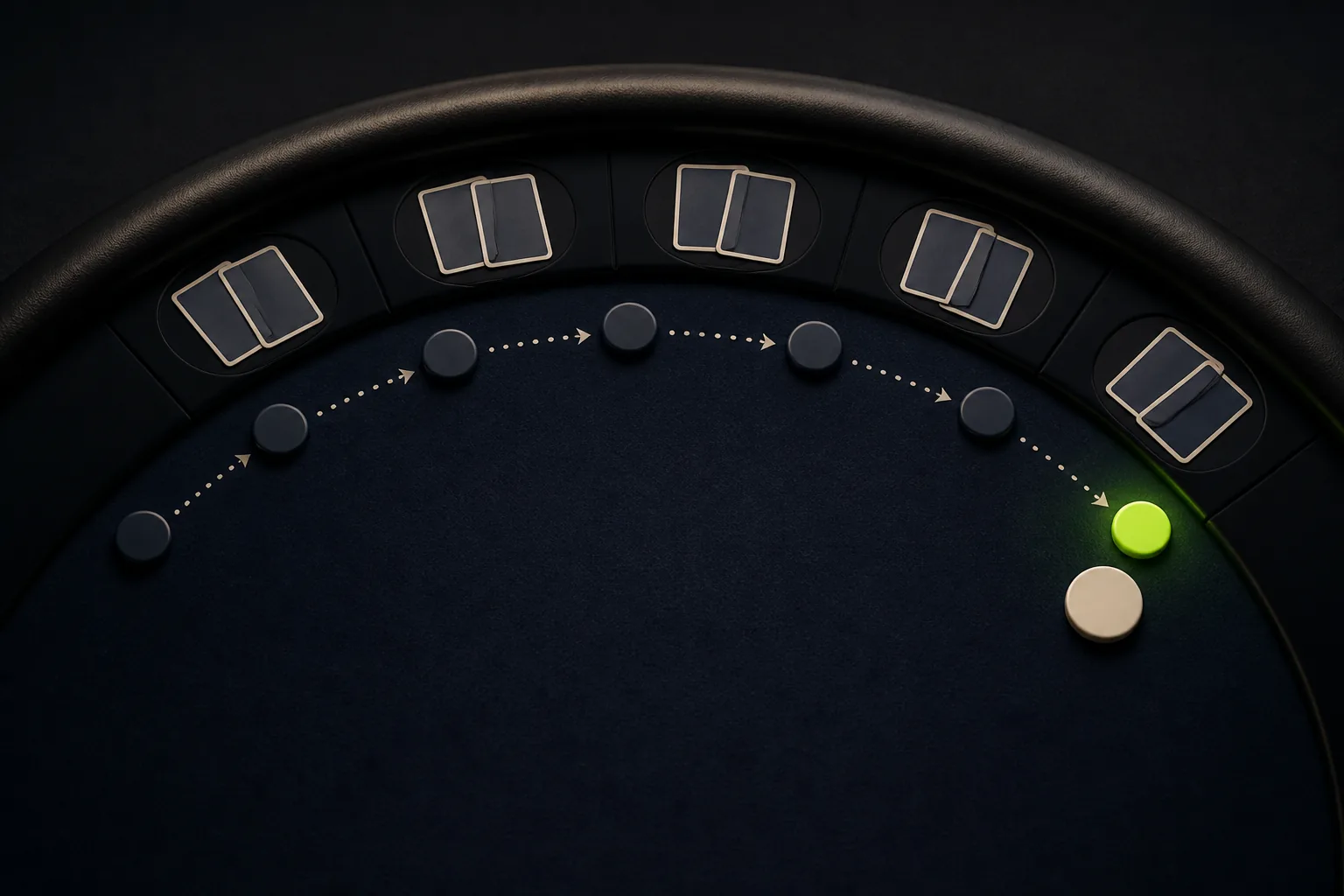
Position in poker describes where you sit relative to the dealer button and, more importantly, when you act. A player is in position against an opponent when that opponent must act first after the flop. A player is out of position when they must act first. Acting later gives you one more piece of information before each decision.
Your named seat—such as cutoff, button, small blind, or big blind—stays fixed for the hand. Your relative position depends on which opponents remain. In a multiway pot, you can be in position against one player and out of position against another.
Position does not make a hand automatically profitable or unprofitable. Cards, ranges, stacks, sizes, and board texture still matter. Position tells you the order in which those decisions are revealed, which is why every useful hand history should record the seats before the strategic review begins.
What does position mean in poker?
Poker position has two connected meanings. Table position is your named seat relative to the dealer button. Action position is whether you act before or after the other players at a decision. The names organize the table; the action order creates the strategic difference.
In a standard multi-handed hold'em hand, preflop action begins with the first active player to the left of the big blind and moves clockwise. After the flop, action begins with the first active player to the left of the button. The button therefore acts last after the flop whenever the button is still in the hand.
What do in position and out of position mean?
You are in position, often shortened to IP, when you act after an opponent on the flop, turn, and river. You are out of position, or OOP, when you act before that opponent. These labels are relative: one player cannot be both in position and out of position against the same opponent on the same street.
Suppose under the gun opens and the button calls. If the blinds fold, under the gun acts first on every postflop street and is out of position. The button acts second and is in position. The order is unchanged whether the first player checks, bets, calls, or raises.
What are the common poker positions at a six-handed table?
A six-handed table commonly uses six seat names: under the gun (UTG), hijack (HJ), cutoff (CO), button (BTN), small blind (SB), and big blind (BB). The button marks the dealer position. The cutoff sits immediately before the button, and the blinds sit immediately after it.
These names prevent vague hand histories. “I raised from late position” leaves room for interpretation. “Cutoff opens to 2.5 big blinds and button calls” fixes the seats, the preflop order, and who will act last after the flop if the blinds fold.
Larger tables add middle-position names such as lojack or UTG+1. Shorter tables remove seats rather than changing the basic relationship to the button. Because naming conventions can vary, record the exact seat abbreviations used in the hand instead of relying only on early, middle, or late position.
Why is acting later useful?
Acting later lets you observe an opponent's current action before choosing yours. If the out-of-position player checks, the in-position player knows that check occurred before deciding whether to check or bet. If the out-of-position player bets, the in-position player sees the size before choosing to fold, call, or raise.
That information repeats on each postflop street. It can make pot control, value betting, bluffing, and equity realization easier to plan, but it does not turn every weak hand into a bet or every marginal hand into a call. The value of position comes from choosing with more of the current sequence already visible.
Does position change after the flop?
Your seat does not change during a hand, and the normal postflop order stays anchored to the button. What can change is your position relative to the players who remain. Folds can remove the player who would have acted before or after you.
Imagine a three-way flop with the big blind, cutoff, and button. The cutoff is in position against the big blind but out of position against the button. If the button folds on the flop, the cutoff will act last against the big blind on later streets. Describing the cutoff only as “in position” before the fold would hide half of the original situation.
How does heads-up action order work?
Heads-up poker is the common exception that deserves its own note. The button also posts the small blind and acts first preflop. The big blind acts second preflop. After the flop, the order reverses: the big blind acts first and the button acts last.
This arrangement preserves the button's postflop positional advantage while giving each player one blind. When reconstructing a heads-up hand, do not reuse the multi-handed preflop shortcut that action starts to the left of the big blind without accounting for the two-player setup.
What is a complete position example?
At a six-handed table, under the gun opens to 2.5 big blinds and the button calls. Both blinds fold, creating a 6.5-big-blind pot before the flop. The flop is queen of spades, eight of diamonds, four of clubs.
Under the gun acts first. If that player checks, the button learns about the check before choosing an action. If under the gun instead bets 2 big blinds, the button sees the exact size before responding. On the turn and river, under the gun will again act before the button as long as both remain in the hand.
The example does not say checking or betting is correct. It isolates the positional fact: under the gun must reveal a choice before seeing the button's choice, while the button makes each postflop decision after observing the first action.
How should position change a hand review?
Start by writing the exact seats and action order, then pause at the decision you want to study. Ask which player had to act first, which player could close the action, and whether anyone still behind could call or raise. This separates a heads-up positional advantage from a multiway spot with unfinished action.
Next, test the ranges and future branches. Did an early-position open suggest a different starting range than a button open? Did acting out of position make it harder to reach showdown or collect value on later streets? Did your chosen size leave a workable plan if the opponent called? These are review questions, not automatic rules.
Finally, compare the same decision under a positional swap. If the other player had checked to you instead, would you still prefer the same action and size? If you had to act first on the next street, would the line still be easy to execute? The comparison reveals which part of your reasoning depends on cards and which part depends on order.
What are the most common position mistakes?
The first mistake is recording only “early” or “late” position. Use the exact seat. The second is treating the button as though it acts last preflop; the blinds still act after the button in a multi-handed hand. The third is forgetting that heads-up preflop order is different from postflop order.
Another mistake is using one label for a multiway spot. A middle player may have position on one opponent while another player still has position on them. Also avoid treating position as a verdict. Acting later is useful, but it does not replace range construction, pot odds, effective stack, or board analysis.
How can Tells help you review position?
In the Tells Poker iOS app, Guided Entry lets you choose the player count, your seat, individual stacks, and the action in table order. Quick Capture can also preserve a completed hand from a typed or spoken account when you already remember the sequence.
After the hand is saved, Replay shows the seats, stacks, pot, cards, and active action as you move through each street. Use it to confirm who acted first and who acted last, then open Analysis for a street-by-street structured second opinion. Keep that debrief in its intended lane: reflection after play has ended. It is not live assistance or a claim of flawless strategy.
Frequently asked questions
Is the button always in position after the flop?
Yes, if the button remains in the hand, it acts last on each postflop street. Preflop is different: at a multi-handed table, the small blind and big blind act after the button unless earlier action changes who still has a decision.
Who acts first before the flop?
At a multi-handed table, the first active player to the left of the big blind acts first; that seat is commonly called under the gun. Heads up, the button posts the small blind and acts first preflop.
Who acts first after the flop?
The first active player to the left of the dealer button acts first after the flop. If the hand is heads up between the button and big blind, the big blind acts first and the button acts last.
Can a player be in position and out of position in the same hand?
Yes, in a multiway pot. A player seated between two opponents can act after one opponent but before the other. Once the later-acting opponent folds, that player may become last to act against the remaining opponent.