
A side pot is a separate pot formed when a player is all-in for less than the other players can wager. The all-in player can win the main pot, but cannot win additional chips wagered and matched only by players with larger stacks. Those extra matched chips go into a side pot that only the deeper players can win.
The easiest way to understand a side pot is to split every contribution into layers. First, count the amount all players can match. Then count any additional amount that only the deeper players matched. Each layer has its own eligible players and its own winner at showdown.
This is a way to reconstruct a completed hand, not a shortcut for making decisions during play. Work from recorded contributions rather than from the final chip movement, which can hide where each pot came from.
When does a side pot form?
Suppose three players remain. Player A can put in 20 big blinds, while players B and C can each put in 50. Once A is all-in for 20, B and C can continue wagering against one another. A has no claim to their extra matched chips because A could not match that part of the wager.
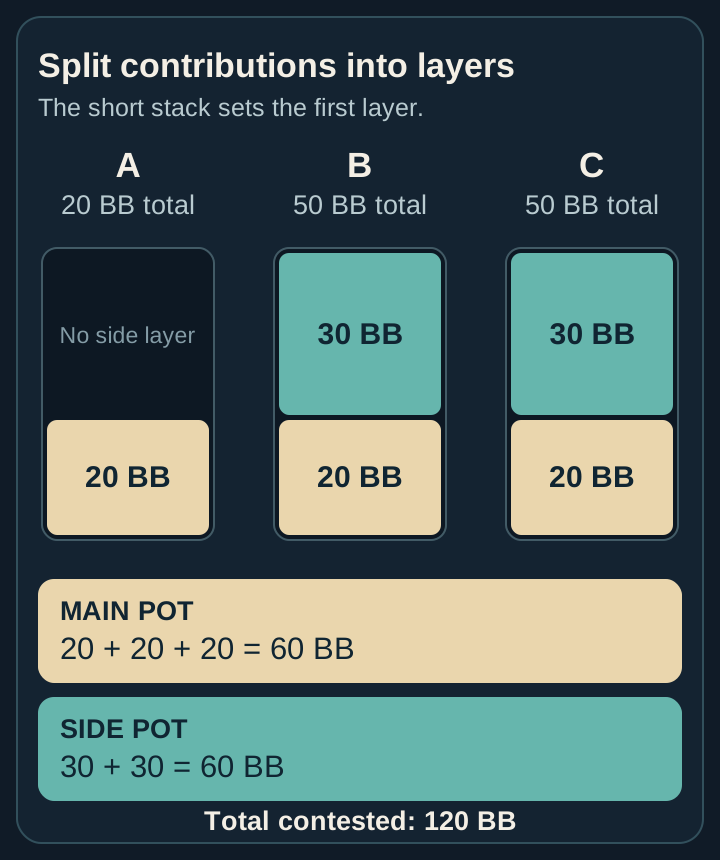
The 20 BB matched by all three belongs to the main pot. The additional 30 BB matched by B and C belongs to a side pot. This is about eligibility, not about which hand is strongest. A can have the best cards and still be ineligible for the side pot.
How do you calculate the main pot and side pot?
Assume no earlier money is in the pot for this contribution-only example. A contributes 20 BB, B contributes 50 BB, and C contributes 50 BB. The first layer is 20 BB from each player: 20 + 20 + 20 = 60 BB in the main pot. B and C each have 30 BB above that layer: 30 + 30 = 60 BB in the side pot. The two pots total 120 BB, exactly matching the three contributions.
Do not stop after multiplying the short player's contribution by all three players. That gives you the main pot, but it leaves the deeper players' matched amount unaccounted for. Build the pots from contribution layers and check that the sum equals the chips committed.
Who can win each pot at showdown?
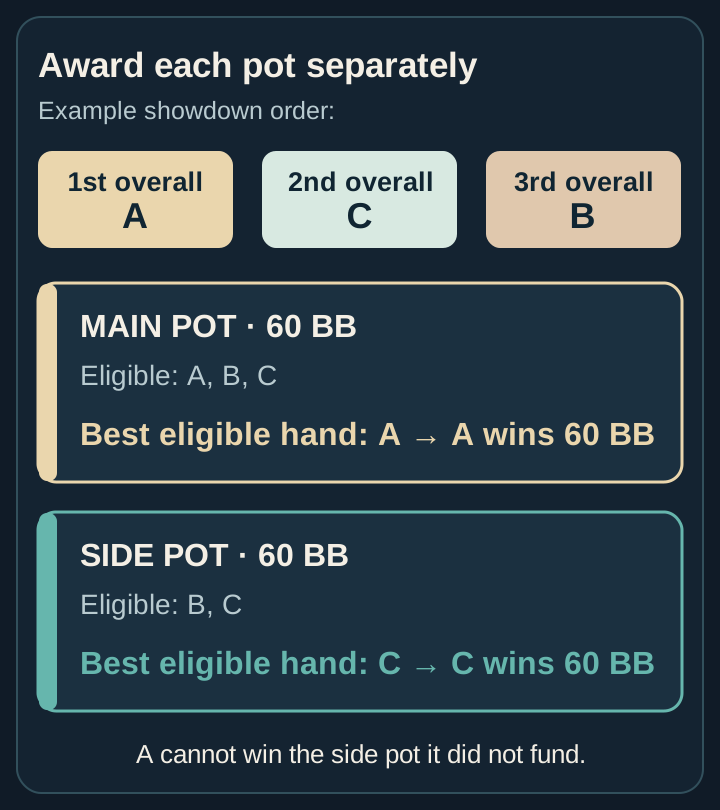
All three players can win the 60 BB main pot. Only B and C can win the 60 BB side pot. Resolve each pot against its eligible hands. For example, if A has the strongest hand overall, C has the next strongest, and B has the weakest, A receives the main pot and C receives the side pot. If B has the strongest hand overall, B wins both pots.
A hand that beats A does not automatically receive the main pot if another eligible hand beats it. Likewise, winning the main pot does not grant access to the side pot. Keep the eligible-player list beside each pot until both are awarded.
What happens to an unmatched extra bet?
Change only C's contribution in the example to 70 BB while A contributes 20 and B contributes 50. No one can match C's last 20 BB, so that 20 BB is returned to C. The contested pots are still 60 BB main and 60 BB side. The original 140 BB placed forward equals 120 BB contested plus 20 BB returned.
An unmatched amount is not a third pot and does not become a prize C can win back. When you reconstruct a hand, separate returned chips from the amounts that were actually contested. Earlier folded-player contributions or prior-street chips can make a real hand more complex; track those amounts by the pot they entered instead of forcing them into this simplified example.
Can a hand have more than one side pot?
Yes. With several all-in amounts, make a new layer whenever the next shortest player runs out of chips. A player is eligible for a layer only if they matched the contribution for that layer. The same method scales: sort the committed amounts, identify each matched band, then list the players who funded it.
For post-session study, write the layers in order before looking at the showdown. This catches two common errors: awarding every pot to the best hand at the table, and treating an uncalled amount as contested.
How should you review a side-pot hand after the session?
Record the players still in, each starting stack, each total contribution, any folded money already in the pot, and every returned amount. Rebuild the action in order. Mark the point where each player becomes all-in, then calculate the main pot and each side pot from the matched contributions. Only after that, compare the eligible hands at showdown.
In the Tells Poker iOS app, you can save a completed hand and step through its recorded action in Replay, including seats, stacks, and wager amounts. Use that record to check the sequence, then write the side-pot layers and eligibility separately during review. If a stack or raise amount was not recorded precisely, treat the arithmetic as conditional rather than inventing a value. The Analysis tab can offer a structured second opinion on the hand's decisions, not perfect or definitive play.
Frequently asked questions
Can the short-stacked player win the side pot?
No. They can win the main pot funded by their matched contribution. Only players who contributed to a side-pot layer are eligible for that layer.
Does the best hand always win every pot?
No. Each pot is awarded to the best eligible hand for that pot. In the 20/50/50 BB example, A can win the main pot while B or C wins the side pot.
What if only one player has chips above the others' all-in amounts?
The unmatched extra amount is returned to that player. A side pot requires at least two players to match that layer.