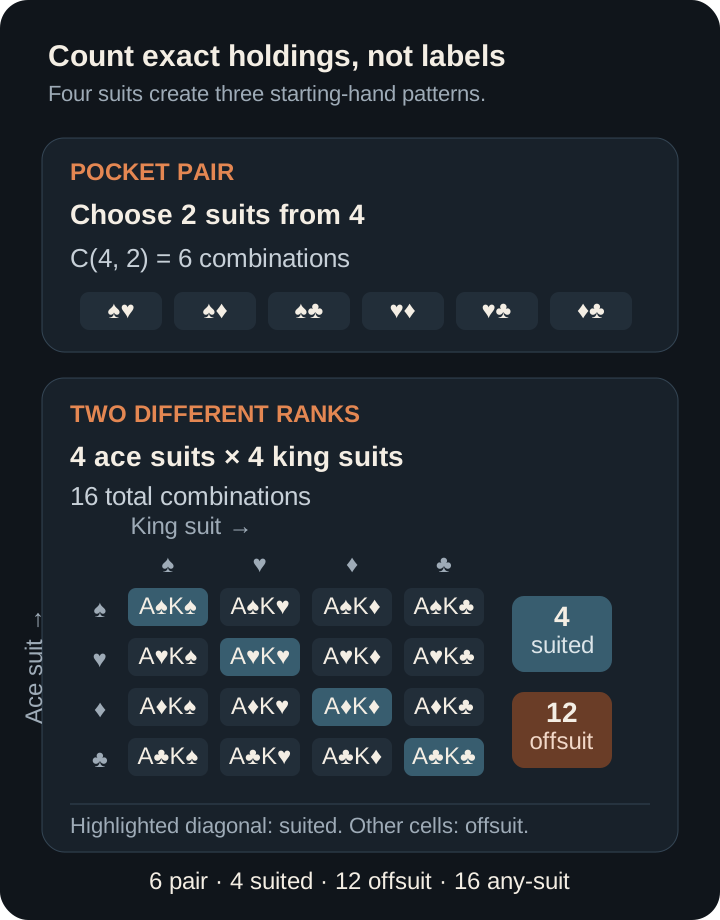
To count poker hand combinations, translate each hand label into the exact two-card holdings still available. A pocket pair begins with 6 combinations. Two different ranks begin with 16: 4 suited and 12 offsuit. Then remove every combination that conflicts with your cards or the board.
Combination counting makes a range more precise, but it does not decide the hand for you. A mathematically available holding must still fit the position, stack depth, previous actions, and bet sizes. Count after you build a plausible range, then use the count to compare its important regions.
This guide uses fixed, original examples for post-session study. The numbers show what the deck permits under stated assumptions. They do not reveal an opponent's actual cards or prescribe perfect play.
What is a poker hand combination?
A poker hand combination, often shortened to combo, is one exact two-card holding. A♠ K♠ and A♥ K♥ are two different combinations even though both are described by the starting-hand label AK suited. Suits matter because known cards can remove one exact holding while leaving another available.
Hand labels are useful shorthand; combinations are the inventory behind that shorthand. Saying an opponent can have AA names one type of hand. Counting the six available suit pairings tells you how many exact versions of AA exist before any ace is visible.
How many two-card combinations are in a full deck?
A 52-card deck contains 1,326 unordered two-card starting combinations. Multiply 52 choices for the first card by 51 for the second, then divide by 2 because A♠ K♥ is the same holding as K♥ A♠: (52 × 51) ÷ 2 = 1,326.
You rarely count all 1,326 during a hand review. Start from a range shaped by the action, then count the specific pairs, suited hands, and offsuit hands inside it. The full-deck number explains the universe; the practical work happens in the smaller candidate range.
Why does a pocket pair have 6 combinations?
Each rank has four suits. A pocket pair uses two of those four cards, so the count is the number of ways to choose two suits from four: C(4, 2) = 6. Pocket queens, for example, can be spade-heart, spade-diamond, spade-club, heart-diamond, heart-club, or diamond-club.
Do not multiply four by four for a pair. That would include impossible repeats such as choosing the same physical queen twice and would count the order of the cards. Choosing two distinct suits once gives the correct six holdings.
Why do two different ranks have 16 combinations?
For two different ranks, each of the four cards of the first rank can pair with each of the four cards of the second: 4 × 4 = 16. Ace-king therefore has 16 total combinations before any ace or king is known.
Four of those combinations are suited because the suits match: spade-spade, heart-heart, diamond-diamond, and club-club. The other 12 are offsuit. That produces the standard starting counts: 4 for AK suited, 12 for AK offsuit, and 16 when both categories are included.
How do blockers and board cards change the count?
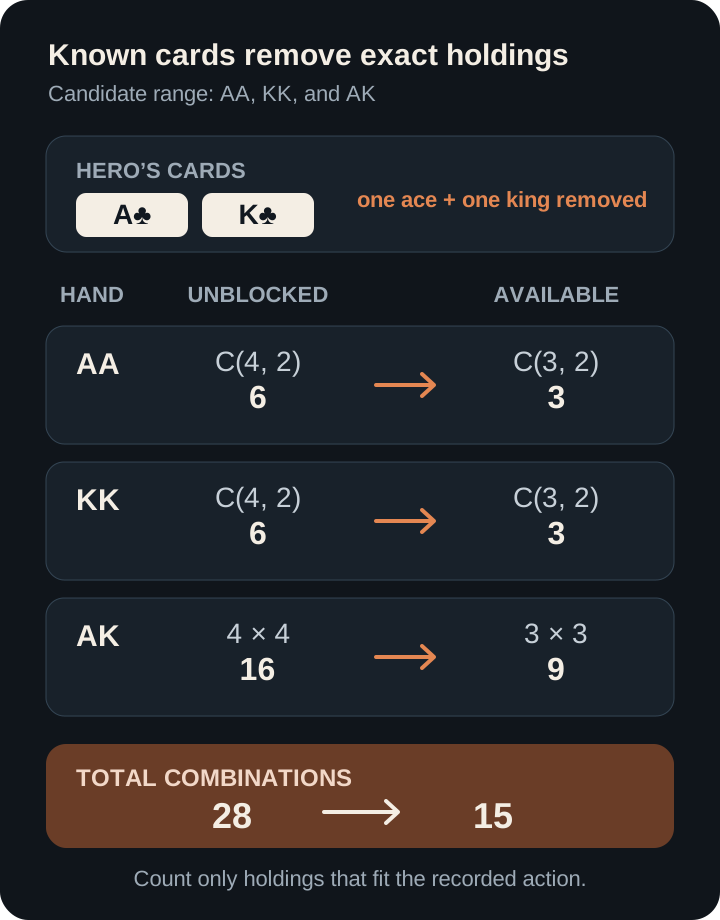
Every known card removes itself from every opponent holding. If you hold one ace, only three aces remain available. Pocket aces then falls from C(4, 2) = 6 combinations to C(3, 2) = 3. If another ace is on the board, only two remain and exactly one pocket-aces combination is possible.
For two different ranks, multiply the remaining cards of one rank by the remaining cards of the other. Holding one ace and one king leaves three aces and three kings, so AK falls from 4 × 4 = 16 combinations to 3 × 3 = 9. This card-removal effect is what players mean when they say a card blocks a hand.
A blocker can remove hands from more than one region of a range. An ace may reduce strong ace-high value hands, but it may also reduce missed ace-high draws that could bluff. Count what the card removes on both sides before calling it useful.
What is a complete poker combination example?
Suppose you are reviewing a preflop decision and, for a deliberately narrow first pass, the opponent's candidate range is AA, KK, and any AK. Before considering your cards, that set contains 6 combinations of AA, 6 of KK, and 16 of AK, for 28 total.
You hold A♣ K♣. Three aces and three kings remain. AA now has C(3, 2) = 3 combinations, KK has 3, and AK has 3 × 3 = 9. The candidate range therefore contains 15 available combinations, not 28.
That result is an availability count, not proof that the opponent plays all 15 holdings this way. Next filter the set through their position, sizing, stack depth, and previous action. If only some AK holdings fit the line, reduce or weight those combinations rather than silently keeping every one.
How do combinations improve a range review?
Combination counts prevent a short list of hand labels from creating a distorted comparison. A range written as AA and AK contains two labels, but unblocked it contains 22 exact holdings: 6 combinations of AA and 16 of AK. The labels are equally numerous on the page while their weights in the deck are not.
For a river bluff-catcher, count the value hands and bluffs that plausibly reach the decision. Then apply known cards and the earlier action. Compare that mixture with the price of calling, and test how the result changes when uncertain hands are included less often. This connects combo work to a complete opponent-range review.
For a value bet, count worse hands that can call as carefully as better hands that continue. For a bluff, count better hands that can fold and the missed draws available as bluffs. The useful question is not which side has more labels; it is which exact holdings remain and fit the line.
What are weighted combinations?
A weighted combination stays in the range without being counted as present every time. If your model says an opponent takes the observed line with half of the six available QQ combinations, QQ contributes three weighted combinations to that branch. The deck count stays six; the behavioral assumption changes its weight.
Use weights only when the distinction helps. Often, sometimes, and rarely can be clearer than an invented decimal. If a decision changes only when you assign a very specific frequency, record that sensitivity instead of presenting the frequency as a known fact.
What is a simple combo-counting workflow?
First, reconstruct the decision before seeing the result. Second, write a plausible range from the position and action. Third, list every known card in your hand and on the board. Fourth, apply the 6, 4, 12, and 16 starting counts and remove conflicts. Fifth, sort the remaining combinations by role, such as value, bluff, draw, or bluff-catcher.
Finish with a sensitivity check. Add one plausible value hand, remove one questionable bluff, or lower the weight of a mixed hand. If the preferred action changes, your lesson is about the uncertain range assumption. If it does not, the decision may be robust across several reasonable models.
What are the most common combination-counting mistakes?
The first mistake is counting labels instead of exact holdings. The second is forgetting that hero cards and board cards are unavailable. The third is counting both A♠ K♥ and K♥ A♠ as separate holdings. Card order does not create a new combination.
Another mistake is doing correct arithmetic on an implausible range. Six combinations of a pocket pair exist only when all four cards of that rank are unseen, and those combinations matter only if the hand fits the action. Combination counting sharpens a range model; it cannot repair a range that ignored the hand history.
Finally, do not treat a blocker as a universal reason to call, fold, bet, or raise. Identify the value and bluff regions first, count the exact removals, and keep the conclusion tied to the decision you are reviewing.
How can Tells help with combination review?
In Tells Poker, record the exact hole cards, board by street, positions, stacks, and action after the hand is complete. Replay lets you stop at the decision and work with only the information available at that moment, which helps keep later cards and showdown from changing the starting range.
The Analysis tab provides a structured second opinion whose range reasoning can consider card-removal effects when the recorded facts support them. Use it to challenge your count and assumptions, not as a definitive answer. The most useful review still explains which combinations fit the line and why a different assumption would change the choice.
Frequently asked questions
Does ace-king always have 16 combinations?
It begins with 16 when all four aces and four kings are unseen. Known aces or kings in your hand or on the board reduce that count.
Why are there only 6 pocket-pair combinations?
A rank has four suits, and a pair chooses two distinct cards from those four. C(4, 2) equals 6, with card order counted only once.
Does a blocker make an opponent hand impossible?
Sometimes it removes one exact holding completely; more often it reduces the number of available combinations. Count the remaining cards of each required rank to see which case applies.
Do combination counts tell you the correct poker action?
No. Counts describe which exact holdings are available. Position, stacks, previous action, bet sizes, range weights, and uncertainty still determine how useful those holdings are to the decision.