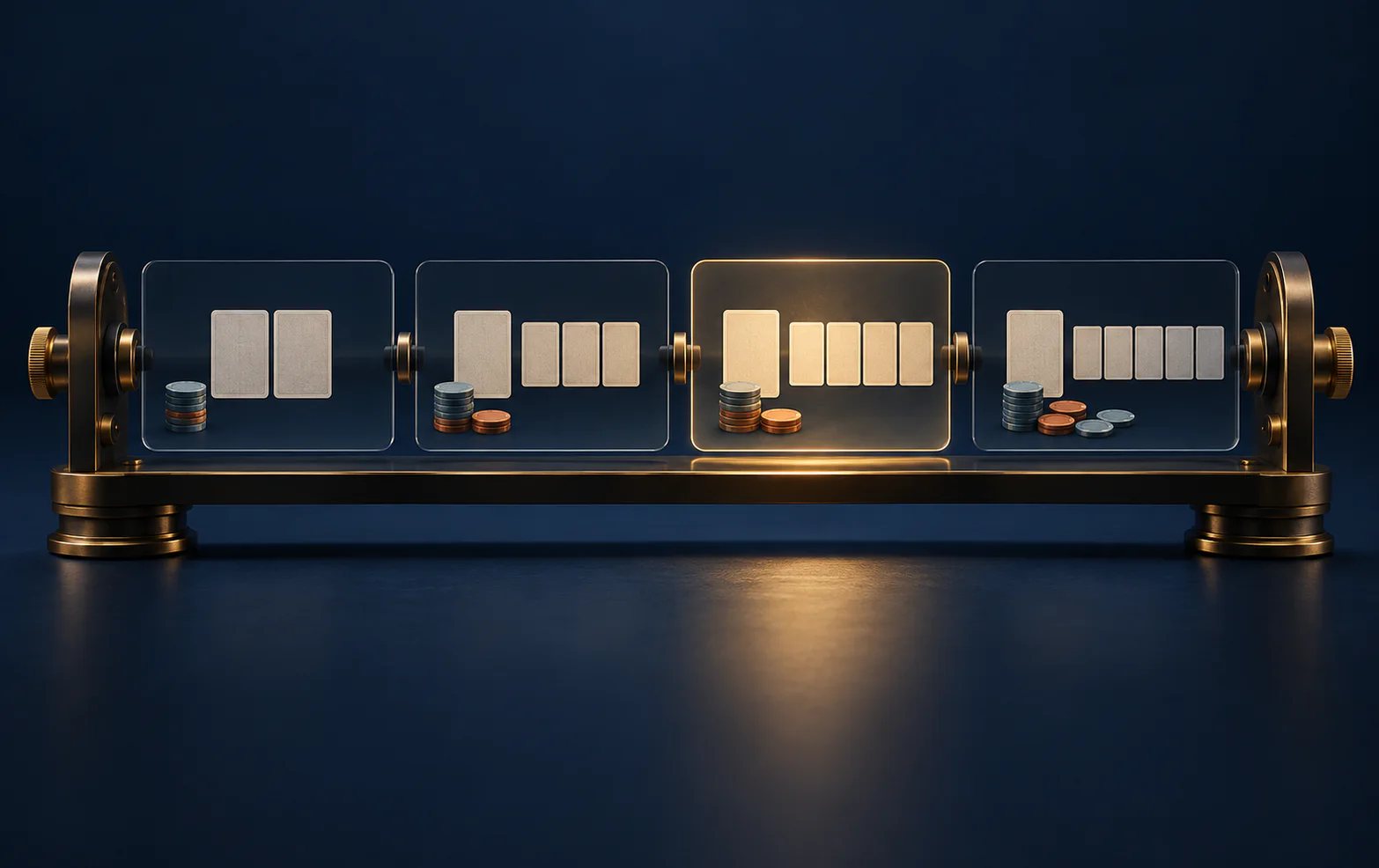
To replay a poker hand, rebuild the completed hand in action order, move street by street, and pause immediately before the decision you want to study. At that pause, verify the positions, board, pot, remaining stacks, amount to call, and earlier actions. Compare realistic choices before revealing what happened next.
A replay is more than retelling the result. It is a sequence of game states. Each state should explain how the next one was reached: which cards were visible, who still had chips, how much entered the pot, and whose turn it was. If one state does not follow from the previous action, fix the record before drawing a strategic conclusion.
Use replay only after the hand is complete. It supports post-session study by making the decision easier to inspect, but it does not turn uncertain inputs into facts or produce perfect, definitive play.
What does it mean to replay a poker hand?
Replaying a hand means reconstructing what was known and what changed at each action. Start with the seats, blinds, and stacks. Add the hole cards you know. Then move through preflop, flop, turn, and river in order, updating the board, pot, stacks, and active players after every check, bet, call, raise, fold, or all-in.
The order matters because later information can distort an earlier decision. A river showdown may make a flop call look obvious in hindsight, even though the opponent's exact cards were unknown on the flop. A good replay stops before the result and asks what the player could reasonably know at that moment.
Which details should be ready before you start?
Record the game format and blinds, each relevant position, the effective stack, your hole cards, the board by street, and every action with its size. For a multiway hand, include which players folded and when. For a heads-up decision, keep the remaining stack for both players visible so a small bet is not judged without its stack context.
Separate known facts from estimates. If you remember that the turn bet was somewhere between 6 and 8 big blinds, write that range instead of choosing 7 because it makes the arithmetic tidy. A replay with one honest unknown is more useful than a precise-looking sequence built on an invented amount.
If the hand is still incomplete, use a post-hand recall routine to preserve the positions, stacks, cards, and action before beginning the strategic review.
How do you replay the hand step by step?
First, run through the hand once without judging any action. Confirm that the cards appear on the correct street, folds remove the right players, and every wager changes the pot and remaining stacks as expected.
Second, restart and stop immediately before the key decision. State the question in one sentence: for example, “Should the cutoff call 7 BB on the turn after checking?” Do not begin with “I lost with top pair.” The first version preserves the decision; the second lets the outcome frame it.
Third, audit the state at the pause. Name the position, board, pot before the action, amount to call, effective stack behind, and action that produced the decision. Recalculate any number that does not reconcile with the earlier sequence.
Fourth, compare a small set of realistic alternatives. A facing-bet decision may be call, fold, or raise. A first-to-act decision may be check or bet at one or two plausible sizes. Describe what each line is trying to accomplish and which opponent hands are expected to continue.
Finally, advance the replay and reveal the result. Use it to check the record, not to grade the earlier choice. Finish with one conditional lesson, such as: “When the turn card adds a draw and the bet is large, rebuild the betting range before treating top pair as an automatic call.”
What does a complete replay example look like?
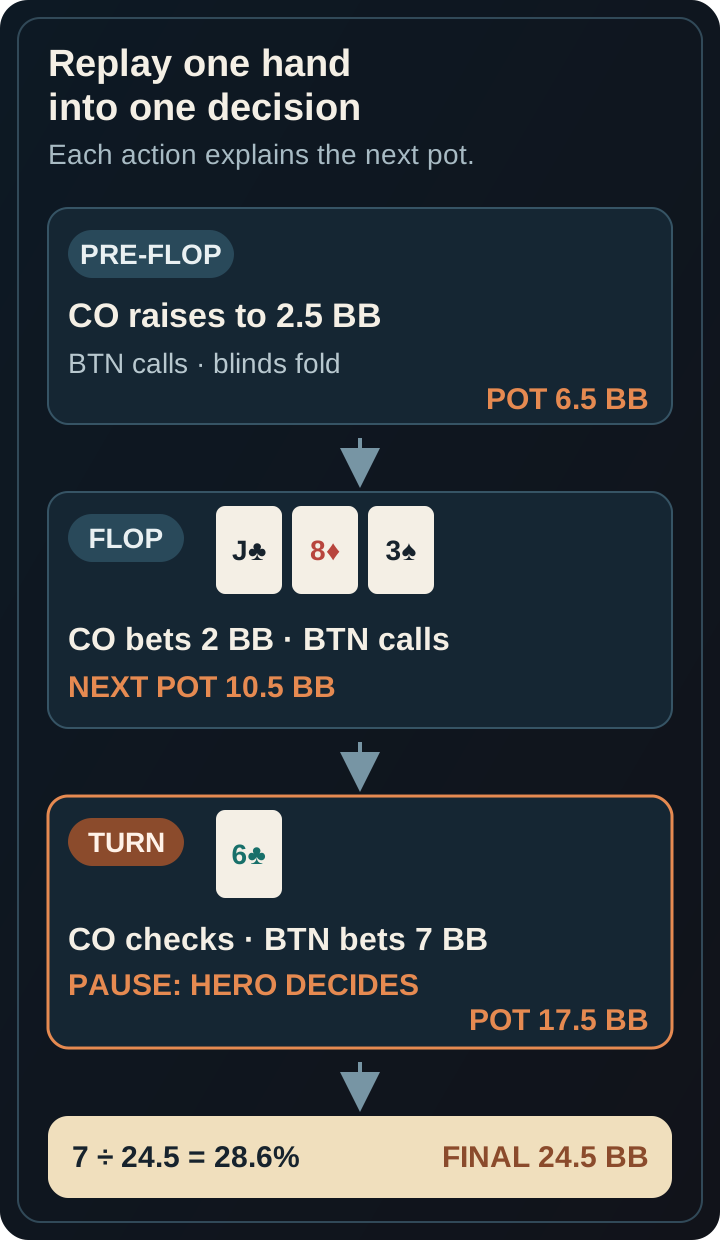
Consider a six-handed cash hand recorded in big blinds. The cutoff holds A-club J-diamond and raises to 2.5 BB. The button calls, both blinds fold, and the pot is 6.5 BB: the 1.5 BB in blinds plus the cutoff's 2.5 BB and the button's 2.5 BB.
The flop is J-club 8-diamond 3-spade. The cutoff bets 2 BB and the button calls, adding 4 BB and making the turn pot 10.5 BB. The turn is 6-club. The cutoff checks and the button bets 7 BB, so the pot is now 17.5 BB before any call.
Pause there. A 7 BB call would make the final pot 24.5 BB, so the direct break-even equity threshold is 7 divided by 24.5, or about 28.6 percent. That number verifies the price; it does not select the action. The review still needs a plausible button betting range, remaining stacks, possible raises, and an honest view of which river cards create further decisions.
Why should you review the replay in three passes?
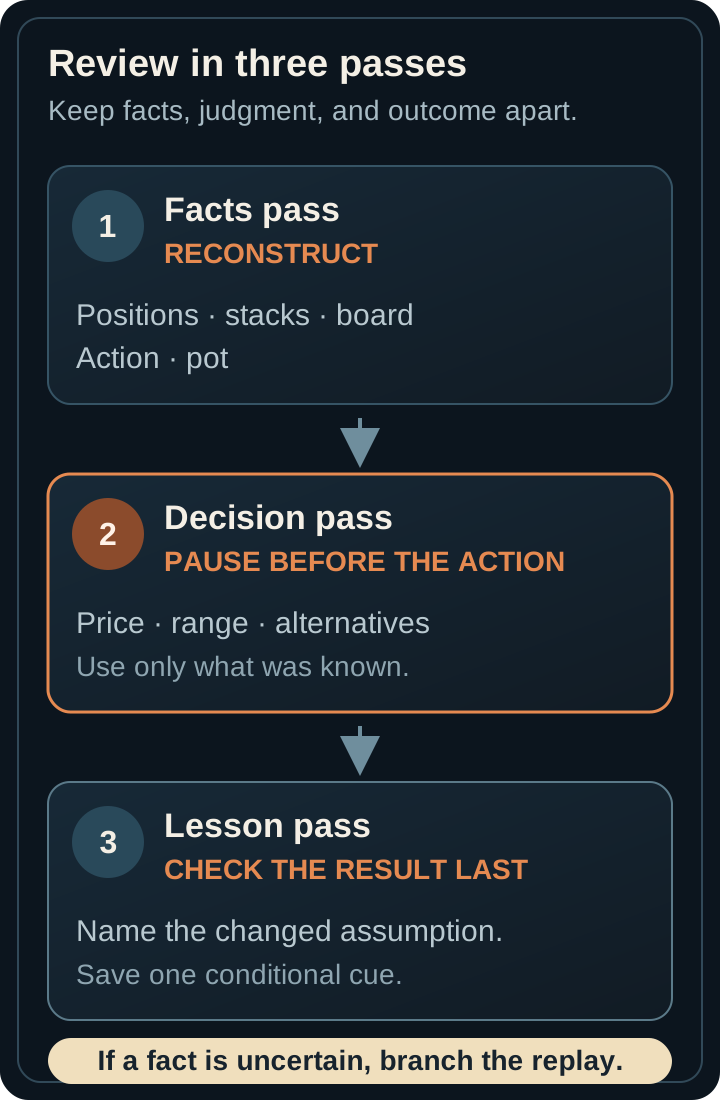
Three passes keep different jobs from contaminating one another. The facts pass asks whether the hand history is internally consistent. The decision pass hides the outcome and examines the choice. The lesson pass reveals what happened, checks which assumption mattered, and saves one cue for future study.
This separation also makes disagreement easier to diagnose. Two reviewers may agree on the pot and price but assign different hands to the opponent. That is a useful strategic disagreement. If they disagree because one person thinks the turn pot was 10.5 BB and the other thinks it was 14 BB, the record needs repair before the strategy discussion continues.
What should you do when a detail is missing?
Do not smooth over the gap. Mark the detail as unknown and test the smallest number of useful branches. If the turn bet was either 6 BB or 8 BB, replay both sizes and see whether the price, remaining stack, or plausible range meaningfully changes. If the conclusion stays the same, the missing amount may not be decisive. If it changes, the correct lesson is conditional.
Some unknowns are too important to work around. Missing positions, an uncertain board card, or confusion about whether a wager was a bet or a raise can change the entire decision. In those cases, stop the strategic review and improve the hand record first.
How does Replay work in Tells Poker?
After a completed hand has parsed actions, the Tells Poker iOS app builds a Replay with a frame for the start of each reached street and a frame after each recorded action. The table view shows the seats, remaining stacks, wager chips, total pot, visible board, and the player who just acted. Street tabs jump to preflop, flop, turn, or river when that street exists.
You can move one frame at a time, play the sequence automatically, restart it, change playback speed, or scrub the progress line. The expandable action log lists the recorded actions by street and can jump to a particular deal or action. These controls make it practical to stop immediately before the decision instead of repeatedly reading a paragraph from the beginning.
Replay depends on the saved record. If parsed actions are not present, the app says Replay is unavailable. If a fact is wrong, correct the hand detail before creating or relying on an analysis. The Analysis tab can then offer a structured second opinion on the decisions; it is not perfect or definitive play.
How is a replay different from an analysis?
A replay answers “What happened, in what order, and what was the game state?” An analysis asks “Given that state and a set of assumptions, how should we evaluate the available choices?” The replay should come first because strategic reasoning cannot repair a wrong pot, missing player, or out-of-order action.
Treat Replay as the shared evidence and Analysis as one interpretation of it. You can also compare the hand with another saved spot, but match the decision context before transferring a lesson.
Frequently asked questions
Do you need a solver to replay a poker hand?
No. A replay is the factual reconstruction of the cards, positions, stacks, pot, and action. Strategic tools may help with a later review, but they do not replace an accurate sequence.
Should you reveal the result during the replay?
Run the replay to the key decision and pause before revealing the later action or showdown. Check the result only after you have stated the available information and compared realistic choices.
What if you cannot remember the exact bet size?
Mark it as uncertain and replay a small range of plausible sizes. If the conclusion changes across those branches, keep the lesson conditional rather than inventing one exact number.
Can Tells Poker Replay be used during a live hand?
Tells Poker is designed for completed-hand and post-session study, not real-time assistance while action is in progress.