Everyone has a friend who recaps hands at dinner. Twenty minutes in, you still don't know the stack sizes.
A bad-beat story begins with the ending. A useful shared hand begins with the decision. It gives another player enough context to pause before the result, build a range, check the price, and explain what they would do next.
Tells packages that context into a share image or a full hand link with Replay, Table Talk, and Analysis. Before you send it, use this checklist to make sure the hand is worth discussing.
1. Include the game and effective stack
Start with the game format, blinds or stakes, and the effective stack between the players who matter. If stacks differ around the table, the effective stack is the amount that can actually be contested by the players in the decision.
This context changes which hands can reasonably continue and which bet sizes create commitment. Without it, even a thoughtful answer may be solving the wrong spot.
2. Preserve positions and the exact action
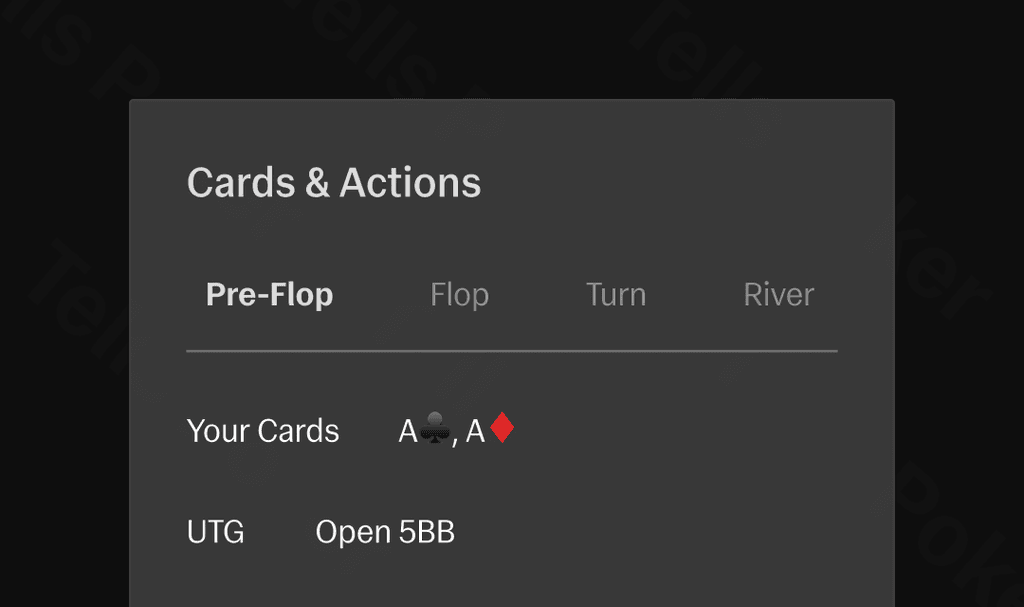
Record who acted from which position, then list every fold, call, raise, and size in order. Include the pot state when it helps clarify the decision. “I raised and got called” is a story; “Button opens, big blind calls” is the start of a hand history.
Tells Replay turns that sequence back into a table. Friends can step through the action, use the street controls, and see where the decision changed.
3. Use exact cards and board streets
Hole-card suits and the order of board cards can affect available draws, blockers, and range combinations. Capture the flop, turn, and river separately rather than writing only the final five-card board.
If you do not remember a suit or size, mark it as uncertain. Honest missing information is more useful than a detail added after you already know the showdown.
4. Ask one decision-focused question
Choose the street and action you actually want reviewed. Ask whether to check or bet, which size fits the goal, whether a call reaches the required equity, or how the opponent range changes after a particular action.
Tells lets the hand owner turn a decision into a Table Talk poll. The options give the group a clean starting point, while comments and replies make room for the assumptions behind each vote.
5. Separate analysis from outcome
Invite your friends to stop Replay before the cards finish running out. The shared Analysis tab can add street grades, spot math, range reasoning, an alternative line, a key insight, and a what-if branch, but the result should not be the reason an action is labeled good or bad.
A complete shared hand does not remove disagreement. It makes the disagreement precise. That is the difference between repeating a bad-beat story and studying a poker decision.
Frequently asked questions
What information should a shared poker hand include?
Include the game format, stakes or blinds, positions, effective stack, hole cards, board by street, exact action, bet sizes, and one focused question.
Should you reveal the result when asking for poker feedback?
It is usually more useful to let reviewers pause at the decision before they see the result. You can reveal the ending later without letting it shape the first analysis.
What is the difference between a Tells share image and share link?
A share image provides a quick visual preview. A share link opens the complete hand experience with interactive Replay, Table Talk, and Analysis when available.