
A bluff catcher is a made poker hand that beats an opponent's bluffs but loses to the value hands in that opponent's betting range. It has enough showdown value to call only when the bet contains enough bluffs for the pot odds, so the decision depends on price and range composition—not on the hand label alone.
Bluff catchers appear most clearly on the river, where no future cards remain. A pair may be a comfortable value hand against one betting range and a pure bluff catcher against another. The useful review question is not simply “Is my hand strong?” It is “Which bets does my hand beat, and are there enough of them?”
Treat the calculation as a structured model. You do not see the opponent's complete range, and a blocker or player tendency can change the assumptions. The goal is to state the threshold, build a plausible betting range, and notice which assumption makes the call work or fail.
What does bluff catcher mean in poker?
A bluff catcher is a hand with little or no value against the value portion of a bet but enough strength to beat the bluff portion. If an opponent bets the river with strong hands and missed draws, and your middle pair loses to every strong hand but beats every missed draw, that middle pair is functioning as a bluff catcher.
The definition is relative to a specific action and range. The same middle pair is not permanently a bluff catcher. It may beat some thin value bets against a wide small size, lose to the entire value range against a large polarized size, or become too weak even to beat the opponent's bluffs if those bluffs include better made hands.
A bluff catcher also differs from a drawing hand. A draw is evaluated before the river partly because future cards may improve it. A river bluff catcher cannot improve later; its call wins only when the current hand is already ahead of enough bets.
Is a bluff catcher the same as a hero call?
A bluff catcher describes the hand's relationship to the opponent's betting range. A hero call describes the action of making a difficult call, usually with a hand that is not near the top of the caller's range. Many hero calls use bluff catchers, but the terms are not interchangeable.
A dramatic call can still be a normal value call if it beats some hands the opponent bets for value. Conversely, folding a bluff catcher can be disciplined when the price requires more bluffs than the range plausibly contains. The label should clarify the range problem, not reward bravery.
How many bluffs does a bluff catcher need to call?
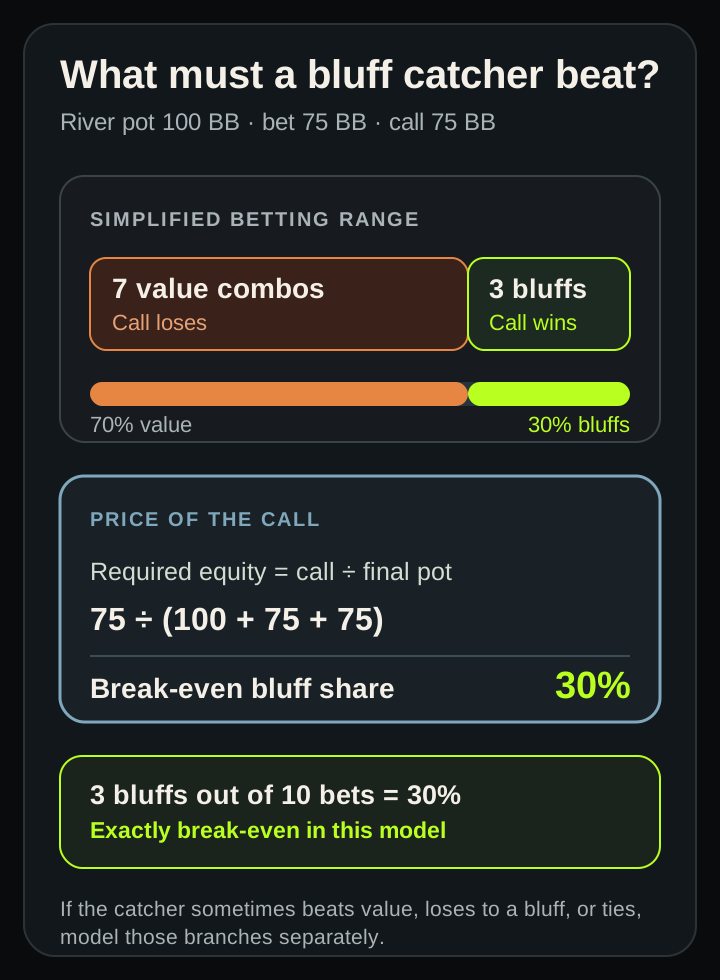
First calculate the call's required equity: call amount divided by the final pot after your call. In a simplified river model where your hand beats every bluff, loses to every value bet, and never ties, that equity threshold is also the minimum bluff share the opponent's betting range must contain.
Suppose the river pot is 100 big blinds and the opponent bets 75. Calling costs 75, and the final pot after the call would be 250. The required equity is 75 divided by 250, or 30 percent. Your bluff catcher needs bluffs to make up at least 30 percent of the betting range to break even before any other costs.
The formula gives a threshold, not the opponent's actual frequency. You still need to construct the value hands and bluffs that reach the river this way. If your hand sometimes beats a thin value bet, loses to a bluff with better showdown value, or ties, separate those branches instead of using the shortcut.
What does a complete bluff-catcher example look like?
Keep the same 100 BB pot and 75 BB river bet. After reviewing the earlier streets, you give the opponent seven equally weighted value combinations that beat your hand and three equally weighted missed-draw combinations that your hand beats. The range contains ten bets, so the three bluffs are 30 percent. The call is exactly break-even under the simplified assumptions.
Now stress-test the range. If one supposed bluff would usually check, the range becomes seven value bets and two bluffs. The bluff share falls to 2 divided by 9, or about 22.2 percent, below the 30 percent threshold. Folding is better in that model.
If instead a fourth credible bluff reaches the river, the bluff share becomes 4 divided by 11, or about 36.4 percent. The call then has positive expected value under the same model: it wins 175 BB four times, loses the 75 BB call seven times, and averages about 15.9 BB across the eleven combinations.
This example shows why range construction matters more than calling because the hand feels underrepresented. One removed or added combination can cross the threshold. Record which candidate bluff or value hand caused the conclusion to change.
How does bet size change a bluff-catching decision?
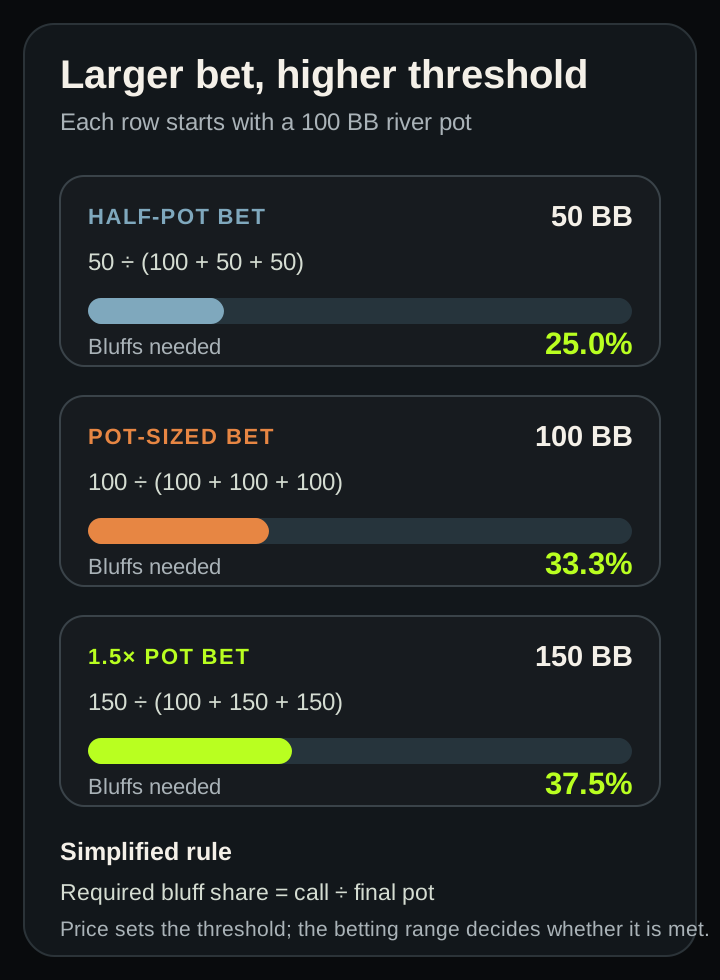
A larger river bet gives the caller worse pot odds and therefore requires a higher share of bluffs. With a 100 BB pot, calling a 50 BB bet needs 50 divided by 200, or 25 percent equity. Calling a 100 BB bet needs 100 divided by 300, or about 33.3 percent. Calling a 150 BB overbet needs 150 divided by 400, or 37.5 percent.
Do not turn that arithmetic into “large bets are always bluffs” or “large bets are always value.” Size changes the price; the line and range determine whether the opponent supplies the required bluffs. Some ranges become more polarized at larger sizes, but the actual mixture remains an assumption to test from the hand's action.
Compare like with like during review. Build the betting range for the size that was used, not the range you imagine for a smaller or larger bet. Hands that can value-bet for half pot may check when the chosen size is an overbet, and candidate bluffs may change with them.
Which hands should become bluff catchers?
Start by finding the hands in your range that beat the opponent's plausible bluffs. Then separate hands that also beat some value bets; those have more than bluff-catching value. Among the remaining catchers, compare card removal, how the line reached the river, and whether each hand beats the same bluff region.
Calling every hand that can technically catch a bluff can defend too many combinations. The price tells you how much of the betting range must be bluffs, while your own range construction helps decide which bluff catchers make the best calls. Stronger showdown value does not always mean a better catcher if several candidates beat exactly the same bluffs and lose to exactly the same value hands.
The bottom of your bluff-catching region can also move with the opponent. Against a range that turns weak pairs into bluffs, one pair may fail to catch every bluff. Against a range built mainly from missed draws, the same hand may cover the full bluff region. Name the hands you expect to see rather than relying on “pair” or “ace high” as fixed categories.
How do blockers affect a bluff catcher?
A blocker matters only through the combinations it removes from the opponent's range. Holding a card that removes likely value bets can improve a bluff catcher. Holding a card that removes likely missed draws can make the call worse because fewer bluffs remain. The direction matters more than the mere fact that your hand blocks something.
Work from the action outward. List the value hands that take the line and the bluff candidates that take the same line, then cross out combinations made impossible by your cards and the board. A card can have mixed effects when it blocks one value region and one bluff region, so count both sides before calling it a good blocker.
Blockers refine a believable range; they do not create bluffs that were never likely to bet. If the opponent's line contains almost no natural bluff candidates, one attractive blocker may not supply enough combinations to clear the pot-odds threshold.
How do bluff catchers work in multiway pots?
The clean bluff-catcher formula above assumes a heads-up river decision. In a multiway pot, another player may still call or raise, the bettor may use a stronger range, and your hand must beat the correct players to win the pot. Reconstruct who remains eligible and who is left to act before applying any threshold.
A call that closes the action is different from a call with a player behind. If a later player can continue, include that branch and the possibility that your hand beats the bettor's bluff but loses to the other player. Do not use a heads-up bluff-to-value count as a shortcut for a multiway tree.
What are the most common bluff-catcher mistakes?
The first mistake is calling because the opponent could be bluffing. Many betting ranges can contain a possible bluff; the relevant question is whether enough bluffs reach this size and line. The second mistake is counting missed draws without asking which of them would actually bet rather than check and give up.
Another mistake is ignoring thin value. If your hand beats some value bets, the decision is not a pure bluff-catcher model and may be better than the shortcut suggests. If some proposed bluffs still beat you, the model may be worse. Classify what the call wins and loses against instead of forcing every bet into two convenient buckets.
Finally, avoid using the result as proof. Seeing a bluff does not make the call correct, and seeing value does not make it wrong. Rebuild the betting range without the shown hand, compare it with the price, and save how sensitive the decision was to the uncertain combinations.
How should you review a bluff-catching call after the hand?
First, reconstruct the river pot, bet, call amount, board, positions, and prior action. Calculate the required equity. Next, list the value hands that plausibly use the exact size and line, then list the bluffs. Remove impossible combinations and note any uncertain hands rather than silently including them.
Compare the bluff share with the threshold. Then change one assumption at a time: remove the weakest bluff, add a thin value bet, or change how a blocker affects the count. If the answer flips easily, save the call as assumption-sensitive instead of turning it into a broad rule.
Finish with a portable cue such as: “Before a river bluff catch, calculate the price and name the natural bluffs that arrive.” That cue gives a future review a clear starting point without pretending every opponent uses the same betting range.
How can Tells help review a bluff catcher?
After the hand is complete, Tells Poker keeps the cards, positions, stack context, and actions together in Replay. Move through the recorded action to the river decision and verify the pot and bet before building the opponent's value and bluff regions.
The Analysis tab can provide deterministic decision metrics such as Pot Odds, MDF, and SPR alongside a graded street-by-street debrief, alternative-line detail, and a what-if branch when available. Use the price as a checked input, then challenge the range assumptions that decide whether your bluff catcher clears it.
Treat the analysis as a structured second opinion, not perfect or definitive play. Tells is designed for completed-hand review and post-session study, not assistance while a hand is in progress.
Frequently asked questions
Is top pair always a bluff catcher on the river?
No. Top pair may beat thin value bets in one spot, making it stronger than a pure bluff catcher, while losing to every value bet in another. Define it against the specific betting range.
Does a bluff catcher always have to call?
No. It should call only when the hands it beats supply enough equity for the price. A hand can catch bluffs and still be a clear fold against a value-heavy range.
Are pot odds and bluff frequency the same thing?
No. Pot odds set the equity threshold for the call. In the simplified pure bluff-catcher model, that threshold becomes the required bluff share, but the opponent's actual range still has to be estimated.
Is blocking a strong hand always good for a bluff catcher?
Not automatically. A card may block value, bluffs, or both. Count how it changes each side of the betting range before deciding whether it improves the call.