
Expected value, usually shortened to EV, is the average amount a poker decision would gain or lose if the same situation could be repeated many times under the same assumptions. Calculate it by multiplying each possible net outcome by its probability, then adding those weighted outcomes together. A positive result is +EV; a negative result is −EV.
EV evaluates the choice, not the next card or the result of one hand. A +EV call can lose today, and a −EV call can win. The useful question after the session is whether the information available at the decision made one option better than its realistic alternatives.
An EV estimate is only as good as its inputs. Keep the pot, price, opponent range, future action, and any uncertain assumptions visible. The number is a structured model of the decision, not proof of perfect or definitive play.
What does EV mean in poker?
Poker EV measures the average change in your stack from a decision point. It includes every meaningful branch that can follow an action, such as winning when called, losing when called, or taking the pot when an opponent folds. Each branch matters in proportion to how often you expect it to occur.
The reference point is the moment of the decision. Chips already committed are sunk: they are no longer part of the choice between folding, calling, betting, or raising. From that point, folding normally has an incremental EV of zero because it adds no more chips and wins no part of the current pot.
EV can be expressed in big blinds, chips, or another consistent unit. Big blinds make hands from different stakes easier to compare, but changing the unit does not change which option has the higher expected value.
How do you calculate expected value in poker?
Use EV = the sum of probability × net outcome for every branch. Probabilities should add to 100 percent, and outcomes should be measured from the same decision point. Gains use positive values; additional chips lost use negative values.
For a two-branch call with no ties, the compact formula is: EV(call) = win probability × net win + lose probability × net loss. More complicated decisions use the same method with more branches. If ties, folds, raises, or future-street actions matter, add them explicitly instead of hiding them inside one estimate.
What is a complete poker EV example?
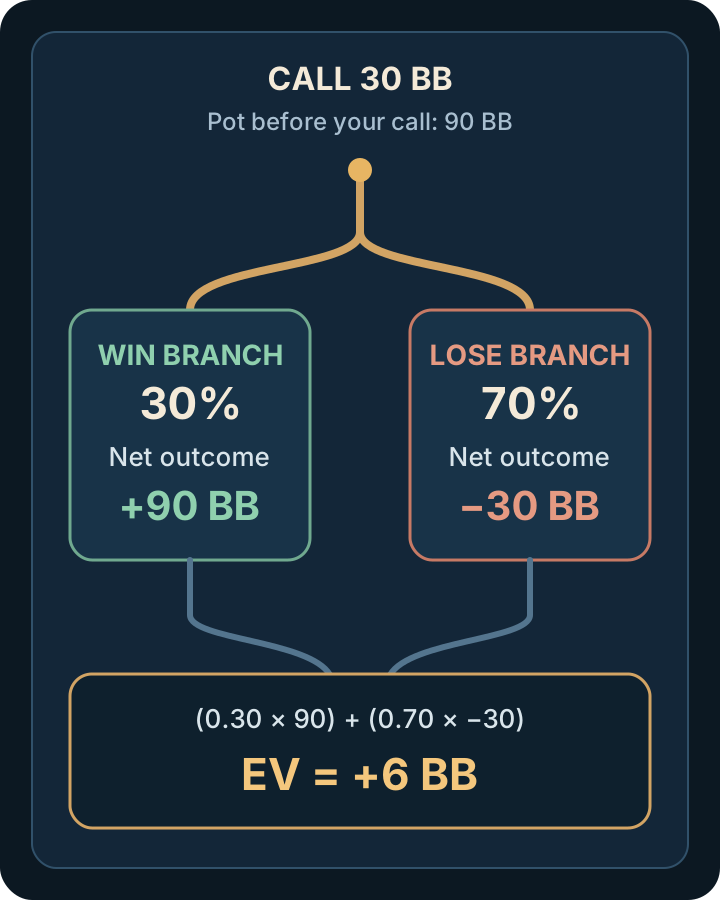
Suppose the river pot is 60 BB. An opponent bets 30 BB, making the pot 90 BB before your decision. Calling costs 30 BB. If you call and win, your net gain from this point is 90 BB. If you call and lose, your net loss is 30 BB.
After rebuilding the opponent's range, assume your hand wins against 30 percent of that range and loses against 70 percent. The call EV is 0.30 × 90 + 0.70 × (−30), which equals 27 − 21, or +6 BB. Folding is 0 EV from this point, so calling is better by 6 BB under this model.
This constructed example ignores ties, rake, and any error in the range estimate. It does not say the call will win. It says the call performs better than folding on average if the 30 percent assumption describes the range that actually reaches this river and bets.
How is EV different from equity and pot odds?
Equity is your share of the possible outcomes against a hand or range. Pot odds describe the price of a call. EV combines the probability and the payoff to estimate the value of an action. They answer related but different questions.
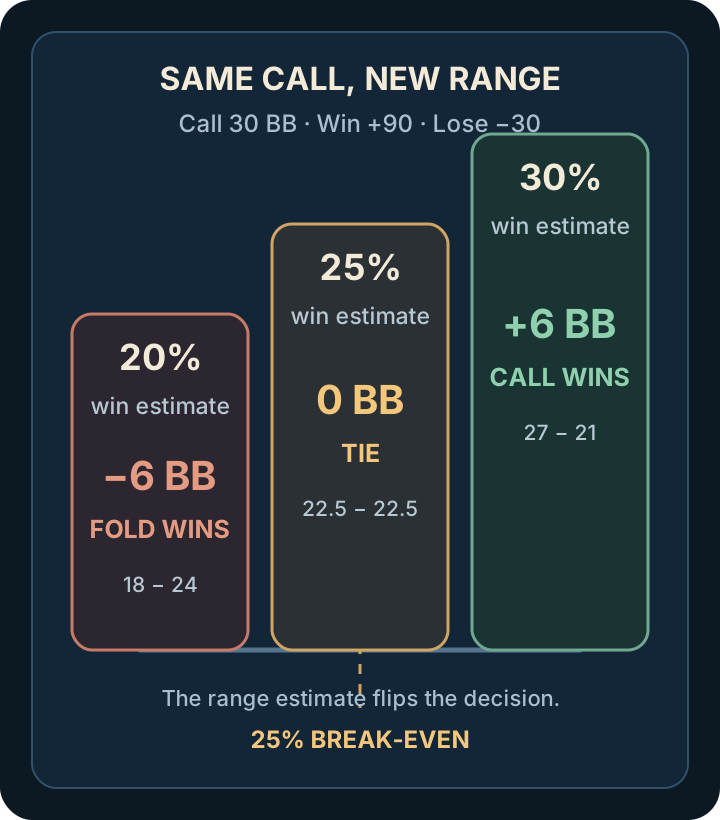
In the example, the call costs 30 BB to compete for a final pot of 120 BB, so the break-even equity is 30 ÷ 120, or 25 percent. That threshold tells you where call EV equals zero. An estimated 30 percent equity sits above the threshold and produces the +6 BB result; an estimated 20 percent sits below it and makes the call −EV.
Equity does not choose the action by itself. A hand can have substantial equity but face a price that is too high, while a modest-equity hand can have a profitable call at a low price. Start with the actual amount faced, then compare it with equity against a stated range.
How do you compare the EV of different poker actions?
Define the branches for each realistic option separately, calculate them from the same decision point, and compare the totals. Folding, calling, betting, and raising do not share the same outcomes. A raise may win immediately, get called, or face another raise; a check may reach showdown or allow a later bet.
Do not stop after proving that one action is +EV. The goal is to find the highest-EV available option, not merely one that is better than losing. A +4 BB call is still worse than a +9 BB raise if the raise model uses credible fold and continue ranges and accounts for the additional amount risked.
Keep false precision out of the comparison. When an opponent range or response frequency is uncertain, use a small range of reasonable estimates and look for the action that remains strongest across them. If the preferred action changes after a small adjustment, the decision is close and the assumption deserves more attention than the decimal place.
Why can a good poker decision lose?
A good decision can lose because EV describes an average across possible outcomes, while one hand produces only one outcome. The branch that happens today does not erase the branches that could have happened. Losing after a +EV call is compatible with choosing well.
The reverse is also true. Winning after a −EV call does not turn the call into a strong decision. If the opponent's betting range contains too little that you beat for the price, catching the rare bluff changes your stack but not the quality of the original model.
Review the information available before the result. Reconstruct the action, hide the showdown when possible, state the range, calculate the price, and choose. Reveal the result only after the decision has been evaluated. This keeps outcome relief and disappointment from rewriting the reasoning.
Which assumptions matter most in an EV estimate?
The opponent range is often the largest uncertainty. In the river call, moving the win estimate from 30 percent to 20 percent changes the EV from +6 BB to −6 BB. The arithmetic did not fail; the conclusion changed because the assumed mix of value hands and bluffs changed.
Bet size and effective stack also change the branches. A larger call increases the loss branch and raises the equity needed. On earlier streets, remaining stack depth affects the future money that can be won or lost, so a one-street shortcut may omit important implied-odds or reverse-implied-odds effects.
Multiway hands need additional branches because beating one range may not win the pot. Ties need their proper pot share. Rake can matter in close cash-game spots. Reads should adjust a starting model only when they describe behavior relevant to this action, not because an opponent won or lost the hand.
How should you review EV after a poker session?
Use five passes: reconstruct the facts, identify the decision point, list the realistic actions, map each action's branches, and stress-test the uncertain inputs. Keep every amount in one unit and make sure each probability set adds to 100 percent.
Start with the simplest model that can separate the choices. A river call may need only win, lose, and tie branches. An earlier-street raise may require immediate folds, calls followed by future play, and re-raises. Add complexity only when it can change the comparison.
Finish with one portable lesson. It might be “this call needs 25 percent equity,” “the decision flips if the opponent has fewer than three bluff combinations,” or “I omitted the chance of facing a re-raise.” Save the assumption that drove the answer so the next review can test it instead of repeating the same arithmetic.
How can Tells Poker support an EV review?
In Tells Poker, start with Replay to verify the cards, positions, action order, pot, and amount faced in the completed hand. Those facts define the decision point and prevent an EV model from beginning with the wrong price or stack.
The Analysis tab can then organize the debrief around a pivotal decision. Its deterministic decision math shows details such as the pot, amount to call or wager, stack behind, and equity needed when relevant. The range read and calculated equity make the key assumption visible beside the recommended action.
Use the street review's other line and key takeaway to compare an alternative and preserve the lesson. Treat the debrief as a structured second opinion, not a final authority: you still need to judge whether the reconstructed facts and opponent range are credible.
Frequently asked questions
What does +EV mean in poker?
+EV means an action has a positive expected value under the model being used. Its probability-weighted gains exceed its probability-weighted losses. The action can still lose in one hand.
Is folding always 0 EV?
From the current decision point, folding is normally assigned 0 incremental EV because you risk no more chips and win none of the pot. Chips committed earlier are sunk and should not be counted as a new folding loss.
Does the highest-equity hand always have the highest EV?
No. EV also depends on the price, amount risked, fold probability, future action, and available alternatives. Equity is one input to the action's expected value, not the complete decision.
Can you know the exact EV of a poker decision?
Usually not in a real hand because the opponent's range and future responses are estimates. EV is most useful as a transparent comparison whose assumptions can be tested, not as a perfectly precise label.