To find poker leaks in your hand history, start with one narrow decision question, collect completed hands that reached comparable spots, hide the results, and review every hand with the same checklist. Look for a repeated reasoning error or action that survives the comparison, then test counterexamples before turning it into a practice cue.
A poker leak is a recurring decision problem, not a hand you lost. Calling one river with too little equity may be a mistake; repeatedly calling similar river sizes without identifying enough bluffs may be a leak. The pattern must live in the decisions and assumptions, not in the short-term results.
Use this process after play. Hand-history review can organize evidence and produce a structured second opinion, but it cannot prove perfect strategy from a small or incomplete set of hands. Keep the conclusion narrow, conditional, and open to revision as you record better examples.
What is a poker leak?
A poker leak is a repeated tendency that makes a class of decisions weaker than the available alternatives. It might be an action, such as calling too many large river bets, or a reasoning habit, such as choosing a bet size before naming the worse hands expected to call.
The word repeated matters. One unusual opponent, missing stack size, or close decision should not become a permanent label. A useful leak statement names the situation, the tendency, and the evidence: “In heads-up river spots facing large bets, I often call before building the bluff region.”
That wording is more useful than “I call too much.” It gives you a filter for finding relevant hands, a checklist for reviewing them, and a condition you can recognize in a future session.
What is the difference between a mistake and a leak?
A mistake is one decision that does not hold up under review. A leak is a mistake pattern that appears across comparable decisions for a similar reason. The same action can be correct in one hand and weak in another because the price, ranges, board, stacks, or number of players changed.
Results cannot separate the two. A weak call can win when the opponent happens to bluff, while a well-supported call can lose to the value part of the range. Judge each choice at its decision point, then compare the reasoning across hands before looking for recurrence.
Treat an early pattern as a hypothesis. “Possible overcalling against large river bets” invites testing. “I am a bad river caller” is too broad to test and too personal to guide the next review.
How do you turn a suspicion into a testable leak hypothesis?
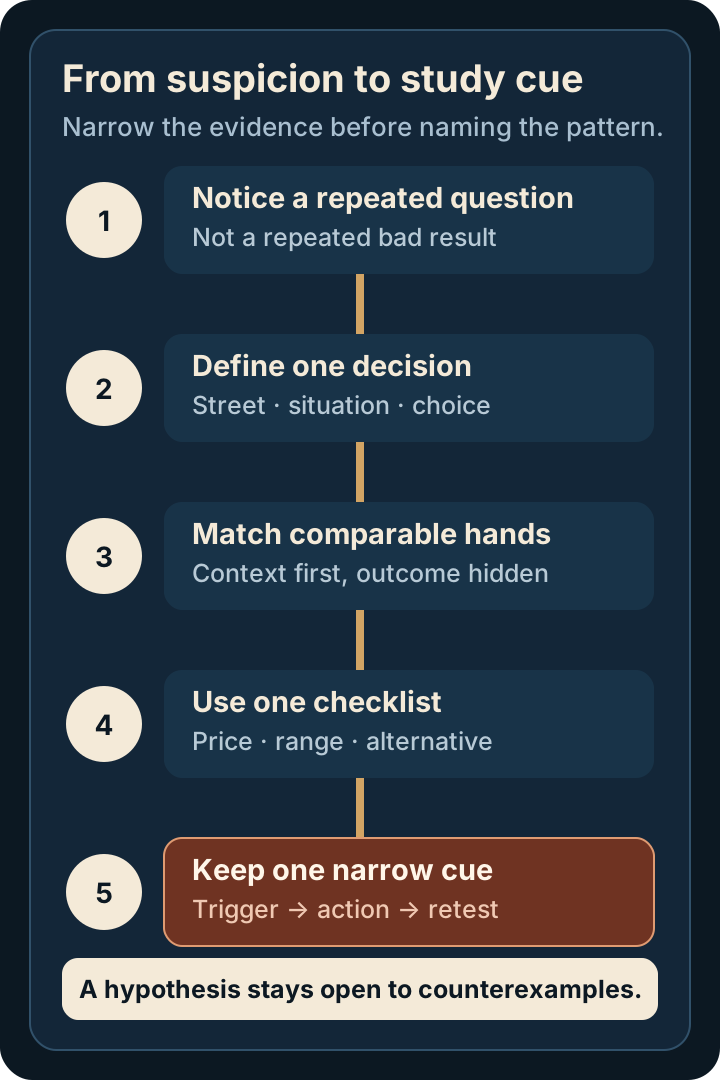
Begin with a question that contains a street, situation, and decision. Good examples include “Do I call too wide on the river after checking twice?” and “Do my turn bets have a clear worse calling range?” Avoid categories such as “postflop” or “aggression”; they combine too many different problems.
Next define what would count as evidence. For a river-call question, record the pot, bet, call price, required equity, plausible value hands, plausible bluffs, and whether the call clears the threshold under the range you assigned. Use the same fields for every candidate hand.
Finally, define a counterexample. A river call that clears its price against a credible betting range should remain in the set even if it lost. Counterexamples prevent the review from selecting only hands that support the original suspicion.
How do you build a comparable set of poker hands?
Match the decision context before comparing outcomes. Start with the game format, street, heads-up or multiway status, relative positions, effective stack, path to the decision, board features, and size faced. Convert amounts to big blinds and express bets as a share of the pot when hands come from different stakes.
The hands do not need to be identical. They need enough shared structure that the differences can be named. If one river call closes the action and another leaves a player behind who can raise, separate them. If one hand lacks the turn action that shaped the river range, mark it incomplete or leave it out.
Keep contrasting hands on purpose. A smaller bet, a cleaner missed-draw region, or a different position can show the boundary of the pattern. The goal is not to assemble a prosecution; it is to learn where the suspected tendency does and does not apply.
What does a complete poker leak review example look like?
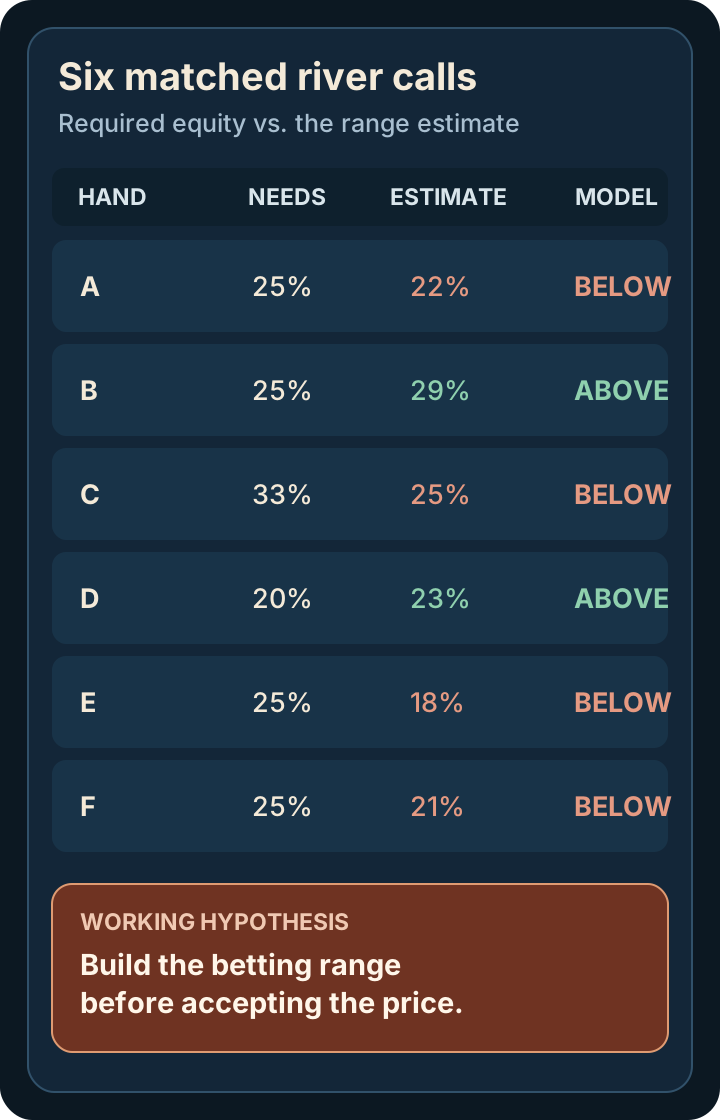
Suppose you collect six constructed heads-up river decisions in which the action closes and your hand is a bluff catcher. For each one, you calculate the equity needed from the pot and bet, then estimate equity against a stated value-and-bluff range without looking at the showdown.
Four calls fall below their modeled thresholds: 22 versus 25 percent, 25 versus 33 percent, 18 versus 25 percent, and 21 versus 25 percent. Two calls clear the model: 29 versus 25 percent and 23 versus 20 percent. The arithmetic is consistent, but each equity estimate still depends on which value hands and bluffs were allowed to reach the river and bet.
The useful hypothesis is not “never bluff-catch.” It is “before calling a closing river bet, I may be accepting the price without building enough bluff combinations.” The two supported calls matter because they show that the action itself is not the leak; skipping the range-to-price check may be.
How much evidence do you need before calling something a leak?
There is no universal hand count that proves a leak. Confidence depends on how complete and comparable the records are, how clearly the same reasoning problem repeats, and whether reasonable counterexamples were included. Six carefully matched decisions can expose a useful study question without proving a permanent population-level tendency.
Separate the certainty of the facts from the certainty of the interpretation. Pot and call amounts may be exact, while the opponent range remains uncertain. If the conclusion disappears after one plausible range adjustment, label the spot assumption-sensitive instead of treating it as stable evidence.
Keep collecting hands after you change the process. The purpose is not to defend the label. It is to see whether the same decision checkpoint now produces clearer reasoning across both winning and losing results.
How do you test whether the pattern is real?
Review every hand result-blind with the same questions. Rebuild the action, calculate the known price, state the range, compare at least one alternative, and change one uncertain assumption. A pattern is more credible when the same omission or mismatch appears without changing the checklist from hand to hand.
Look for disconfirming evidence. If the suspected issue is calling too loosely, include disciplined folds and supported calls from the same context. Ask what those hands contained that the weak calls did not: a lower price, more natural bluffs, a relevant blocker, or a different arrival range.
Use grades, solver output, app analysis, or a friend's view as inputs rather than votes. Trace each disagreement back to the recorded facts or range assumption. A confident label without a visible reason is not stronger evidence.
What should you save from a poker leak review?
Save five parts: the matched context, the repeated tendency, the evidence for it, the strongest counterexample, and one next-time cue. This creates a small record that can be challenged later without reopening every hand from memory.
Write the cue as a trigger followed by an action. For the river example: “When a bet closes the action and my hand beats only bluffs, calculate the required equity and name the bluff region before calling.” The cue does not force a fold; it forces the missing checkpoint.
Choose one adjustment at a time. If you simultaneously change preflop ranges, turn sizing, and river calls, the next set of hands cannot show which intervention helped. A narrow cue is easier to practice and easier to review honestly.
Which leak-finding mistakes create false patterns?
The most common error is filtering by losses. That selects the ending instead of the decision and hides mistakes that won. Other false patterns come from mixing unlike spots, changing the review standard between hands, filling memory gaps, or treating an opponent-specific adjustment as a universal rule.
Do not count every unfavorable grade as the same leak. A turn bet can need work because the size lacked a target, because the range should check more often, or because the effective stack changed the plan. Group the reason, not merely the letter or action.
Avoid making the label bigger than the evidence. “Possible river price-check leak in this matched set” is a useful working conclusion. “I play rivers badly” cannot tell you which hands to find or what to do differently.
How can Tells Poker support a leak review?
In the Tells Poker iOS app, the Hands screen can filter saved hands by position, time period, month, or an exact two-card holding. Use those filters to gather candidates, then open each hand in Replay and pause at the same type of decision to verify the seats, board, action, pot, and remaining stacks.
The Analysis tab can provide street grades, quick takes, deterministic spot math, reasoning, and another line for the completed hand. Compare the explanation and assumptions across the set rather than counting grades alone. The same grade can describe different problems, and different grades can still reveal one repeated checkpoint.
Keep your final leak note outside the result and treat each debrief as a structured second opinion, not perfect or definitive play. Tells helps preserve and revisit the hands; the quality of the pattern still depends on accurate records, comparable contexts, and honest range assumptions.
Frequently asked questions
Can one poker hand reveal a leak?
One hand can reveal a mistake or suggest a hypothesis. A leak needs repeated evidence across comparable decisions, including hands that could disconfirm the pattern.
Should you search only losing hands for poker leaks?
No. Losing-hand filters create results bias and miss weak decisions that won. Review winning calls, losing calls, folds, and counterexamples from the same decision context.
Do low street grades prove a poker leak?
No. Grades can help locate hands, but the repeated reason matters. Verify the facts, price, ranges, and alternative line before grouping decisions into one pattern.
What is the best output from a leak review?
Save one narrow trigger-and-action cue, plus the evidence and counterexample behind it. Continue collecting comparable hands to test whether the cue improves the decision process.