

To review a poker fold after the hand, freeze the action before the fold, reconstruct the pot and call price, build the opponent's betting range, and separate the hands you beat from the hands that beat you. Compare folding with calling and any realistic raise, then reveal the result only after you have graded the decision.
A fold is not correct because the opponent later shows a strong hand, and it is not automatically wrong because the opponent shows a bluff. One revealed holding is one branch of a range. The decision depends on the price, the combinations that plausibly reached the bet, your blockers, any action still behind, and the value of continuing.
Use this process after the hand is complete. The goal is not to recover chips already committed or to prove one perfect play. It is to make the assumptions behind the fold visible, test where the conclusion changes, and save a conditional lesson for a future session.
What should a poker fold review answer?
A useful fold review answers three questions. What price did calling receive? Which part of the betting range did your hand beat? Which realistic alternative had a better expected case than folding? Those questions turn a feeling such as “I think I folded too much” into a decision another player can inspect.
Start at the exact action, not at showdown. Record the street, positions, board, pot before the bet, amount bet, amount to call, effective stack, players still active, and whether your action would close the betting. Then write the cards and actions that shaped both ranges before the final wager.
Keep facts separate from reads. The 14 BB river bet is a fact. “This player rarely bluffs missed draws” is an assumption. Both matter, but only the fact belongs in the pot calculation. Labeling the assumption makes it possible to test a second version without rewriting the hand.
Why does the result not prove whether the fold was good?
After folding, you may see the bettor's cards, hear a table comment, or never learn the result. None of those outcomes reveals the full range that could have taken the same line. A shown bluff proves that one bluff existed once; it does not tell you how many value hands, other bluffs, or mixed actions were available.
The same logic works in the other direction. Folding and seeing a value hand does not prove that calling was poor. If the bet also contained enough bluffs for the price, a call could still have been reasonable even though this particular branch lost.
Review the process without the reveal, record your conclusion, and only then use the shown hand as one observation. This result-last order protects the range estimate from being built around the one holding you happened to see.
How do you reconstruct the fold decision?
Rebuild the hand street by street. Confirm every bet as an amount added or a raise-to amount, carry the pot forward, subtract wagers from the relevant stacks, and stop immediately before the fold. If the pot does not reconcile, correct the history before making a strategic claim.
Next identify the decision options. On the river this may be fold, call, or raise. Earlier in the hand, calling also opens future cards and later bets, while raising creates fold, call, and re-raise branches. A fold comparison is incomplete if the alternative is described only as “continue somehow.”
Finally, note whether another player could act. In a multiway pot, a call may not close the action. A player behind can overcall or raise, which changes both the price you realize and the range your hand must beat.
How does the call price set the burden of proof?
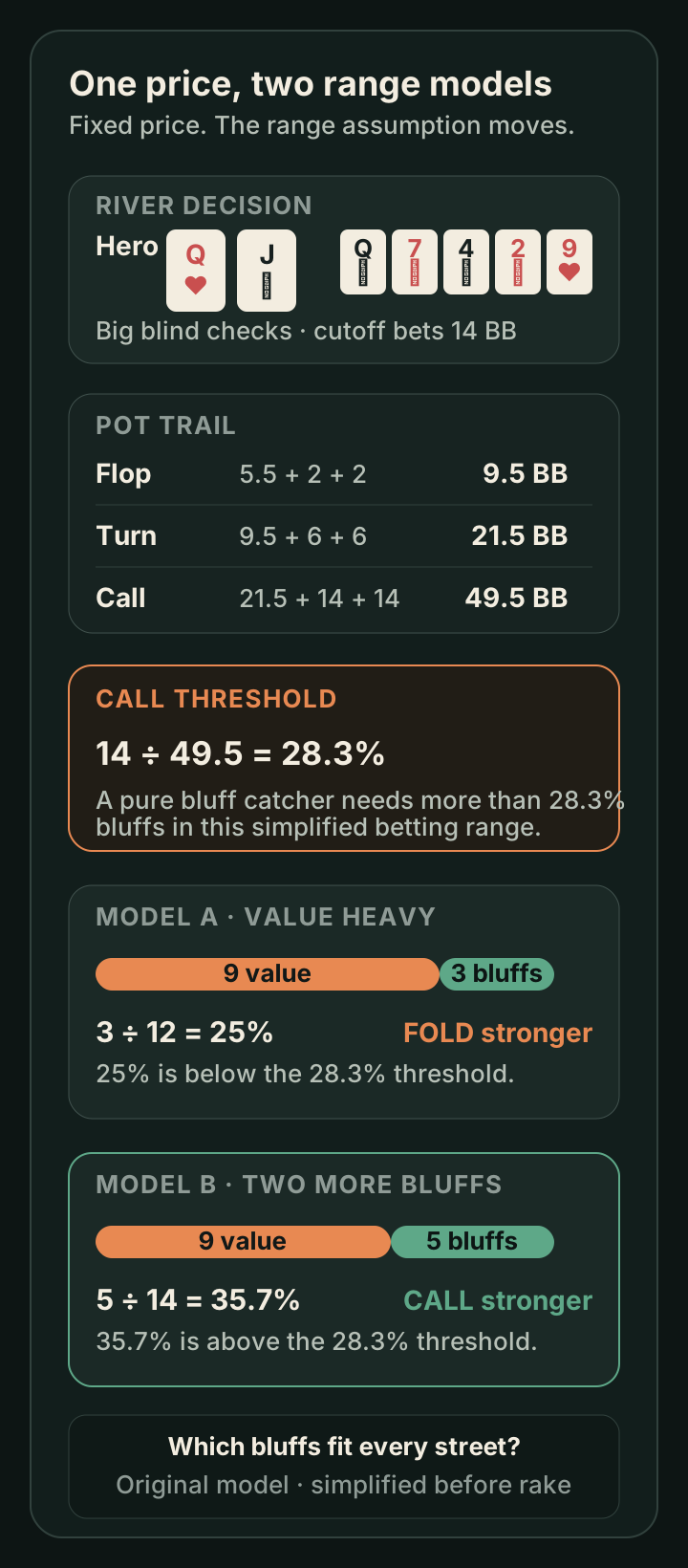
For a closing river decision, calculate the equity required to call by dividing the call amount by the final pot after your call. If the pot is 21.5 BB and an opponent bets 14 BB, calling 14 BB creates a 49.5 BB final pot. The break-even threshold is 14 divided by 49.5, or about 28.3 percent.
A pure bluff catcher wins only against bluffs, so the betting range must contain more than about 28.3 percent bluffs for the call to clear this simplified threshold before rake. Another way to say it: you need to win a little more than 28 times in every 100 comparable calls under the same assumptions.
Do not compare the 14 BB call with the chips already invested. Earlier wagers are sunk at this decision. Folding is normally assigned 0 incremental EV: you add no more chips and win none of the current pot. The question is whether calling or raising has an expected value above that baseline.
Which value hands and bluffs can reach the bet?
Build the betting range from the earlier action. Start with the preflop route, narrow it after each check, bet, call, or raise, and then split the final bet into value hands, bluffs, and any thin or ambiguous region. Do not add a convenient river bluff that would usually have folded preflop or checked an earlier street.
For every value class, ask what worse hand the bettor expects to call. For every bluff class, ask why that hand reached the river and why betting is better than checking. The goal is not false precision. It is a range whose parts tell a coherent story through the recorded line.
When the estimate is uncertain, build two versions. A value-heavy version might make the fold clear. A bluff-heavier version may support a call. The useful lesson is often the boundary between them: which missed draws or thin value bets must be present before continuing becomes competitive?
How should blockers change a fold review?
Your hole cards remove combinations from the opponent's possible range. A card that blocks several likely value hands can make a bluff-catching call more attractive. A card that blocks missed draws can make the same call worse because fewer natural bluffs remain.
Apply blockers after building a plausible range, not before. Saying “I had the ace blocker” is incomplete until you name the value or bluff combinations that ace removes. A blocker is a count adjustment, not proof that the bet is strong or weak.
Board cards remove combinations too. Check every proposed holding against the board and your hand, then keep the action filter in place. A mathematically available combination still needs to fit the positions, sizes, and earlier streets.
How does a full river-fold example work?
Imagine a six-max cash table where the relevant stacks begin at 100 BB. Action folds to the cutoff, who opens to 2.5 BB. The big blind defends Q♥ J♠. Before rake, the two active players have each contributed 2.5 BB and the small blind has contributed 0.5 BB, producing a 5.5 BB flop pot.
The flop is Q♣ 7♦ 4♠. The big blind checks, the cutoff bets 2 BB, and the big blind calls, making the turn pot 9.5 BB. The turn is 2♦. The big blind checks, the cutoff bets 6 BB, and the big blind calls, making the river pot 21.5 BB.
The river is 9♥. The big blind checks and the cutoff bets 14 BB. A call would make the final pot 49.5 BB, so Q♥ J♠ needs about 28.3 percent equity. If it functions as a bluff catcher, the review must estimate whether enough missed draws and other bluffs reach this third bet.
Suppose a first model contains nine value combinations and three bluffs after card removal and action filtering. The bluff share is 3 divided by 12, or 25 percent, below the 28.3 percent threshold, so folding has the stronger simplified case. If two additional plausible bluffs reach the river, the mix becomes nine value and five bluffs. Five divided by 14 is about 35.7 percent, which gives calling the stronger simplified case.
The example does not declare the real range. It shows where the work lives. The 14 BB price is fixed; the decision turns on whether those additional bluffs plausibly take the preflop, flop, turn, and river actions. Save the conclusion conditionally: fold against the 9-to-3 model, call if at least five credible bluffs remain with the nine value combinations.
How do you compare folding with calling and raising?
Compare actions from the current decision forward. Folding has a 0 incremental-EV baseline. Calling risks the call amount to win the final pot according to your equity against the betting range. Raising adds new branches: the opponent may fold, call, or re-raise, and each response needs its own range.
Do not include a raise merely to avoid being bluffed. A raise needs a purpose. For value, name the worse hands that call. As a bluff, name the better hands that fold and the blockers that make your hand a suitable candidate. If neither story works, the real comparison may be only fold versus call.
Change one assumption at a time. Add one bluff class, remove one thin value class, or adjust how often a mixed hand bets. This shows which belief controls the decision instead of hiding several favorable changes inside one revised range.
How do future streets change an earlier fold?
Before the river, pot odds are only the starting price. A call also depends on how often your equity can be realized, which cards improve or weaken your hand, the remaining stack, your position, and the bets you may face later. A draw can have enough raw equity and still struggle to realize it out of position against large future wagers.
Map the next street before judging the fold. Group future cards into useful categories, estimate the pot after a call, and decide what happens when the opponent checks, bets small, or bets large. If many runouts create another guess with too little information, that cost belongs in the comparison.
A raise can also change the path. It may win immediately, set a price, or face a re-raise. Review all likely responses rather than treating the raise as a guaranteed way to see the next card.
Where do fold reviews go wrong?
A frequent error is grading the fold from the revealed hand. Another is comparing the call with the entire amount already invested rather than the current price. A third is naming one possible bluff and one possible value hand without counting or weighting the wider range.
Other mistakes include inventing bluffs that do not fit the earlier action, ignoring blockers, forgetting a player behind, and using exact percentages for uncertain reads. Regret creates another trap: a disciplined fold can feel worse than a loose call because folding ends your chance to win this pot. That feeling is not part of the EV calculation.
Avoid universal lessons such as “always fold one pair to three bets.” Save a cue tied to the decision process instead: “Before folding a bluff catcher, calculate the price and name the missed draws that actually reach the river bet.”
What is a reliable post-session fold review sequence?
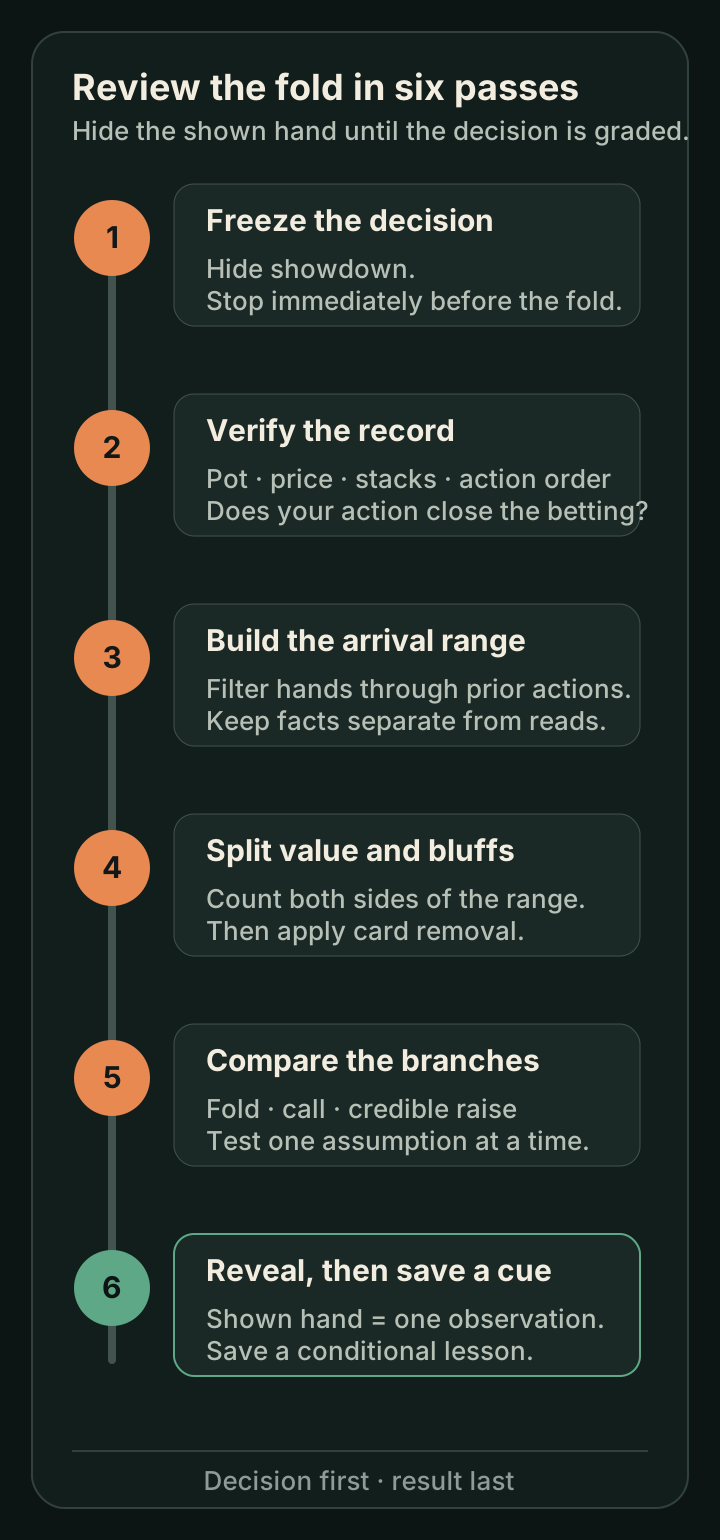
Use six passes. First, freeze the decision and hide the result. Second, verify the hand history, pot, price, stacks, and action order. Third, build the bettor's arrival range. Fourth, divide that range into hands you beat and hands that beat you, then apply blockers. Fifth, compare fold, call, and any credible raise while changing one assumption at a time. Sixth, reveal the result and save one conditional lesson.
Write the threshold beside the range estimate. A note such as “need 28.3 percent; modeled bluffs 25 percent” is easier to revisit than “felt like a fold.” If the conclusion changes when two plausible bluffs are added, record that sensitivity instead of forcing confidence.
The sequence works for folds that saved chips and folds you regret. Its purpose is not to reward caution or aggression. It is to evaluate the information available before the hand moved on.
How can Tells Poker support a fold review?
On iPhone, Tells Replay presents a saved hand as a sequence of table states. Move to the frame immediately before the fold and verify the board, seats, wagers, pot, and stacks without advancing to the later result.
When the Analysis view is available, it can pair verified decision math with street reviews, range reasoning, and another line to consider. Set that structured second opinion beside your own value-and-bluff model, especially when one uncertain assumption changes the conclusion.
Tells supports completed hands and after-session study; it is not a source of real-time assistance. Treat its output as neither perfect nor definitive. Use it to reconstruct the branch, make the price visible, and bring a sharper question to a later discussion with poker friends.
Frequently asked questions
Was a poker fold wrong if the opponent showed a bluff?
Not automatically. A shown bluff is one holding from the betting range. Review the price and the full mix of plausible value hands and bluffs before grading the fold.
Do chips already in the pot count when deciding whether to call?
No. Earlier contributions are sunk at the current decision. Compare the additional call amount with the final pot and the equity your hand has against the betting range.
What is the EV of folding in poker?
From the current decision point, folding is normally assigned 0 incremental EV because you invest no more chips and cannot win the current pot. Calls and raises are compared with that baseline.
Should you reveal the result before reviewing a fold?
No. Freeze the decision, build the ranges, calculate the price, and record a conclusion first. Reveal the result afterward as one observation, not as the answer key.