

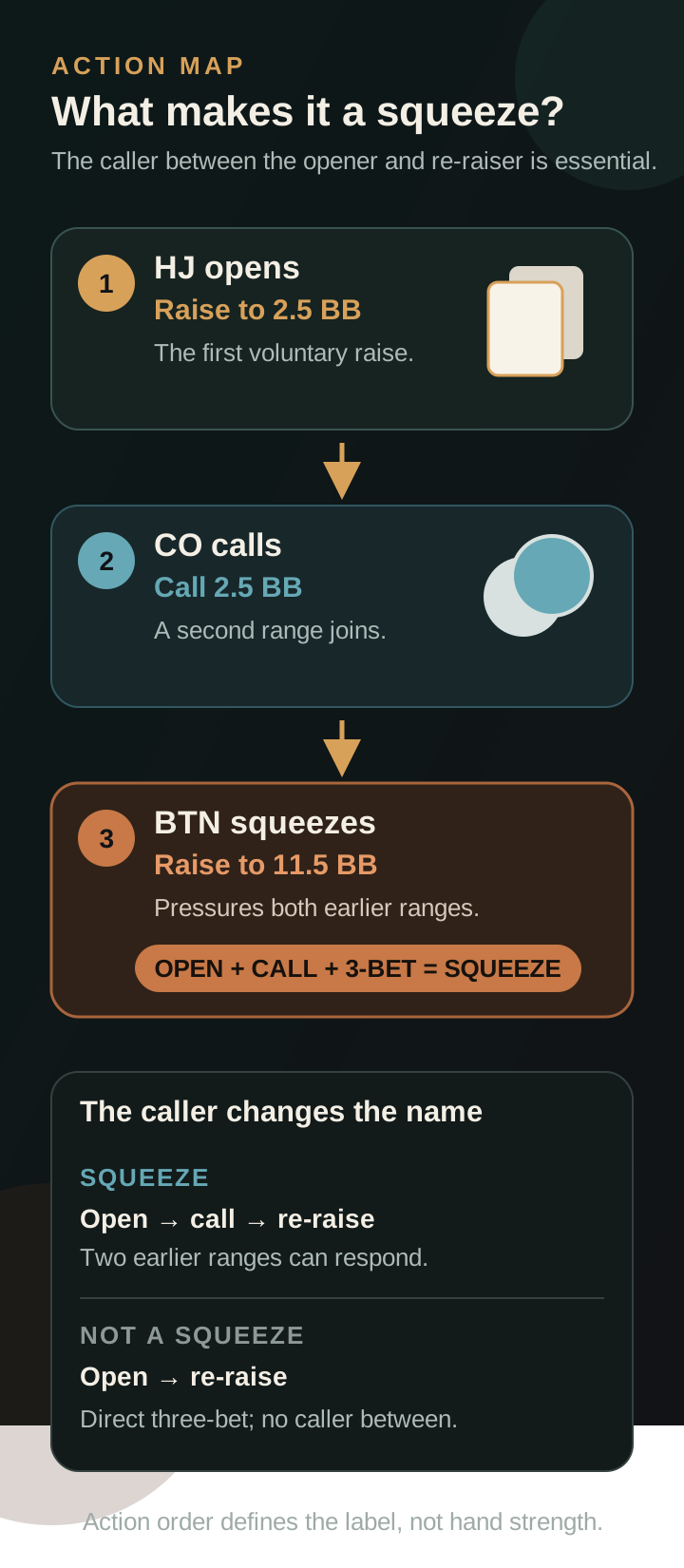
A squeeze play in poker is the preflop re-raise in a sequence that already contains both an opener and a caller. For example, the hijack raises, the cutoff calls, and the button re-raises. The button's action is a squeeze because it pressures both earlier ranges while contesting a pot that already contains the caller's chips.
The name describes action order, not hand strength. A squeeze can be made with a value hand, a bluff, or a hand whose plan depends on the positions and likely responses. It is not automatically profitable simply because the caller added dead money to the pot.
Review a squeeze only after the hand is complete. Reconstruct the opener, every caller, the raise-to size, the effective stacks, and the response order. Then compare the immediate fold branch with the called and four-bet branches instead of grading the play by whether everyone folded.
What does squeeze play mean in poker?
A squeeze is a specific kind of preflop three-bet. Its action order is raise, call, then re-raise from a player who has not yet entered the pot. Remove the call between the two raises and the action is still a three-bet, but it is not a squeeze.
The squeezer may be on the button, in a blind, or in another seat that still has action. Position changes the likely ranges and the postflop plan, but it does not change the definition. The caller between the opener and re-raiser is the defining feature.
A squeeze can also follow several callers. If the hijack opens, the cutoff and button call, and the small blind re-raises, the small blind has squeezed three earlier ranges. Each extra caller adds chips to the current pot and another player who may fold, call, or re-raise.
How is a squeeze different from a direct 3-bet, isolation raise, and 4-bet?
A direct three-bet happens when one player opens and the next aggressive action is a re-raise, with no caller between them. A squeeze is still a three-bet, but the intervening call creates the squeeze sequence and changes the pot before the re-raise.
An isolation raise usually follows one or more limps. Because a limp is a call of the big blind rather than an open raise, the isolator is making the first voluntary raise. A squeeze follows an actual raise and at least one call, so the squeezer is re-raising.
A four-bet is the next raise after the three-bet. If the button squeezes and the original opener raises again, the opener has four-bet. The same is true if the caller responds to the squeeze with another raise. The squeeze label stays attached to the earlier three-bet.
Why does the caller change a squeeze decision?
The caller changes both the pot and the response tree. More chips are available to win immediately, but the re-raise must now pass through at least two earlier ranges. The opener can fold, call, or four-bet, and the caller acts after seeing that response unless the action has already ended.
Do not treat the caller's range as automatically weak. A call can contain hands that prefer not to three-bet, hands setting a trap, or hands whose plan changes after a squeeze. Build the caller's range from position, stack, and action rather than from the word call alone.
Action order matters after the squeeze. If the opener calls, the caller receives a new price with more information. If the opener folds, the caller may still continue. A review that records only the opener and squeezer erases one of the decisions that defines the spot.
Which hands make reasonable squeeze candidates?
A value candidate should have a coherent plan against calls and four-bets from both earlier players. Name the worse hands that may continue, the stronger hands that can re-raise, and whether the remaining stack supports the postflop branch. A strong label is not enough without a response map.
A bluff candidate needs specific folds from the opener and caller. Card removal can reduce some strong continuing combinations, while suited or connected properties can preserve useful postflop branches when called. Neither feature makes a squeeze automatic; the hand still needs enough fold targets and a workable plan.
Build the squeezing range together with the calling and folding ranges. Some hands are too strong to fold but gain little from re-raising. Others cannot continue profitably when called. Separating value, bluff, call, and fold regions prevents every playable hand from becoming a squeeze by default.
How should you choose a squeeze size?
Choose the raise-to amount from the current pot, the open size, the number of callers, position, effective stack, and the responses you expect. The size should create a branch you can explain. Copying a fixed multiple without reconstructing the contributions can leave the caller an unintended price or consume too much of the stack.
A smaller squeeze risks less and leaves a higher stack-to-pot ratio when called, but it may invite more calls. A larger squeeze asks the earlier players to commit more and creates a lower postflop SPR, but it also risks more when everyone folds or someone four-bets. Neither direction is automatically better.
Record squeeze sizes as raise-to amounts. If the opener made it 2.5 BB and the button raises to 11.5 BB, the button puts 11.5 BB into the pot, not 14 BB. The opener has already contributed 2.5 BB, so calling the squeeze costs 9 BB more.
How does the full 100 BB squeeze example work?
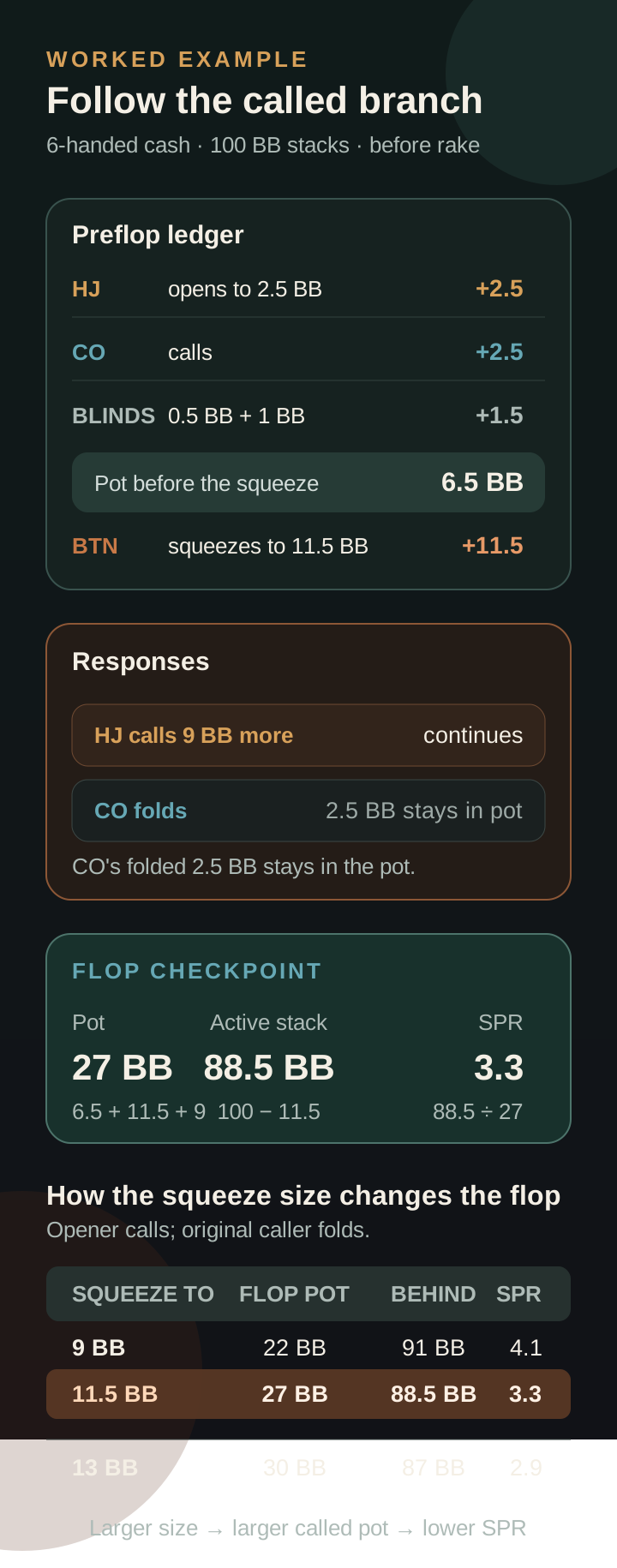
Use a six-handed cash example with 100 BB starting stacks. The small blind posts 0.5 BB and the big blind posts 1 BB. After the first seats fold, the hijack opens to 2.5 BB, the cutoff calls 2.5 BB, and the button squeezes to 11.5 BB. Before the squeeze, the pot is 6.5 BB: 0.5 plus 1 plus 2.5 plus 2.5.
Suppose both blinds fold, the hijack calls 9 BB more, and the cutoff folds. The flop pot is 27 BB before rake: the original 6.5 BB, the button's 11.5 BB, and the hijack's additional 9 BB. The cutoff's folded 2.5 BB remains part of that pot.
The button and hijack each have 88.5 BB behind. Dividing 88.5 by the 27 BB pot gives a flop SPR of about 3.3. The preflop size therefore changes more than the immediate price; it also changes how much room remains for later-street bets.
Compare nearby sizes under the same response assumption. If only the opener calls and the original caller folds, a squeeze to 9 BB creates a 22 BB flop pot with 91 BB behind, or about 4.1 SPR. A squeeze to 13 BB creates a 30 BB pot with 87 BB behind, or 2.9 SPR. The comparison isolates what the size changes.
How often must an immediate squeeze bluff work?
A simplified immediate-fold model compares the squeeze risk with the pot available before the raise. In the example, the button risks 11.5 BB to win 6.5 BB. The break-even fold rate is 11.5 divided by 18, or about 63.9 percent, if the hand has no value after a call and the model ignores rake.
That number is a reference point, not a complete strategy. A real hand retains some equity when called, may realize that equity imperfectly, and can face different responses from two players. Rake and future betting also change the full expected value.
Use the threshold to test assumptions. Which opener hands fold? Which caller hands fold after the opener continues or releases? What happens when only one player calls? The calculation is useful when it exposes the response model rather than replacing it.
What should happen after a squeeze is called or 4-bet?
If one player calls, rebuild the postflop ranges from that exact branch. The opener calling and caller folding creates a different comparison from the opener folding and caller calling. Preserve who continued, the price each player received, and the effective stack that remains.
If both players call, the pot becomes multiway and the postflop SPR falls further. The squeezer must now account for two continuing ranges and a different action order. A preflop plan based only on getting one caller has reached a branch that needs a new review.
If either earlier player four-bets, compare folding, calling, and raising again from the new pot and stack. Do not defend the squeeze merely because chips are already committed. Those chips are part of the pot; the next action must stand on its own price and range assumptions.
How do position and multiple callers change a squeeze?
A button squeeze may play postflop in position against players who continue from earlier seats. A blind squeeze can face the same preflop sequence while playing later streets out of position. That difference changes equity realization, future sizing, and which marginal hands can continue comfortably.
Each additional caller increases the current pot but also adds another range that must respond. More dead money does not mean an effortless bluff. The squeezer may win more when everyone folds while also receiving calls from a wider set of positions or facing a back-raise from a player who first called.
Review every active seat separately. List the opener, first caller, later callers, and players still behind the squeezer. One combined opponent range cannot preserve who acts when, who can re-raise, or which effective stack applies to each branch.
Where do squeeze play reviews go wrong?
The first mistake is calling every preflop three-bet a squeeze. Without an intervening caller, the action is a direct three-bet. The second is assuming the caller must be weak, which removes traps and durable calling hands before the review begins.
Other mistakes include forgetting folded contributions in the pot, confusing raise-to with raise-by, reusing one size across different caller counts and stacks, and planning only for folds. A squeeze that gets called has not failed automatically; it has entered a branch that should have been considered in advance.
Results can hide these errors. Winning 6.5 BB preflop does not prove the range or size was sound, and losing a large postflop pot does not prove the squeeze was wrong. Grade the information, branches, and plan before revealing the result.
How should you review a squeeze play after the hand?
First, reconstruct every preflop contribution and confirm that an open, call, and re-raise actually occurred. Second, write separate starting ranges for the opener, each caller, and the squeezer. Third, calculate the pot before the squeeze and the effective stack against each possible continuer.
Fourth, compare at least two raise-to sizes and the calling or folding alternatives. Fifth, map all-fold, one-call, multiway-call, and four-bet branches. Sixth, carry the actual branch to the flop and recalculate the pot, remaining stacks, position, and SPR.
Finish with one conditional lesson. “Squeeze more when there is dead money” is too broad. “From the button in this stack configuration, use a squeeze only when I can name folds from both earlier ranges and still explain the one-call branch” is narrow enough to test again.
How can you examine a squeeze in Tells Poker?
Once play has ended, use step-by-step, text, or voice capture to record the positions, stacks, blinds, open, calls, squeeze size, and responses in Tells Poker. Include every caller whose chips or action changes the branch instead of shortening the record to hero versus one opponent.
Open Replay and step through the saved sequence to verify that the pot and action order match what happened. Pause before the squeeze, then compare the recorded raise with calling and folding. If a player continued, move to the flop and confirm the lower stack-to-pot ratio created by the preflop action.
When the saved hand is eligible for analysis, open the Analysis tab for a street-by-street debrief. Keep its suggestions in the role of a structured second opinion while you challenge the ranges and branches; they are not a perfect or definitive ruling. This remains a completed-hand study workflow, not real-time assistance.
Frequently asked questions
Is every squeeze play a 3-bet?
Yes, in the standard preflop meaning. The squeeze is the three-bet in a raise-call-re-raise sequence. A direct three-bet with no caller between the raises is not a squeeze.
Can value hands make a squeeze play?
Yes. A squeeze can be made for value, as a bluff, or with a hand whose purpose depends on the expected responses. The action sequence determines the label rather than the hand's strength.
Is raising after several limpers a squeeze?
Usually not. Raising after limps is commonly an isolation raise because no player made an open raise first. A squeeze requires an open raise, at least one call of that raise, and then a re-raise.
Can the original caller 4-bet after a squeeze?
Yes, if the action returns to that caller and the player still has chips available. A player can call the open and then re-raise the squeeze; that response is a four-bet and may represent a very different range from a call.