
A straddle in poker is a voluntary blind bet posted before the cards are dealt. It usually creates an extra live blind beyond the big blind, so the first preflop decision, the amount needed to enter the pot, and the size of the starting pot can all change. The exact size, eligible seat, and action order depend on the game’s rules.
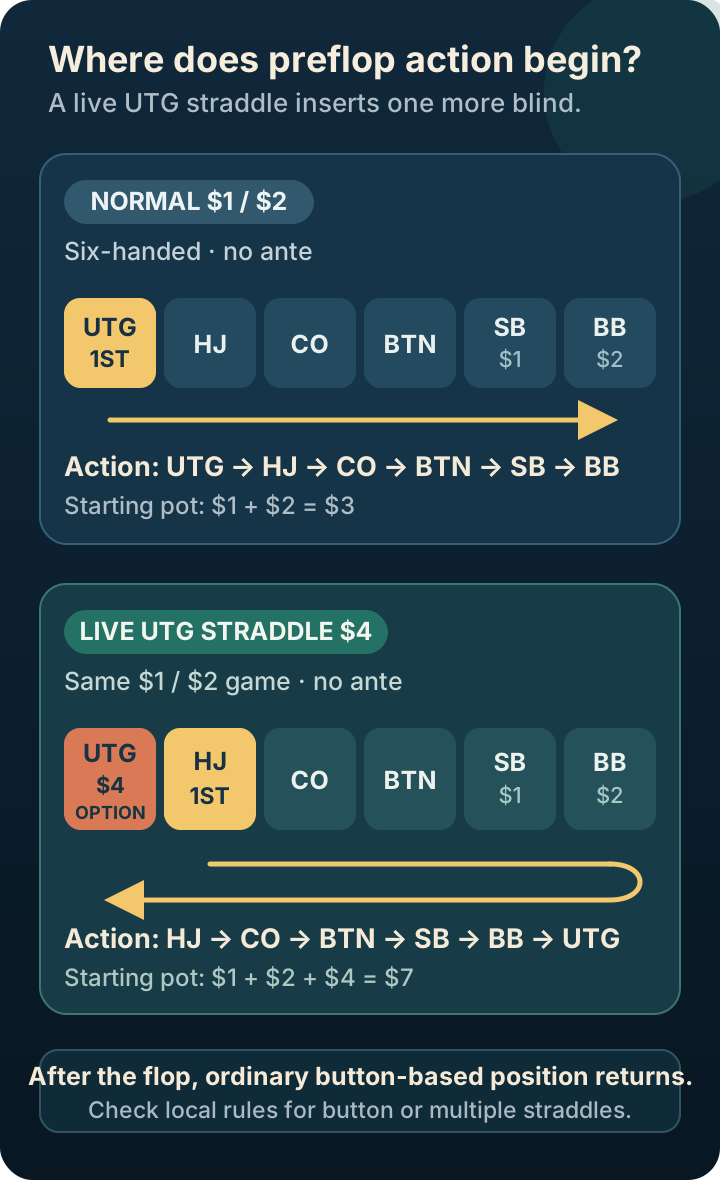
In a common $1/$2 live-game example, the player under the gun posts $4 before receiving cards. The next player acts first preflop, and the straddler usually gets an option when the action returns. The hand now begins with $7 in forced wagers rather than $3, before any antes or other contributions.
The straddle does not change anyone’s chip count by itself, but it makes the stacks shallower relative to the largest blind wager. A $200 stack is 100 big blinds at $1/$2 and only 50 units of a $4 straddle. Record that context after the hand so ranges, sizes, pot math, and later decisions are reviewed on the correct scale.
What does straddle mean in poker?
A straddle is money placed blind before the deal by a player who is not posting the ordinary small blind or big blind. In games where it is live, the wager behaves like an additional blind for preflop action. Players who have not entered must at least match it to call, while a raise must follow the game’s rule for raising over that amount.
The most familiar version is an under-the-gun straddle, posted by the player immediately left of the big blind. Other versions may be allowed from the button or another seat, and some games allow more than one straddle. Those variations can change who acts first and who receives the last preflop option.
Do not infer the rule from the word alone. Before reviewing the hand, record which seat posted, the exact amount, whether the straddle was live, whether another straddle followed, and where action began. A clean rule description prevents the rest of the hand from being reconstructed in the wrong order.
Is a straddle the same as a raise?
A straddle is not an ordinary raise made after looking at the cards. It is posted before the deal and commonly establishes another blind level for the first round of betting. The distinction matters because action may start after the straddler rather than with the usual under-the-gun player.
Once action begins, later raises should be recorded as raise-to amounts. If the straddle is $4 and a player makes it $12, that player has raised to $12, not raised by $12. If the straddler continues, they have already committed $4 and add $8 more to call the $12 total.
Minimum-raise rules and special straddle options can vary. During post-session review, use the actual house or game rule instead of assuming every straddle follows the same procedure.
Who acts first in a straddled pot?
In a common under-the-gun straddle, the player immediately left of the straddler acts first preflop. Action then moves around the table, and the straddler usually acts after the big blind when the action returns. This is why the straddle is often described as buying the last preflop option.
That special order applies before the flop. After the flop, position returns to the ordinary seat order based on the button. Posting a straddle does not automatically give that player last action on the flop, turn, or river.
A button straddle or another local variation can rearrange the preflop order differently. Write the actual first actor into the hand history. If the rule is uncertain, preserve that uncertainty rather than forcing the action into the normal unstraddled sequence.
How does a straddle change the starting pot?
A straddle adds money before any player voluntarily calls or raises. At $1/$2 without antes, the small blind and big blind create a $3 starting pot. Add a $4 straddle and the starting pot becomes $7. In big-blind units, that is an increase from 1.5 BB to 3.5 BB.
That larger base carries into every later calculation. A raise, call, and flop bet build on the $7 already present. Forgetting the straddle understates the pot and can make pot odds, stack-to-pot ratio, and raise sizes appear different from what the players actually faced.
Keep folded blind money in the pot even when the blind later folds. Keep an uncalled excess raise separate and return it before finalizing the contested pot. The same pot-reconciliation rules apply in straddled and unstraddled hands; the opening ledger simply contains one more forced wager.
How does a straddle change effective stack depth?
The effective stack is still the smaller amount that two players can wager against each other. The straddle does not remove chips from the deeper stack or change the dollar amount they can contest. It changes the scale used to describe how much room remains for betting.
At $1/$2, two $200 stacks begin 100 BB effective. If a $4 straddle is live, the same $200 is 50 straddle units. The players still have $200, but the pot starts larger and common preflop sizes may use more dollars, so the hand can reach a low stack-to-pot ratio sooner.
State both measures when they clarify the review: $200 effective, equal to 100 BB or 50 straddles. Saying only 100 BB can make a straddled hand look deeper than it played. Saying only 50 blinds can hide that the ordinary big blind was still $2. The two labels answer different questions.
What does a complete straddled-pot example look like?
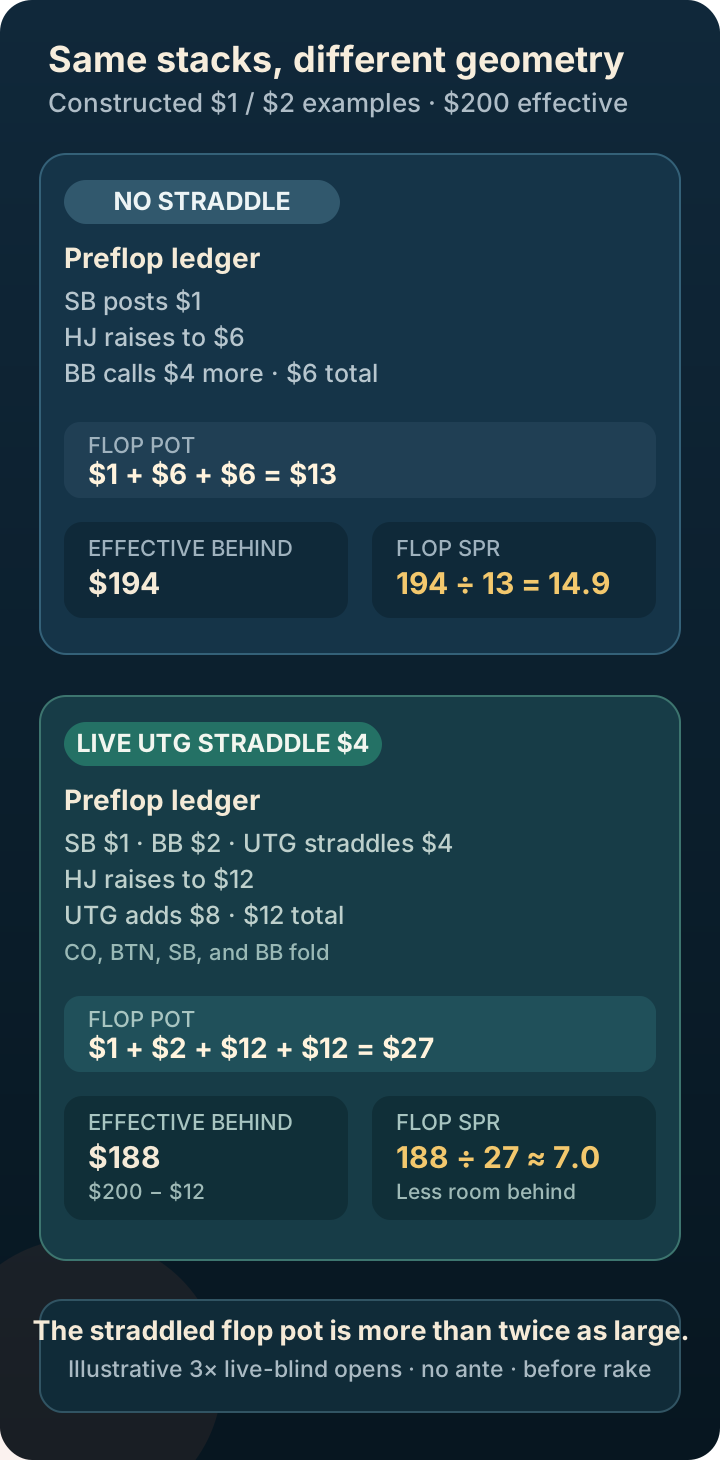
Consider a constructed six-handed $1/$2 cash hand with $200 effective stacks and no ante. Under the gun posts a live $4 straddle. Before the deal, the pot is $1 from the small blind, $2 from the big blind, and $4 from the straddler: $7 total.
The hijack acts first and raises to $12. The cutoff, button, small blind, and big blind fold. The straddler calls by adding $8, because $4 is already posted. The flop pot is $27 before any rake: $1 from the folded small blind, $2 from the folded big blind, $12 from the hijack, and $12 total from the straddler.
Both active players have $188 behind, so the flop stack-to-pot ratio is about 7.0. For comparison, an unstraddled $1/$2 hand in which the hijack raises to $6 and the big blind calls produces a $13 flop pot with $194 behind, an SPR of about 14.9. These are illustrative three-times-the-live-blind sizes, not a claim that either raise is mandatory.
The straddled hand reaches the flop with roughly the same chip stacks but a much larger pot relative to those stacks. That is the practical depth change to preserve in the review. It does not make every postflop decision automatic; it changes the price and branch sizes that the ranges must navigate.
How should a straddle change your hand review?
Begin with mechanics. Confirm the straddler, amount, action order, starting pot, effective stack, and remaining stack after every preflop action. Normalize sizes to big blinds when comparing with ordinary hands, and to straddle units when judging how deep the straddled pot played.
Then rebuild the ranges from the correct first actor. A player acting immediately after the straddler faces more players still to act than the usual under-the-gun opener in an unstraddled hand. A call or raise from the straddler comes after seeing the earlier preflop responses. Those action positions should shape the range discussion even though the postflop seat order has not changed.
Finally, compare decisions using the actual pot. Larger starting pots can change the size of later bets in dollars and reduce the remaining SPR. Do not import an unstraddled conclusion only because the hole cards and board look similar; match the action order, price, and relative depth first.
Which straddle mistakes are most common?
The first mistake is omitting the straddle from the hand history. That shifts the action order and loses $4 from every later pot calculation in the example above. The second is recording the $12 raise as twelve more instead of twelve total, which overstates both the wager and the pot.
Another mistake is calling a $200 stack 100 BB deep without noting that the live wager was $4. The chip stack is accurate, but the relative-depth description is incomplete. The opposite mistake is calling the game $2/$4 when the posted stakes remain $1/$2 with an optional $4 straddle.
Players also confuse preflop option with postflop position. The straddler may act last before the flop in a common under-the-gun format, yet still act early after the flop. Keep the two action orders separate, and record any local variation explicitly.
How can Tells Poker support a straddled-hand review?
After the hand is complete, save the full action in Tells Poker with the straddle, positions, stacks, and raise-to amounts included in the record. Open Replay and step through the preflop sequence to check the seats, wagers, pot, folds, and remaining stacks before evaluating the later streets.
The Analysis tab can organize verified spot math when supported, estimated range reasoning, street feedback, and another line to consider. Compare that structured second opinion with the exact straddle rule and action you recorded, especially when a missing forced wager would change the pot or effective depth.
Tells is for completed-hand review and post-session study, not real-time assistance. Treat the analysis as a structured second opinion rather than a final verdict. Use it to keep the facts together, expose the assumptions, and bring a clearer straddled-pot question to a later discussion.
Frequently asked questions
Is a poker straddle always twice the big blind?
No. Twice the big blind is a common example, but the allowed size can depend on the game. Record the exact amount and rule used in the hand you are reviewing.
Does a straddle count as a raise?
A straddle is a blind wager posted before the deal, not an ordinary raise made after seeing cards. In a live-straddle game it commonly establishes the amount to call before later players raise over it.
Who acts first after an under-the-gun straddle?
In a common under-the-gun format, the player immediately left of the straddler acts first preflop and the straddler receives the last option when action returns. House rules can differ, so verify the actual order.
Does a straddle change the effective stack?
It does not change the number of chips in the effective stack. It makes that stack shallower relative to the live blind and the larger starting pot, so it helps to record both big-blind and straddle-unit depth.