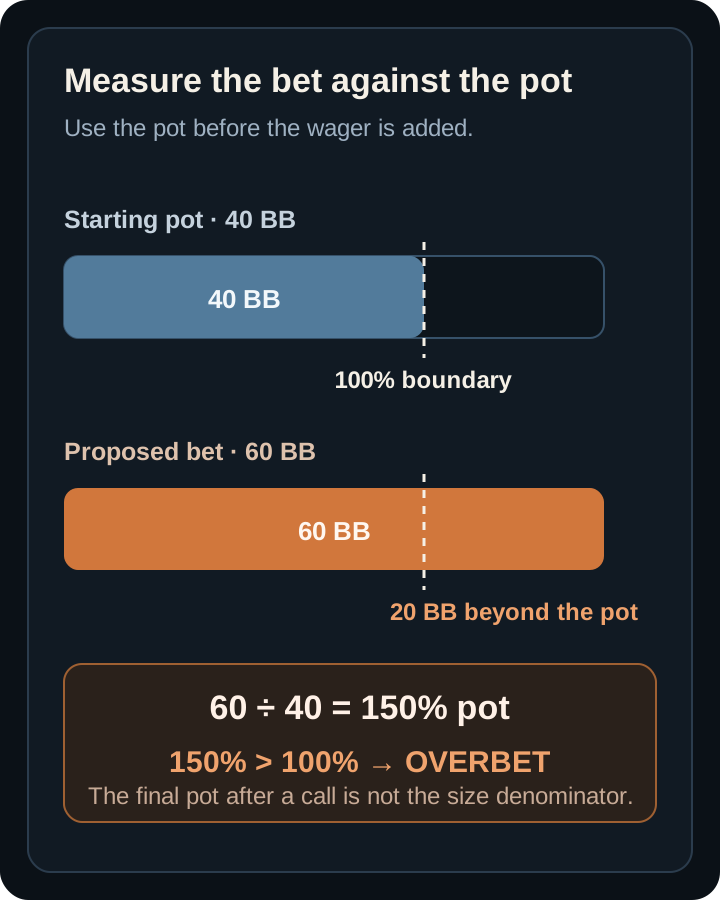
An overbet in poker is a postflop bet larger than the pot that exists before the wager. If the pot is 40 big blinds, any bet above 40 BB is an overbet. A 60 BB wager is a 150% pot overbet because 60 divided by 40 equals 1.5.
The larger size gives a caller worse pot odds and lets the bettor put more money behind a narrower value-and-bluff range. It does not automatically mean strength, weakness, or a good decision. The board, ranges, effective stack, and likely responses still determine whether the size makes sense.
Review an overbet after the hand is complete. Verify the pot first, calculate the price, build the bettor’s value and bluff regions, and compare the large wager with smaller bets and checks. Treat analysis as a structured second opinion rather than proof of one perfect line.
What does overbet mean in poker?
An overbet is a bet greater than 100% of the current pot. The comparison uses the pot before the bet is added. With 30 BB in the middle, 31 BB is technically an overbet, 45 BB is a 150% pot overbet, and 60 BB is a 200% pot overbet.
The label describes size, not intention. A player can overbet for value, as a bluff, or with a draw that has equity when called. A large wager can be carefully constructed or poorly chosen. You still need to ask which hands use it and what each part of the opponent’s range does next.
Do not compare the wager with the final pot after calling. A 60 BB bet into 40 BB is 150% pot even though a call would produce a 160 BB final pot. The starting pot determines the size label; the final pot determines the caller’s price.
How does an overbet change the price of a call?
A larger bet asks the caller to risk more relative to the final pot. Facing a 20 BB half-pot bet into 40 BB, a call creates an 80 BB final pot, so the caller needs 20 divided by 80, or 25% equity, in a simplified heads-up model that ignores ties.
A pot-size 40 BB bet creates a 120 BB final pot and requires 33.3%. A 60 BB overbet into the same 40 BB pot creates a 160 BB final pot and requires 37.5%. The overbet does not force the caller to be correct most of the time, but it does move the threshold upward.
Price is only one side of the decision. The caller must still estimate equity against the range that chooses this size. A hand with 40% equity can call in the simplified example; a hand with 30% cannot. Those percentages are useful only if the range estimate is credible.
Why would a player use an overbet?
An overbet lets a strong hand seek more value from the part of the opponent’s range that can still call. It also lets a bluff risk more to pressure hands that would continue against a smaller size. Both uses depend on arriving at the street with enough credible combinations.
In a simple river bluff with no showdown value, betting 60 BB to win a 40 BB pot needs folds 60 divided by 100, or 60% of the time, to break even. That is a higher fold requirement than a smaller bluff. The reward is that the opponent must defend a narrower range because calling costs more.
Earlier streets add another branch: a called bluff or semi-bluff may improve later. That equity can support an overbet, but future action also raises the cost of a mistake. Remaining stacks, possible raises, and the next street must be included in the plan.
What should an overbetting range contain?
Overbetting ranges are often polarized: strong value hands at one end and bluffs at the other, with many medium-strength hands checking or using a smaller size. The large wager asks the caller to continue with a strong region, so marginal value hands may struggle to receive enough worse calls.
Polarized does not mean only the absolute nuts and hands with zero equity. The value region depends on what the opponent can call, while bluff candidates depend on which better hands can fold. On earlier streets, strong draws can occupy the aggressive end because they retain useful equity when called.
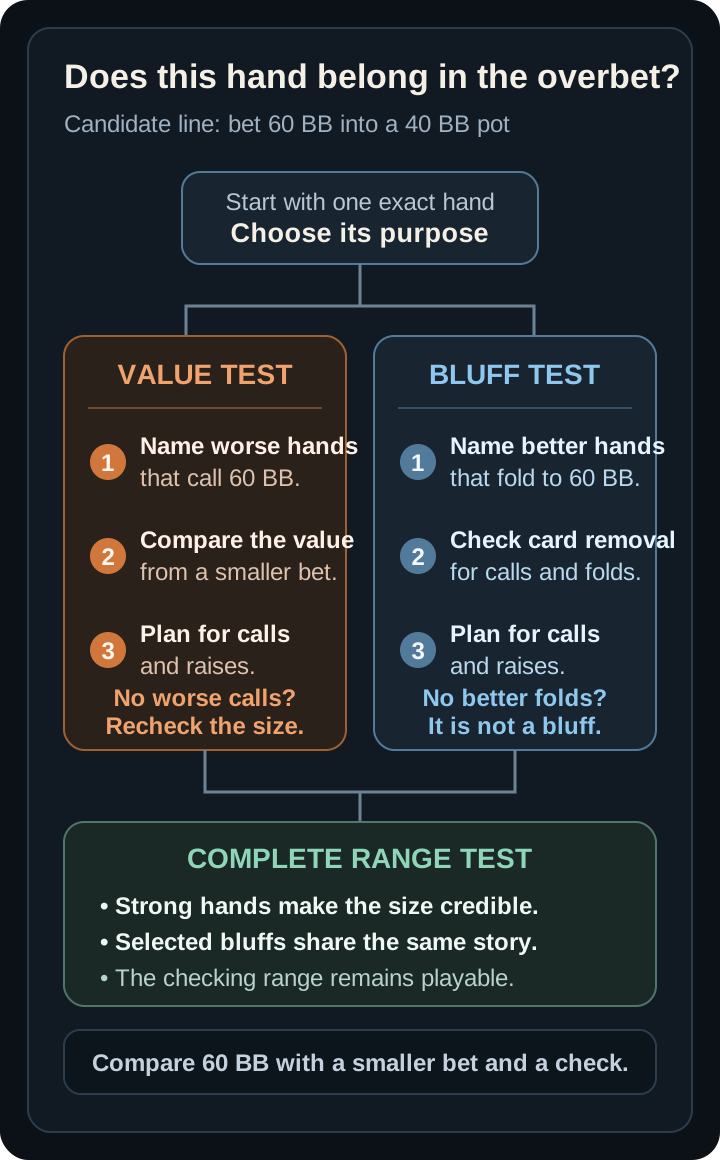
Build the range from both directions. First name the value hands and their worse calling targets. Then choose bluffs that fit the action and interact sensibly with the calling range. Finally, protect the checking range by leaving it enough strong and playable hands. One impressive value hand does not create a complete strategy.
What does a complete river overbet example look like?
Suppose the river pot is 40 BB and the opponent bets 60 BB. Calling 60 BB would create a 160 BB final pot, so a pure bluff catcher needs 37.5% equity. In the simplified model, it wins against every bluff, loses against every value hand, and never ties.
Now construct an illustrative betting range with five value combinations and three bluff combinations. The bluff share is three divided by eight, or 37.5%. A pure bluff catcher is exactly break-even against that range before rake or other complications, because its winning share matches the price.
Remove one proposed bluff because the earlier action no longer supports it. The range becomes five value combinations and two bluffs. Its bluff share falls to two divided by seven, or about 28.6%, so the same bluff catcher becomes a fold in this model. The lesson is not that every overbet must use a five-to-three mix. It is that one range assumption can move a close call.
Which value hands and bluffs make sense for an overbet?
A value overbet needs a realistic worse calling region. Start with the opponent’s bluff catchers and strong made hands, then ask which of your holdings can win when those hands call the large size. If only better hands continue, the supposed value bet is not earning value.
A bluff overbet needs better hands that can fold. Useful candidates may remove some strong calls while leaving missed draws or weak bluff catchers available, but blocker language should remain precise. Name the exact combinations affected instead of declaring that any ace or suit card is a good bluff.
Medium-strength hands often prefer checking because they retain showdown value and dislike facing a raise. That is a tendency, not a universal rule. A smaller size may also earn calls from weaker hands that would fold to an overbet. Compare the entire response range before moving a hand into the largest size.
How do the board, position, and effective stack change an overbet?
Board texture determines whether the bettor can credibly hold enough very strong hands and bluffs. A runout that favors one player’s range can create clearer overbet candidates. A runout that strengthens the caller’s range may make the same size less convincing or more dangerous.
Position changes how the line reaches the decision. In position, a player sees the opponent check before choosing the overbet. Out of position, a river overbet acts before the opponent and cannot use that check as new information. Earlier streets also determine which strong hands and missed draws remain available.
The effective stack caps the wager. If the pot is 40 BB but the shorter remaining stack is 30 BB, a 60 BB overbet is impossible. If 80 BB remains, the same 60 BB bet leaves only 20 BB behind, which changes the meaning of a raise and the plan for any future street. In multiway pots, the bluff must pass through every player who remains, so a heads-up response model is incomplete.
How should you respond when facing an overbet?
First calculate the price from the actual pot and amount to call. Second, rebuild the betting range from the action rather than from the intimidating size. Separate value, bluffs, and any thinner hands that could use the bet. Third, compare your hand’s equity with the required threshold.
Choose continuing hands for reasons you can state. Some calls win against enough bluffs. Some folds block the missed draws you hoped to catch. Some raises represent an even narrower value-and-bluff region. Avoid calling only because the wager looks suspicious or folding every hand because the bet looks strong.
Run a sensitivity check when the answer is close. Remove the weakest bluff, add one plausible value hand, or change a mixed-frequency assumption. If the preferred action flips quickly, save the spot as assumption-sensitive. That is more useful than pretending the range estimate was exact.
Which overbet mistakes are most common?
One mistake is calling any large-looking wager an overbet without checking the pot. A 60 BB bet is an overbet into 40 BB but only a half-pot bet into 120 BB. Another is calculating the percentage from the final pot instead of the pot before the wager.
Players also use the size with too many medium hands, bluff because the bet feels powerful, or assume an opponent’s overbet is always polarized. Those shortcuts skip the actual value targets, fold targets, and earlier actions. The correction is to construct the range before judging the label.
A final mistake is reviewing only the call or fold. The bettor also chose among checking, a smaller bet, and the overbet. The caller may have raise options. Compare those branches and the remaining stack so the lesson explains the whole decision rather than one dramatic number.
How should you review an overbet after the hand?
Use a five-part review. Verify the pot before the wager. Convert the bet into a percentage of that pot. Calculate the caller’s required equity. Build the bettor’s value and bluff regions. Then compare the overbet with a smaller size and a check through the likely fold, call, and raise responses.
Continue the line when the overbet occurs before the river. Record which turns or rivers improve the betting range, which cards help the caller, and how much stack remains. A flop overbet is not a complete plan if the bettor has no response to a call or raise.
End with a conditional lesson, such as: “When this river favors my strongest value region, compare an overbet with a pot-size bet and check whether enough worse bluff catchers still call.” A narrow cue transfers better than “overbet scary boards” or “never fold to a big bet.”
How can Tells Poker support an overbet review?
Tells Poker is built for completed-hand study, not real-time assistance. After play, capture the positions, cards, stacks, pot, and action. Use Replay to verify the pot before the overbet, the amount wagered, the order of action, and the stack that remained.
In the Analysis tab, the current debrief can organize the key decision, deterministic spot math, conditional range groups, street-by-street review, and an alternative line when the saved hand supports them. Compare that structured second opinion with your own value-and-bluff construction rather than treating either range as perfect knowledge.
Bring one precise question to the hand: “Which worse hands call this size, which better hands fold, and what changes if the wager is smaller?” That keeps the dramatic bet attached to the recorded facts and the alternative branches.
Frequently asked questions
How large does a poker bet need to be to count as an overbet?
It must be larger than the pot before the wager. A bet equal to the pot is a pot-size bet; any amount above 100% of the starting pot is an overbet.
Is an all-in bet always an overbet?
No. All-in describes using the player’s remaining stack. It is an overbet only when that wager is larger than the current pot. A short-stack all-in can be smaller than half pot.
Does an overbet always represent a polarized range?
No. Overbets are often built around strong value hands and bluffs, but the actual range depends on the board, action, stack depth, and player. Infer the range from the hand rather than the size alone.
What pot odds do you get against a 150% pot overbet?
Facing a bet of 1.5 times the pot, a call needs 37.5% equity in a simplified heads-up model with no ties: 1.5 divided by the 4 pot units in the final pot after calling.