
A gutshot and an open-ended straight draw can both make a straight with the next card, but the missing ranks are arranged differently. A gutshot needs one rank inside the sequence and usually has four candidate outs. An open-ended draw can complete at either end and usually has eight candidate outs.
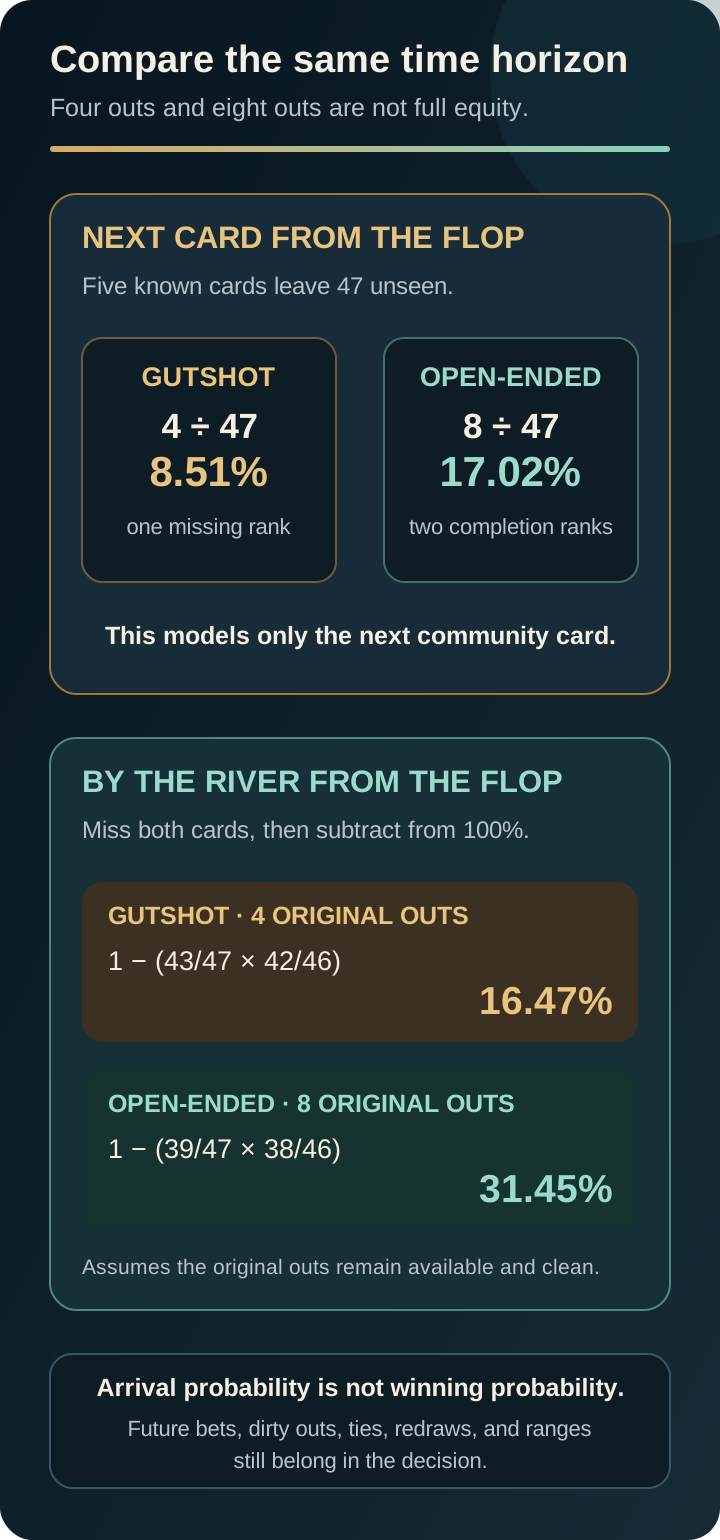
That difference makes an open-ended draw complete more often when you compare the same time horizon. From a hold'em flop with no relevant cards removed, a four-out gutshot hits on the next card about 8.51% of the time; an eight-out open-ended draw hits about 17.02% of the time. Those are card-arrival probabilities, not full equity or instructions to call.
Use the labels during post-session review to organize the cards, then test every candidate out against the opponent range, the price, and future action. A draw can have the right shape while some apparent outs make a second-best hand, create a tie, or cost another bet before you see the river.
What is the difference between a gutshot and an open-ended straight draw?
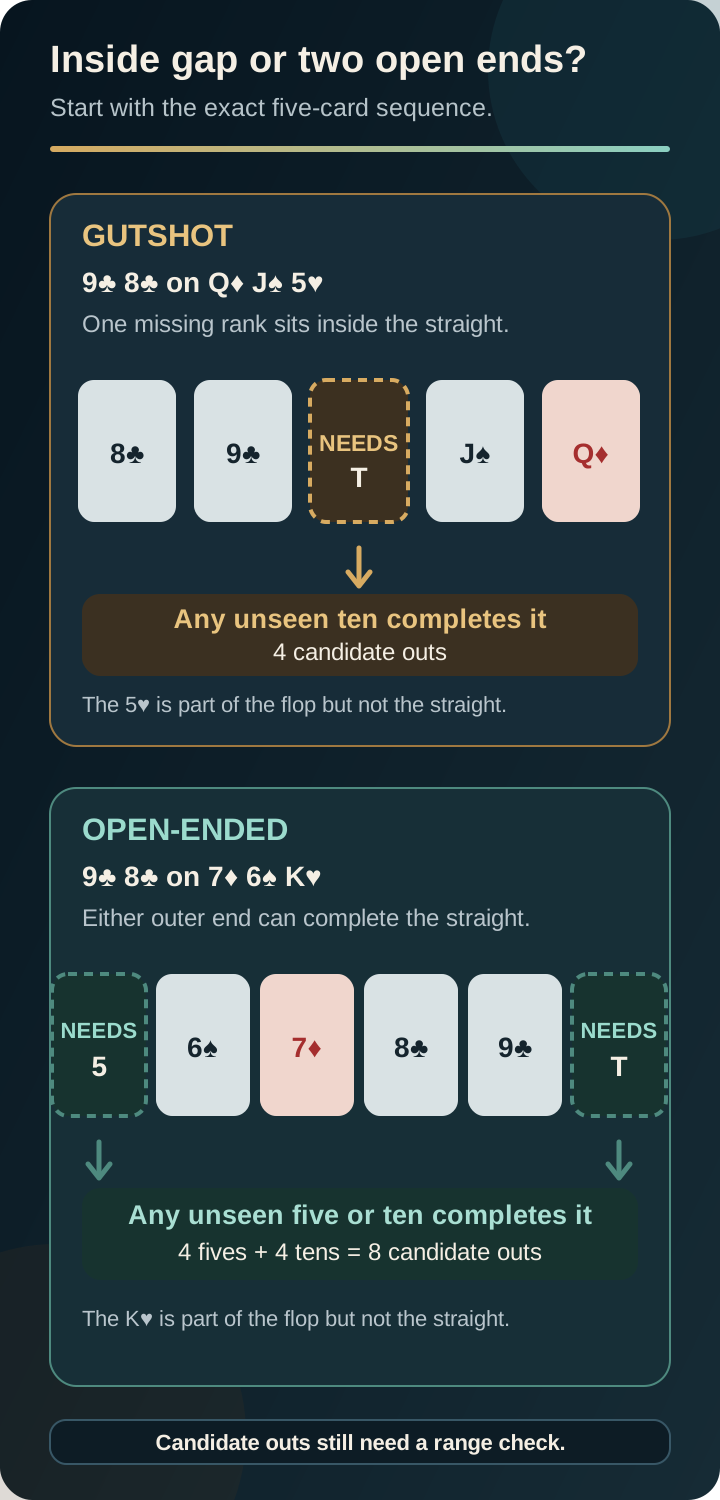
A gutshot has one missing rank inside a five-rank straight sequence. With 9♣ 8♣ on Q♦ J♠ 5♥, the relevant sequence is 8-9-T-J-Q. Only a ten fills the interior gap, so the four unseen tens begin as candidate outs.
An open-ended straight draw has four consecutive ranks with a possible completion rank on each side. With 9♣ 8♣ on 7♦ 6♠ K♥, the connected ranks are 6-7-8-9. Any five makes 5-6-7-8-9, while any ten makes 6-7-8-9-T. Four fives plus four tens produce eight candidate outs before range testing.
Both are direct draws because either can complete on the next community card. The label describes the structure of the missing rank or ranks. It does not say whether the draw is clean, whether the finished straight will win, or whether betting, calling, or checking has the highest expected value.
What does gutshot mean in poker?
A gutshot, also called an inside straight draw, needs a rank between the cards already available. The gap is internal rather than beyond the lowest or highest connected rank. In the 8-9-T-J-Q sequence, the ten sits between the nine and jack.
The name applies to the five-card pattern, not to one particular starting hand. Hole cards and board cards can supply different parts of the sequence. What matters is that exactly one rank inside the potential straight completes the named draw on the next card.
A basic gutshot has four candidate outs because four cards of the missing rank exist in the deck. Start with four, then subtract any copies already visible and question any copy that also completes a stronger holding for the opponent range.
What does open-ended straight draw mean in poker?
An open-ended straight draw contains four consecutive ranks and can be completed by the rank immediately below or immediately above them. A 6-7-8-9 sequence is open at the five end and the ten end, so both ranks can finish a five-card straight.
The ace creates an important boundary. A-2-3-4 can complete with a five, but there is no rank below an ace that wraps around to make another straight. J-Q-K-A can complete with a ten, but an ace cannot connect past the top of the rank order. Those shapes do not have two ordinary open ends.
An open-ended label still does not guarantee eight clean outs. Known cards can remove copies of an end rank, and a completion card can give part of the opponent range a higher straight, a flush, a full house, or a tie. Count the physical cards first, then test their quality.
How many outs does each straight draw have?
A standard gutshot starts with four candidate outs: the four cards of its one missing rank. A standard open-ended draw starts with eight: four cards from each of two completion ranks. These counts assume none of those cards is already known and no candidate has yet been discounted.
A double gutshot can also have eight candidate outs, but its shape is different. It has two separate interior gaps rather than one run of four consecutive ranks with open ends. Count its two completion ranks without relabeling it as open-ended; precise structure helps you see which later cards change each branch.
Candidate outs are not automatically clean outs. If a ten completes your queen-high straight but gives a plausible A-K holding Broadway, that ten improves your hand without putting it ahead of that branch. Mark it dirty or false for that branch instead of keeping an unexplained full count.
What are the odds of completing a gutshot or open-ended draw?
On the flop, your two hole cards and three community cards are known, leaving 47 unseen cards. A four-out gutshot completes on the next card with probability 4 divided by 47, or about 8.51%. An eight-out open-ended draw completes with probability 8 divided by 47, or about 17.02%.
To model seeing at least one original out by the river, calculate the chance of missing on both streets and subtract it from one. The gutshot model is 1 minus 43/47 times 42/46, or about 16.47%. The open-ended model is 1 minus 39/47 times 38/46, or about 31.45%.
The by-river calculation assumes the original outs remain available and clean. It also says nothing about whether the current payment buys both remaining cards. If another bet can arrive on the turn, the flop call may only buy the next card before a new decision.
How does a complete gutshot-versus-open-ended example work?
Imagine two separate flop reviews with a 12 BB pot and a 6 BB bet. Calling 6 BB creates a 24 BB final pot after the call, so the immediate price is 6 divided by 24, or 25%. Use that same price only to compare the draw structures; the different boards and ranges still need their own analysis.
In the gutshot example, 9♣ 8♣ on Q♦ J♠ 5♥ has four candidate tens and an 8.51% next-card arrival rate. In the open-ended example, 9♣ 8♣ on 7♦ 6♠ K♥ has four fives and four tens, for a 17.02% next-card arrival rate. Neither next-card number alone clears a 25% price.
That does not finish either decision. Full equity can include times the current hand is already ahead, ties, backdoor paths, and later winning cards. Implied value may help if a completed straight gets paid, while reverse implied odds can hurt if a completion card makes a higher straight or flush for a plausible holding. Rebuild those branches before grading the call.
Is an open-ended straight draw always stronger than a gutshot?
An open-ended draw usually has more candidate outs than a gutshot, so it usually completes more often over the same horizon. That is a useful starting comparison, not a complete ranking of the two hands.
Straight quality matters. A gutshot to the highest possible straight can have cleaner payoff potential than a low open-ended draw whose completion cards create higher straights for part of the opponent range. Suits matter too: an apparent straight out can simultaneously finish a flush.
Position, stack depth, showdown value, and fold equity can reverse the preferred action even when one draw has more outs. A hand that can check behind and realize its equity faces a different tree from a hand that may be raised out of the pot. Compare full lines rather than choosing the draw with the larger label count.
How should pot odds affect a straight-draw decision?
Start with the price of the call: amount to call divided by the pot after calling. Then compare that threshold with equity measured over the same decision horizon. Do not compare a next-card out probability with a by-river price, or a by-river arrival probability with a call that may face another bet first.
Outs are one input to equity, not a substitute for it. Test whether the candidate cards are clean against the betting range, whether your current hand sometimes wins unimproved, and whether ties or redraws change the outcome. Keep the assumptions visible so a precise percentage does not hide a vague range.
For a bet or raise, add fold equity separately. Name the better hands that can fold, the hands that continue, and the plan after a call or raise. A draw can be a useful semi-bluff candidate, but having four or eight outs does not by itself make aggression profitable.
What changes on the turn and river?
When a completion card arrives, rebuild the best five-card hand and the opponent range. Do not stop at the word straight. Ask which higher straights, flushes, sets, two pair, and redraws remain possible after the new card and prior action.
When the draw misses, the new card can still change its structure. A gutshot can gain a second completion rank, an open-ended draw can lose clean outs, or an unrelated suit can introduce a flush draw. Recount from the new street rather than carrying the flop label forward unchanged.
On the turn, six cards are known, so 46 remain unseen before the river. A clean four-out draw arrives 4/46 of the time, about 8.70%, while a clean eight-out draw arrives 8/46 of the time, about 17.39%. Use those turn numbers only after verifying that the same candidates still work.
Which gutshot and open-ended draw mistakes are most common?
The first mistake is counting the two visual sides of every four-card pattern as open ends. Ace boundaries do not wrap, and a separated sequence may contain an interior gap instead. Write the exact five-rank straight before naming the draw.
The second mistake is treating all four or eight candidates as clean without checking known cards and ranges. The third is double-counting a card that completes more than one draw. One physical card is one out even when it makes both a straight and a flush.
Players also use a by-river percentage as if the current call guarantees two cards, or judge the original count by the runout. Missing does not prove a call was wrong, and hitting does not prove an out was clean. Grade the assumptions at the decision before revealing what came next.
How should you review a straight draw after the hand?
First, pause at the decision and hide the result. Record the hole cards, board, positions, pot, amount to call, effective stack, and prior action. Second, write the exact straight sequence and label the missing rank or ranks before calculating anything.
Third, list the physical candidate cards and remove known copies. Fourth, test each candidate against the opponent range for higher hands, ties, and redraws. Fifth, calculate the next-card or by-river arrival probability that matches the action tree, then compare calling, checking, betting, and raising where those options are realistic.
Finish with one conditional lesson, such as: “When a flop call may face another turn bet, compare my draw with the next-card price before using a by-river percentage.” A narrow rule travels better than “always call open-ended draws” or “always fold gutshots.”
How can Tells Poker support a straight-draw review?
After the hand is complete, Tells Poker can save the spot through Guided Entry or Quick Capture with typed or spoken notes. Verify the cards, positions, stacks, and action instead of silently filling in a missing detail; the draw structure depends on the exact record.
Replay lets you move through the recorded streets and actions with the board, seats, total pot, and remaining stacks together. Pause before the draw decision, name the missing rank or ranks, and build the candidate-out list without letting the turn or river rewrite the earlier spot.
The Analysis tab can organize the key decision, spot math, range groups when available, street-by-street review, and an alternative line. Use it after the session as a structured second opinion, never as real-time assistance or perfect, definitive play. The useful conclusion remains tied to the range and facts you recorded.
Frequently asked questions
Is a gutshot the same as an inside straight draw?
Yes. Both terms describe a straight draw that needs one rank inside the five-card sequence. A basic example has four candidate outs before known cards and range quality are considered.
Does an open-ended straight draw always have eight outs?
It usually starts with eight candidate outs because two ranks can complete it, with four cards of each rank. Visible cards can remove copies, and some apparent outs may be dirty or false against the relevant range.
Can a double gutshot have eight outs?
Yes. A double gutshot can have two interior completion ranks and eight candidate outs, but it is not the same card structure as four consecutive ranks open on both ends.
Should you always call with an open-ended straight draw?
No. Compare the call price with range-based equity over the correct time horizon, then account for future bets, stack depth, position, dirty outs, implied value, and reverse implied odds.