
A tie in poker happens when two or more players have identical best five-card hands at showdown. In Texas Hold’em, each player may use any five cards from the two hole cards and five community cards. Unused cards do not break the tie. The eligible tied players divide the contested pot equally.
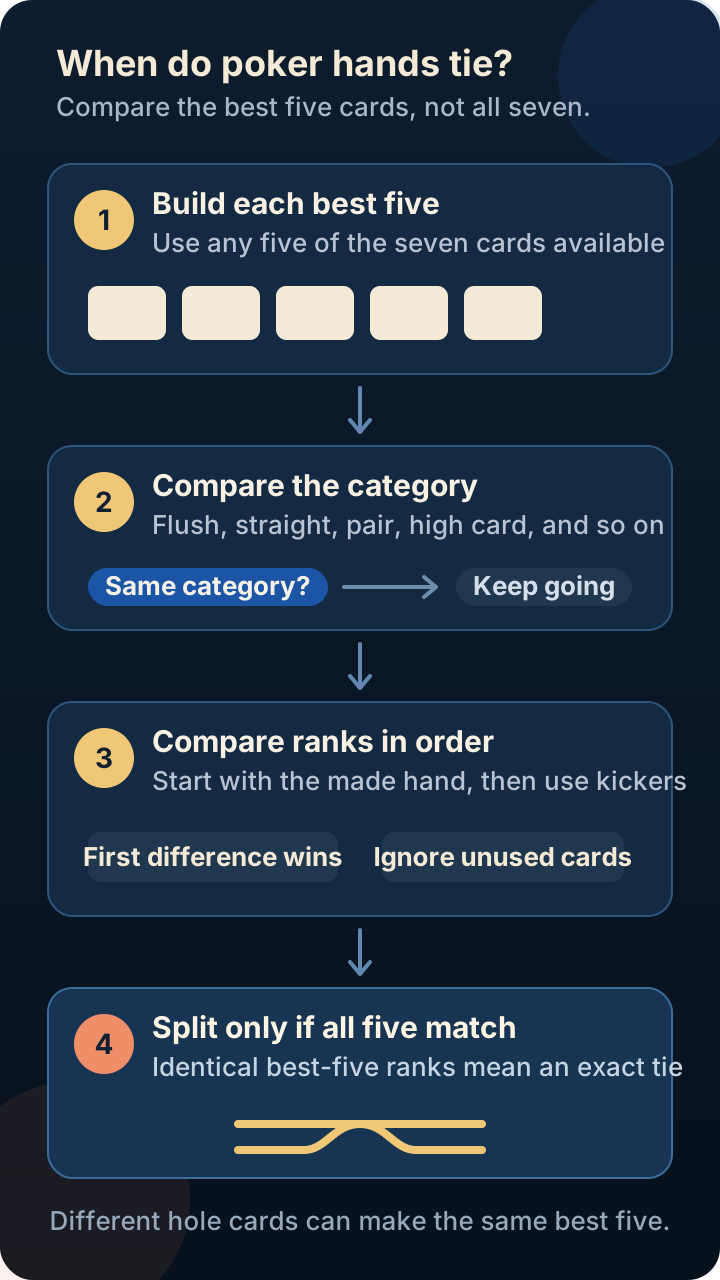
The reliable comparison is category first, then the ranks inside that category from highest to lowest. A higher category wins immediately. If the categories match, compare the made-hand ranks and then any kickers that belong to the best five. Stop at the first difference. If no difference exists, the hands tie.
Review the showdown only after the hand is complete. A split pot explains where the chips went, but it does not prove that every earlier check, bet, call, or raise was sound. Separate the mechanical hand comparison from the decision review so the result does not grade the line for you.
What happens when poker hands tie?
When eligible players tie, they share the pot they were both entitled to win. With two tied players in a 96 BB pot, each receives 48 BB. With three tied players in a 99 BB pot, each receives 33 BB. The arithmetic begins only after the winning best-five hands and pot eligibility are settled.
A tie is also called a chop or split pot. Those labels describe the result, not the action that produced it. Two players can reach a split after checking down, after large bets, or after an all-in. The size and emotion of the pot do not change the hand comparison.
If a physical pot cannot be divided evenly into the available chip units, the extra indivisible chip follows the game or venue procedure. Record that local procedure rather than inventing a universal rule. The underlying poker result is still an equal tie in hand value.
How do you compare two poker hands at showdown?
First build each player’s best five-card hand. Do not compare both hole cards automatically, and do not keep a sixth or seventh card as a spare kicker. Once the best five are fixed, compare the hand category. A straight beats three of a kind, a flush beats a straight, and every other category follows the ordinary hand-ranking order.
When the categories match, compare the defining ranks. For straights, compare the highest card in the straight. For four of a kind, compare the four matching cards and then the kicker. For full houses, compare the three-of-a-kind rank first and the pair rank second. For flushes and high-card hands, compare the highest card, then the next highest, until a difference appears.
For three of a kind, compare the trip rank and then the two kickers. For two pair, compare the higher pair, then the lower pair, then the kicker. For one pair, compare the pair rank and then the three kickers in order. If every rank in the five-card comparison matches, stop: the hands tie.
Can the board make every player tie?
Yes. The community cards can already form the strongest five-card hand available to every remaining player. If the board is ace, king, queen, jack, and ten with no possible higher category from a player’s hole cards, every eligible player can use the same ace-high straight from the board.
This is often described as the board playing. Hole cards can look very different and still be irrelevant. A pocket pair below the board and two unrelated low cards both disappear from the final five when the board itself supplies the best hand.
Do not assume the board always forces a tie just because it looks strong. A player may be able to improve the board with a flush, full house, higher straight, or better kicker structure. Build each best five before declaring that everyone chops.
How do kickers break a poker tie?
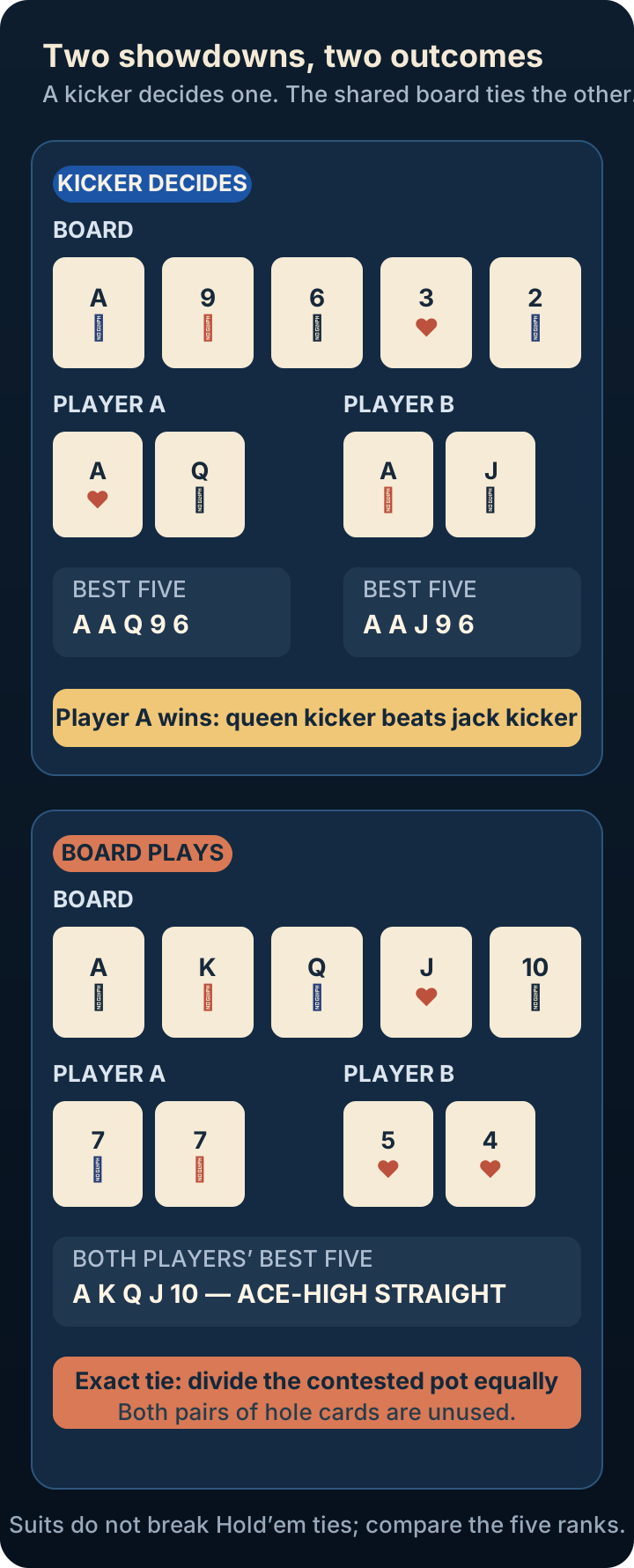
A kicker is an unpaired card in the best five that separates otherwise equal made hands. On an ace-nine-six-three-two board, ace-queen against ace-jack gives both players one pair of aces. The queen is the first differing kicker, so ace-queen wins. The lower board cards are compared only if the higher kickers also match.
Kickers do not always play. If the board is ace-ace-king-king-queen, a player holding a jack and a player holding a ten both use the board’s ace-ace-king-king-queen when neither hole card improves it. The queen on the board is already the fifth card, so the jack and ten are unused and cannot break the tie.
The phrase ‘my kicker is higher’ is therefore incomplete. Ask whether that card belongs to the final five. If both hands already use five stronger cards, the supposed kicker has no role in the showdown.
Do suits break ties in Texas Hold’em?
No. In Texas Hold’em, one suit does not outrank another at showdown. Spades do not beat hearts merely because of the suit symbol. Compare the category and card ranks inside the best five.
Flushes are compared by their card ranks from highest to lowest. An ace-high flush beats a king-high flush. If both players’ best flush contains the same five ranks, the hands tie; the suit itself supplies no extra tiebreaker.
Suits still matter because they determine whether a flush exists and which suited cards can be used. They simply do not create a separate ranking after the five-card hand has been built.
How is a split pot calculated?
Start with the contested pot, not with the stacks players had before the hand. Include matched wagers and any contributions left behind by folded players. Return uncalled excess first, because chips no opponent matched are not part of the pot being awarded.
Then identify the players eligible for that pot. If two eligible players tie for a 74 BB pot, each share is 74 divided by 2, or 37 BB. A folded player contributed chips but is not eligible to receive them. A player who was all-in for less may be eligible for the main pot but not for later side-pot wagering.
Keep hand value and pot division separate on the page. First write the best five for every eligible player. Second identify which pot each player can win. Third divide only the pots whose winners actually tie. This order prevents a clean hand comparison from being attached to the wrong chip pool.
How do side pots change a tie?
A main pot and each side pot are evaluated separately because they can have different eligible players. Suppose three players reach showdown, but one was all-in before the other two added more chips. The short stack can win or tie the main pot, yet cannot win the side pot created by wagers that player did not match.
The same player can therefore tie one pot and lose another. Two players might share the main pot because their best five match, while a deeper player wins the side pot outright against the only other player eligible for it. Do not divide the combined pile first and try to repair the shares afterward.
Reconstruct the contribution levels before comparing awards. If the original hand record does not preserve the all-in amounts, mark the side-pot division as uncertain. A confident payout built on guessed stack sizes is less useful than an honest incomplete record.
What do two complete showdown examples look like?
In the first constructed hand, the board is A♠ 9♦ 6♣ 3♥ 2♠. Player A holds A♥ Q♣ and Player B holds A♦ J♣. Both have one pair of aces. Player A’s best five is ace-ace-queen-nine-six; Player B’s is ace-ace-jack-nine-six. The queen is the first difference, so Player A wins.
In the second hand, the board is A♣ K♦ Q♠ J♥ 10♣. Player A holds 7♠ 7♦ and Player B holds 5♥ 4♥. Both players use all five board cards for the same ace-high straight. Neither pocket sevens nor five-four improves that straight, so the eligible players tie and divide the contested pot equally.
Notice that the second example does not compare pocket sevens with five-high. Those cards are visible, but they are not in either best five. The showdown is decided by the shared straight before the private cards can matter.
Which poker tie mistakes are most common?
The first mistake is comparing all seven available cards. Hold’em hands contain exactly five cards at showdown. A sixth card cannot break a tie, even when it is higher than the opponent’s unused sixth card.
The second is treating both hole cards as mandatory. Hold’em allows two, one, or zero hole cards in the best five. This differs from games with other construction rules, so confirm the game format before transferring the comparison method.
Other mistakes include using suit as a tiebreaker, forgetting that the board can play, splitting a side pot among players who were not eligible for it, and letting the payout answer an earlier strategy question. Fix the hand value, pot eligibility, and decision review as three separate tasks.
How should you review a tied or close showdown?
Write the five cards that play for each player before discussing the betting. If the hands tie, identify which visible cards were unused. If one player wins by a kicker, circle the first rank that differs. This makes the result mechanical instead of relying on a vague label such as ‘same pair.’
Next rebuild the pot and any side pots from the action. Confirm matched contributions, returned excess, folded players, and eligibility. Only after the payout is clear should you move backward to the decision you want to study.
For the strategic review, hide the opponent’s exact cards again and restore the range that was plausible at the time. Compare the check, bet, call, raise, or fold using information available before showdown. A tie is one outcome from the range, not proof that the earlier action was perfect or mistaken.
How can Tells Poker support a showdown review?
Once play has ended, save the record in Tells Poker and move to Replay. The current iOS replay keeps the board, hero cards, seats, action order, total pot, committed chips, and remaining stacks attached to each recorded step. Use that record to verify which five cards play and where each contribution entered the pot.
Pause before the decision that led to showdown and check the hand without the result first. If an all-in or side pot is involved, make sure the saved amounts match what happened before relying on the payout reconstruction. Correct an uncertain detail instead of forcing precision into the review.
Use the Analysis tab as a structured second opinion on the earlier decision, with recorded spot math and range reasoning where the hand supports them. It is post-session study, not perfect or definitive play. The best-five comparison remains a direct card exercise; the analysis helps examine how the hand reached that showdown.
Frequently asked questions
Can two flushes tie in poker?
Yes. If both players’ best five-card flush contains the same five ranks, the hands tie. Compare flush cards from highest to lowest; suit does not break the tie in Texas Hold’em.
Does a kicker always break a poker tie?
No. A kicker matters only when it belongs to the best five-card hand. If the board already supplies all five cards that play, higher unused hole cards do not break the tie.
Can a player tie the main pot but lose a side pot?
Yes. Each pot has its own eligible players and winner comparison. A player can share the main pot while another eligible player wins a side pot that the tied player could not contest.