
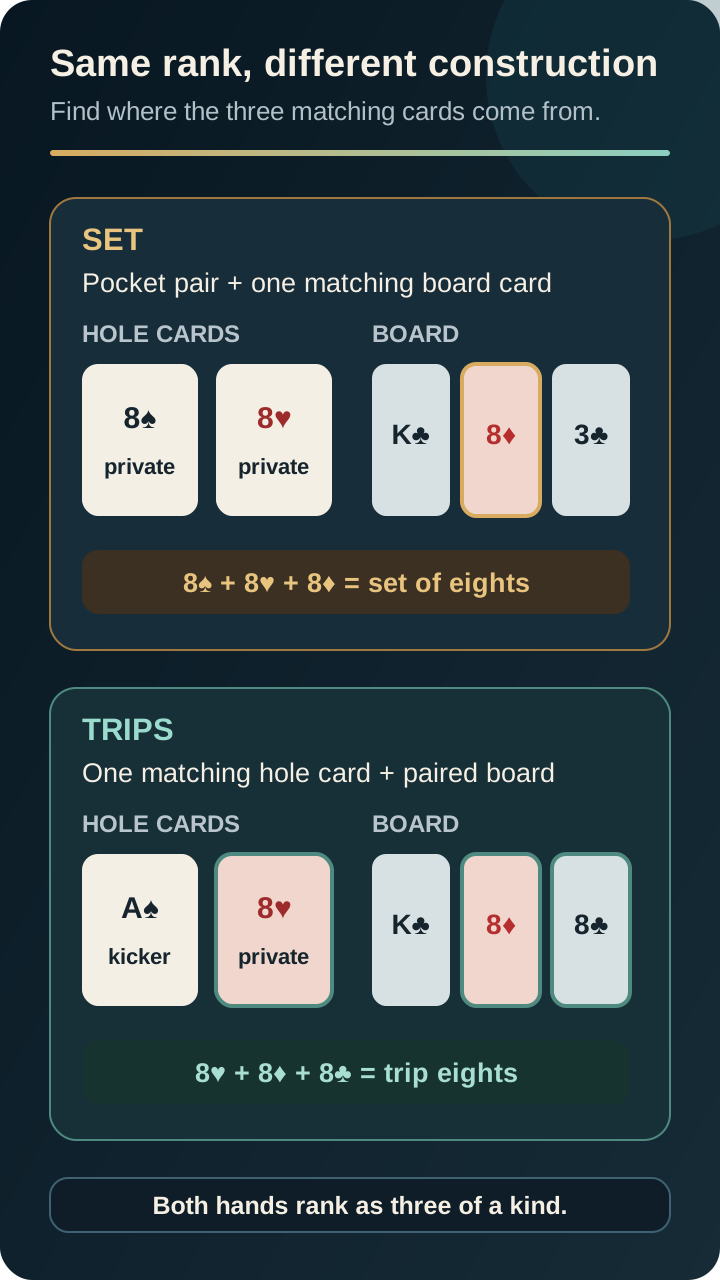
A set and trips are both three of a kind, but they are built differently. A set uses a pocket pair in your hand plus one matching card on the board. Trips uses one matching hole card plus a pair of that rank on the board. Neither name outranks the other; both are scored as three of a kind.
The distinction matters because the visible cards remove different holdings from the deck. With a set, your two hole cards use two of the four cards of that rank. With trips, the paired board is visible to everyone, another player may hold the remaining card of that rank, and kickers or full-house cards can decide the pot.
Review sets and trips only after the hand is complete. Rebuild the exact hole cards, board, action, and ranges before judging a bet or call. The label explains how the hand was formed; it does not prescribe one correct way to play it.
What is the difference between a set and trips in poker?
A set is three of a kind made with a pocket pair and one matching community card. If you hold 8♠ 8♥ and the flop is K♣ 8♦ 3♣, your two private eights combine with the 8♦ on the board to make a set of eights.
Trips is three of a kind made with one hole card and two matching community cards. If you hold A♠ 8♥ and the board is K♣ 8♦ 8♣, your 8♥ combines with the paired eights on the board to make trip eights.
The words describe construction, not separate places in the hand-ranking order. A set of eights and trip eights are both three of a kind. If two players reach showdown with three of a kind of the same rank, the best five-card hand and its kickers decide the winner.
Does a set beat trips?
No. A set does not automatically beat trips, and trips does not automatically beat a set. Poker compares the final five-card hands. First compare the rank of the three matching cards. If that rank is the same, compare the highest side card, then the second side card when needed.
Suppose the board is K♣ 8♦ 8♣ 5♠ Q♥. A player holding A♠ 8♥ has trip eights with ace and king kickers: 8-8-8-A-K. A player holding J♠ 8♠ also has trip eights, but the best side cards are king and queen from the board: 8-8-8-K-Q. The ace-eight hand wins because its first kicker is higher.
A full house or four of a kind beats any three of a kind. On that same paired board, K♦ 8♠ makes eights full of kings, while Q♠ Q♦ makes queens full of eights. Both hands beat trip eights. Always build the actual best five cards before comparing labels.
Why does the construction matter if both hands rank the same?
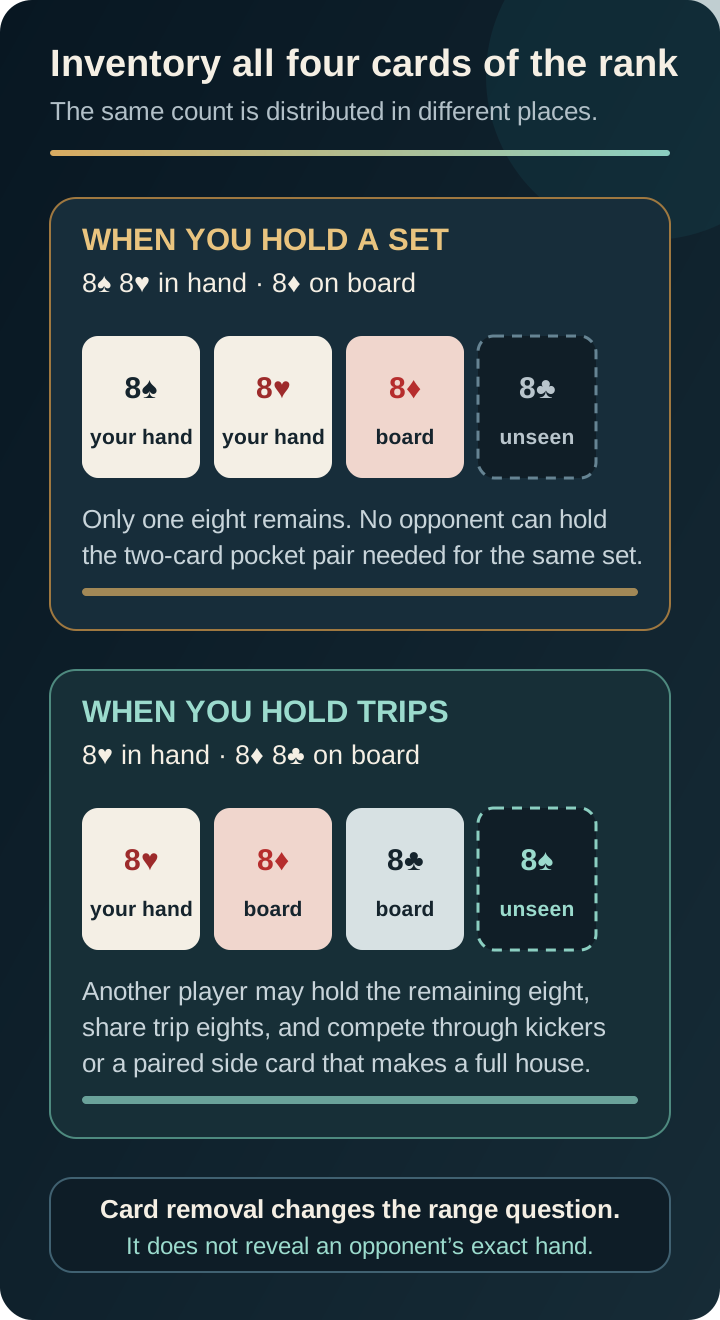
Construction changes card removal. When you hold a pocket pair and make a set, three of the four cards of that rank are already known: two in your hand and one on the board. Only one remains. No opponent can also hold two cards of that rank, so another player cannot have the same set.
When you make trips, two matching cards are on the board and you hold a third. One matching card remains. Another player can hold it and share the same three-of-a-kind rank. That makes kickers, side-card pairs, and full-house possibilities especially important on a paired board.
Construction also changes what the action can represent. A set requires a pocket pair that reached the street. Trips requires a hole card matching the paired board. Those starting groups can contain different numbers of combinations after positions, preflop action, blockers, and earlier decisions are considered.
How do you identify a set correctly?
Start with your hole cards. If they are a pocket pair, look for exactly one matching board card. Pocket sixes on A-K-6 make a set of sixes. Pocket queens on Q-9-4 make a set of queens.
Do not call every three of a kind a set. Holding QJ on Q-Q-4 is trips, because only one queen is in your hand and two are on the board. Holding no queen on Q-Q-Q means the board itself supplies three queens; your final hand may use board trips with two kickers, or a full house if your hole cards pair another board rank.
Update the label when the board changes the best five cards. A flopped set can become a full house when the board pairs another rank, or four of a kind when the last card of the set rank arrives. The earlier description remains useful history, but the current hand category has changed.
How do you identify trips correctly?
Look for a paired board and one hole card matching that pair. A♠ 8♥ on K♣ 8♦ 8♣ is trip eights. The ace is not part of the three matching cards, but it may become the highest kicker if no full house or straight replaces it in the best five.
A pocket pair on a paired board is not automatically trips. Pocket jacks on K-8-8 make two pair, eights and jacks, unless another jack is also on the board. The repeated board rank must match one of your hole cards for your hole card to complete trips.
More than one player can hold trips of the same rank because one copy of the paired rank remains after you account for the two board cards and your matching hole card. That possibility does not prove another player has it. It simply keeps same-rank trips inside the range you may need to review.
How do kickers work with trips?
When two players have the same three-of-a-kind rank, compare the two remaining cards in each best five-card hand. The highest kicker decides first. If those are tied, compare the next kicker. Hole cards do not receive special priority; use whichever available cards create the strongest five.
Return to K♣ 8♦ 8♣ 5♠ Q♥. A♠ 8♥ makes 8-8-8-A-K. J♠ 8♠ makes 8-8-8-K-Q because the king and queen on the board are stronger than the jack. The first hand wins with the ace kicker.
Kicker analysis stops if either player can make a full house or four of a kind. K♦ 8♠ does not merely have trip eights with a king kicker on this board; the second king creates 8-8-8-K-K, a full house. Build the category first, then compare within that category.
What ranges can contain sets and trips?
For a set, begin with the pocket pairs that could reach the street through the actual action. On K-8-3, pocket eights is the set. Pocket kings and pocket threes also make sets, but whether those combinations remain depends on positions, raises, calls, and blockers.
For trips on K-8-8, begin with the eight-x hands that could reach the board. Some may fold before the flop, some may raise, and some may call. Weight the specific suited and offsuit combinations instead of assuming every eight-x holding appears equally often.
Then add full houses and four of a kind separately. On K-8-8, pocket kings, pocket eights, and K8 can occupy stronger regions, subject to available cards and earlier action. A range review should preserve those branches rather than treating every hand containing an eight as the same strength.
How does the board change a set or trips on later streets?
A later board pair can improve a set to a full house. With 8♠ 8♥ on K♣ 8♦ 3♣, a river king gives you eights full of kings: 8-8-8-K-K. A river eight gives you four of a kind.
Trips can also improve. With A♠ 8♥ on K♣ 8♦ 8♣, an ace can produce eights full of aces because your ace pairs. A king can pair the board, allowing every eight-x hand to use eights full of kings. The exact hole cards then determine whether a different full house is available.
Not every board pair is equally helpful. A card can improve your category while improving an opponent’s plausible range even more. Rebuild the best five cards and both ranges after every street instead of carrying the flop label unchanged to the river.
What does a complete set-versus-trips review look like?
Compare two original river records. Hand A: you hold 8♠ 8♥ on K♣ 8♦ 3♣ 5♠ Q♥. You have a set of eights, and your best five cards are 8-8-8-K-Q. Hand B: you hold A♠ 8♥ on K♣ 8♦ 8♣ 5♠ Q♥. You have trip eights with ace and king kickers, 8-8-8-A-K.
The second hand has the stronger five-card holding in isolation because of the ace kicker, but that does not make trips generally stronger than a set. The boards and ranges are different. Hand A leaves no opponent able to hold the same set of eights. Hand B leaves one eight available, while K8 and pocket queens can make full houses on the paired board.
Review the decisions separately. Record which worse hands can call, which better hands can raise, and which draws or made hands reached each river. Do not transfer a bet size or calling rule from one construction to the other merely because both hands are called three of a kind.
Which set-versus-trips mistakes are most common?
The first mistake is saying a set always beats trips. The categories are equal; the trip rank, kickers, and any full house or quads determine the winner. The second is calling any three of a kind a set without checking whether the pocket pair supplied two matching cards.
Another mistake is ignoring the remaining card of the paired-board rank. When you hold trips, another player can sometimes hold that last card and share the trip rank. Their kicker or paired side card may matter. Possibility is not certainty, so keep the hand inside a range rather than guessing it exactly.
Finally, do not grade the action from the showdown alone. Seeing an opponent reveal a full house does not prove every earlier bet or call was wrong. Hide the result, rebuild the available combinations and response ranges, compare alternatives, then use the reveal to update the assumptions.
How should you review a set or trips after the hand?
Use five passes. First, write the exact hole cards and board. Second, build the best five-card hand and name its current category. Third, inventory the four cards of the trip rank so card removal stays visible. Fourth, build the opponent’s plausible sets, trips, full houses, draws, and weaker made hands from the action. Fifth, compare the actual choice with at least one alternative.
Save the lesson conditionally. “Always bet a set” and “slow down with trips” are too broad. A better note is: “On a paired board, count the remaining matching card, compare kicker and full-house branches, and identify which worse hands continue before choosing a size.”
If a card or action is uncertain, preserve that uncertainty. Review one version with the remembered detail and another without it. A transparent range of possibilities is more useful than a precise conclusion built on a reconstructed fact that may be wrong.
How can Tells Poker support a set-or-trips review?
After play has ended, capture the completed hand in Tells Poker with step-by-step entry, typed text, or voice. Open Replay and move through the saved action. Verify the hole cards, paired or unpaired board, pot growth, and remaining stacks before naming the hand category.
When available, Analysis can organize the key decision, deterministic spot numbers, conditional range reasoning, a street-by-street debrief, and an alternative line. Compare that structured second opinion with your own card inventory and range. It is not perfect or definitive play.
Tells Poker is for post-session review, not assistance during an active hand. The useful outcome is a faithful record and a clearer question: did the construction change which same-rank hands, kickers, and full houses were actually available?
Frequently asked questions
Are a set and trips both three of a kind?
Yes. Both rank as three of a kind. A set uses a pocket pair plus one matching board card; trips uses one matching hole card plus a pair on the board.
Does a set always beat trips?
No. Compare the final five-card hands. The higher trip rank wins; if the trip rank is the same, kickers decide unless a player can make a full house or four of a kind.
Can two players have the same trips?
Yes. With two matching cards on the board, two players can each hold one of the two remaining cards of that rank. Their best five-card kickers or full-house cards then decide the winner.
Can two players have the same set?
Not from separate pocket pairs of the same rank in a standard deck. One board card plus one player’s two matching hole cards leaves only one card of that rank, so no second player can also hold the required pocket pair.