

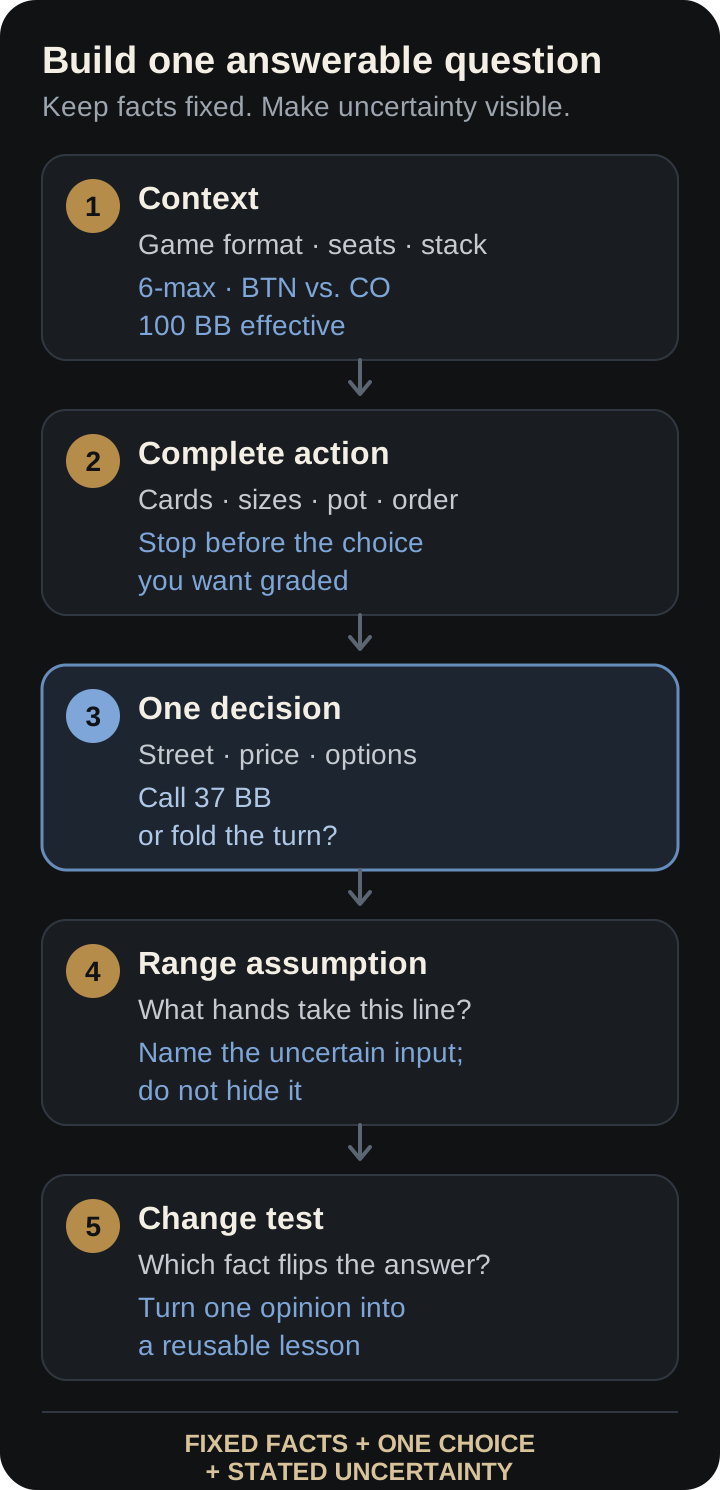
To ask for useful poker hand advice, share the complete context and action, stop at one decision, name the range assumption you are unsure about, and ask what fact would change the answer. Hide the result at first. A focused question gives other players the same decision you faced instead of asking them to judge a story shaped by the showdown.
The hand record and the question do different jobs. The record fixes the game format, positions, effective stack, cards, bet sizes, pot, and action order. The question identifies the exact choice you want to study. When either part is missing, replies often solve different hands without realizing it.
The goal is not to collect a quick verdict or let a vote replace your judgment. Ask for the reasoning behind a call, fold, bet, raise, or check; compare the assumptions inside each reply; and save one conditional lesson you can test in future completed hands.
What information should a poker hand question include?
Start with the facts that determine the decision: game format, number of players, positions, effective stack, hero's cards, board cards by street, and every relevant action with its size. Use big blinds when that makes the hand easier to compare, and state the pot at the decision if you can reconstruct it reliably.
Action order matters as much as the final amounts. A bet into the previous aggressor is a different branch from a continuation bet, and a call with players still behind is different from closing the action. Write the sequence so another player can pause at the same moment you did.
Include reads only when you actually had them during the hand. Label a read as an observation rather than a fact about hidden cards. If the opponent had shown several large river bluffs earlier, say that. If you learned something after the hand, keep it out of the first review pass.
How do you turn a hand history into one clear question?
Use five parts. First, set the context. Second, give the complete action through the decision. Third, name one choice and its price. Fourth, state the range assumption that makes you uncertain. Fifth, ask which change in that assumption would change the preferred action.
A broad prompt such as ‘How did I play this?’ invites replies about every street, every size, and the result. A narrower prompt such as ‘On the turn, should the button call 37 BB or fold against a reasonable cutoff check-raise range?’ gives the discussion a shared node.
The change test makes the answer portable. Asking which value hands or bluffs must be present before a call improves teaches more than a bare yes or no. You can carry that relationship into another hand even when the exact cards and opponent are different.
Why should you hide the result when asking for advice?
Hide the result because the cards shown later can pull the discussion toward hindsight. If everyone knows the opponent held a bluff, a close fold can suddenly look obviously wrong. If everyone sees the top of the value range, a reasonable call can look careless. Neither reaction rebuilds what was knowable at the decision.
Stop the first version of the hand before the choice and ask each person to commit to a range and action. Reveal the later street or showdown only after the reasoning is visible. The result can then test the story without becoming the story.
You do not need to hide whether the pot was won forever. Results are useful for checking the action record and discussing how the range actually appeared. They simply belong after the decision review, not before it.
What does a useful poker hand question look like?
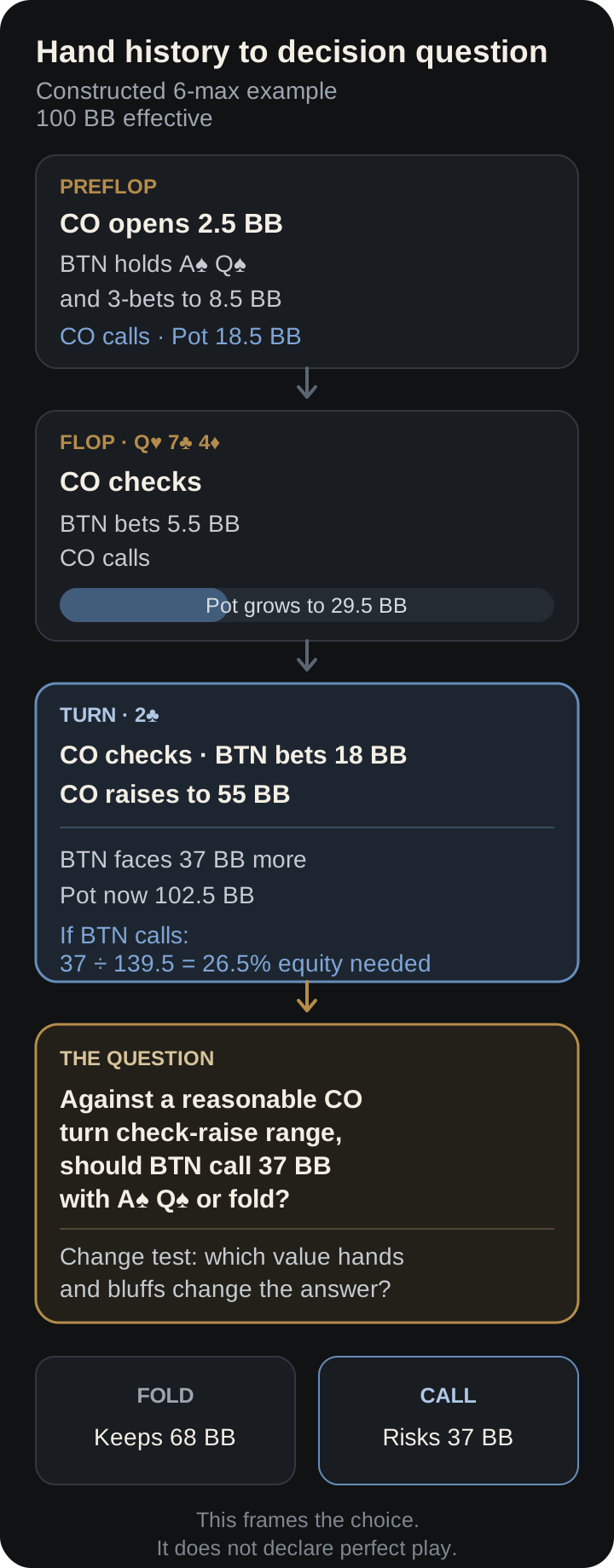
Consider a constructed six-handed cash-game hand with 100 BB effective stacks. The small blind posts 0.5 BB and the big blind posts 1 BB. The cutoff opens to 2.5 BB. The button holds ace-queen of spades and three-bets to 8.5 BB. Both blinds fold and the cutoff calls, making the pot 18.5 BB.
The flop is queen of hearts, seven of clubs, and four of diamonds. The cutoff checks, the button bets 5.5 BB, and the cutoff calls. The pot is now 29.5 BB. The turn is the two of clubs. The cutoff checks, the button bets 18 BB, and the cutoff check-raises to 55 BB total.
Before the button acts, the pot is 102.5 BB and the button must call 37 BB. Calling would create a final pot of 139.5 BB, so the direct equity threshold is 37 divided by 139.5, or about 26.5%. Folding preserves the button's remaining 68 BB. Those numbers establish the price; they do not establish the cutoff's range or the correct action.
A focused question is: against a reasonable cutoff turn check-raise range, should the button call 37 BB with ace-queen of spades or fold? Which value hands and bluffs must be present before the answer changes? That question keeps the arithmetic fixed and places the uncertainty where it belongs: the range that takes this line.
Should you include your own reasoning in the question?
Yes, but put your reasoning after the clean hand record. State what you were trying to accomplish, which hands you expected to continue, and where your uncertainty begins. This helps other players respond to your actual thought process instead of inventing one for you.
Avoid defending the decision before anyone answers. A paragraph explaining why a call had to be correct can turn the discussion into a debate about your conclusion. A better note is: ‘I thought the cutoff could raise strong one-pair hands and club draws, but I am not sure those hands reach this size.’
Ask responders to separate facts from assumptions too. ‘The call needs about 26.5% equity’ is arithmetic. ‘The cutoff has enough bluffs’ is a range claim. Keeping those statements separate makes disagreement easier to locate.
What should you do when a hand detail is missing?
Mark the detail as unknown instead of filling it with a convenient guess. An uncertain stack, suit, or raise size can change the price, available combinations, and future betting room. False precision creates a clean answer to the wrong hand.
If the missing detail is central, ask the question conditionally. For example: ‘If the raise was to 55 BB, the call needs about 26.5% equity; if it was larger, how would the threshold and continuing range change?’ A conditional answer preserves what can still be learned.
When several details are missing, use the hand to study a concept rather than grade the exact action. You might ask how turn check-raise ranges are usually constructed on this board, while clearly saying that the original decision cannot be settled from the record you have.
Which poker hand questions lead to the best discussion?
Decision questions work well because they expose a tradeoff: call or fold, bet or check, small size or large size, value raise or call. Range questions are useful when the action is clear but the opponent's plausible hands are not. Process questions help when you want to know how another player would organize the review.
Ask for a reason, not only an action. ‘What worse hands call?’ improves a value-bet discussion. ‘Which better hands fold?’ improves a bluff discussion. ‘What does this blocker remove?’ improves a close bluff-catching discussion. Each question reveals the bridge between the range and the choice.
Avoid asking for certainty the hand cannot support. Poker advice depends on ranges, position, price, stacks, and observations. A strong answer can be conditional and still be useful. The aim is a clearer decision model, not a promise that one line is perfect in every game.
How should you compare different answers from friends?
Do not count votes until you compare assumptions. Two friends may both say call while assigning completely different check-raise ranges. Another may say fold because they exclude the bluffs that the callers include. The disagreement is about the input, not merely the button they would press.
Rewrite each reply as a conditional statement. For example: call if the range includes enough club draws and overplayed one-pair hands; fold if the range is concentrated in sets and stronger made hands. Then ask which description is better supported by the action and the information available at the table.
A majority can still be wrong, and a single thoughtful reply can be more useful than several unexplained choices. Keep the answer whose assumptions are visible, internally consistent, and testable against future hands.
How can Tells Poker support a hand-advice question?
After the hand is complete, save it in Tells Poker and use Replay to verify the seats, cards, actions, committed chips, pot, and remaining stacks. Pause before the decision you want to discuss. Correcting the shared record first keeps friends from spending the conversation on avoidable reconstruction errors.
The current iOS app can create a share link or share image from a saved hand. Anyone with the link can open the shared hand, replay the action, and comment in Table Talk. The hand owner can also add a top-level decision poll built from an available decision in the recorded action, while replies can choose an option and discuss why.
Use the Analysis tab as a structured second opinion alongside the conversation. It can organize the key decision, deterministic spot math when the recorded hand supports it, range reasoning, an alternative line, and a what-if branch. It is post-session study, not perfect or definitive play and never real-time assistance.
What should you save after the discussion?
Save one conditional lesson, not the loudest verdict. A useful note might be: when facing a large turn check-raise after betting twice, calculate the price first, then test whether the raising range contains enough natural bluffs before continuing with one pair.
Also save the fact that would have changed the answer. That could be a different suit, a smaller effective stack, a player behind, a larger raise, or evidence that the opponent's range is narrower. Change tests are what make a lesson travel from one hand to another without becoming a rigid rule.
Return to the lesson when a similar completed hand appears. If it no longer fits, refine the condition instead of forcing the new hand into the old conclusion. Good collaborative study produces better questions over time, not a growing collection of absolute commands.
Frequently asked questions
Should you include the poker hand result when asking for advice?
Hide the result during the first review pass so the showdown does not shape the range or action in hindsight. Reveal it after people have stated their reasoning, then use it to check the record and discuss what actually appeared.
What is the most important part of a poker hand question?
The most important part is one precisely located decision supported by a complete action record. State the street, price, realistic options, and the range assumption you want to test.
Can you ask for poker advice when some details are missing?
Yes, if you label the missing details and ask conditionally. If the unknown information controls the decision, study the broader concept instead of pretending the exact action can be graded reliably.
Does a decision poll determine the correct poker play?
No. A poll shows which options people chose, but the useful part is the reasoning and range assumptions behind those choices. Treat the result as discussion input, not proof of perfect play.