

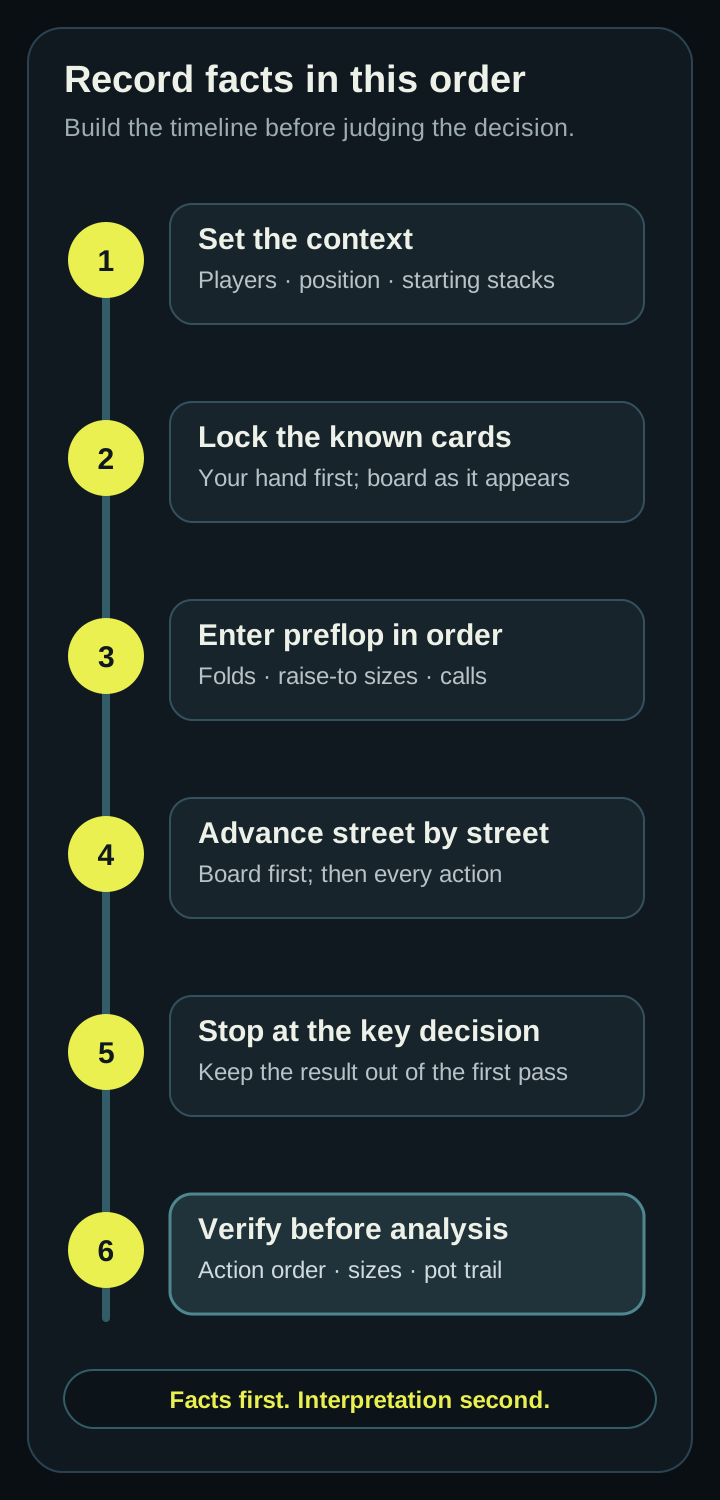
To record a poker hand step by step, start with the game context, player count, positions, and starting stacks. Add your hole cards, then enter every action in table order from preflop through the street that contains the decision. Write raises as total raise-to amounts, check the pot after each street, and keep the result out of the first review pass.
The goal is not to produce a dramatic story. It is to preserve a decision that another player—or your future self—can reconstruct without guessing. A useful record answers who acted, what options were available, how much went into the pot, which cards were known, and where the uncertainty begins.
Use this process after the hand is complete or during a post-session review, never as real-time assistance. If one detail is missing, mark it as unknown or approximate instead of silently inventing it. A visibly incomplete record can still support a careful discussion; a false exact detail can send the entire review in the wrong direction.
What should you record before the action?
Begin with the facts that shape every later decision: cash game or tournament, number of players, blind level or stakes, your position, and the starting stack for each player who matters to the hand. The effective stack may be enough for a heads-up spot, but separate seat stacks are safer when several players begin with different amounts.
Record your two hole cards exactly, including suits. Add known opponent cards only if they were actually shown. Community cards belong to the street on which they appeared, so a turn card should never be folded into a five-card board summary before the flop and turn action have been preserved.
Separate a known fact from an estimate. “Button started with about 80 BB” is more honest than “Button started with 82 BB” when the exact stack was never counted. The estimate can still frame the spot, while the label prevents later analysis from treating invented precision as evidence.
What order should you use to record a poker hand?
Use one stable order: context, known cards, preflop action, flop action, turn action, river action, then the decision and result. Within each street, follow the seats in their real action order. This makes a skipped player, impossible check, or missing response easier to notice.
On preflop, include folds when they establish who remained active or explain why the action reached a certain seat. On later streets, enter the board first, then each check, bet, call, raise, or fold. After a raise, continue until every active player has folded, called, raised again, or moved all in.
Stop the first pass at the decision you want to study. Verify the timeline and ask what the player knew at that moment. The showdown, opponent hand, and pot result can be attached afterward, but they should not repair or rewrite the earlier facts.
How should you write bet and raise sizes?
Write a bet as the amount wagered when no bet is already open on that street: “Button bets 4 BB.” Write a raise as the total amount after the raise: “Big blind raises to 14 BB.” The word “to” prevents a reader from adding 14 BB on top of the original bet.
Calls need the same clarity. “Button calls 10 more” describes the additional amount needed after already betting 4 BB. “Button calls to 14 total” describes the player’s total contribution on that street. If you write only “calls 10,” make sure the surrounding action leaves no doubt about whether 10 is the added amount or the total.
Big blinds are useful for review because they keep the action comparable across stakes, but convert consistently. In a $1/$2 game, a $10 open is 5 BB. Do not switch between dollars and big blinds halfway through the record unless both units are shown clearly.
For an all-in, preserve the amount if it is known and note which stack limits the confrontation. “Cutoff all in for 36 BB; button covers” is more useful than “cutoff shoves.” The size controls the call price, the remaining players’ options, and any side-pot structure.
What should you do when a hand detail is missing?
Mark the gap instead of filling it with the most familiar number. Useful labels include “about 60 BB effective,” “flop bet between one-third and one-half pot,” or “turn suit unknown.” The uncertainty now becomes part of the review rather than a hidden assumption.
Then ask whether the missing fact can change the conclusion. A forgotten river suit may matter greatly when a flush completes. A one-BB difference in a deep-stack preflop open may matter less. Review the stable branch first, then compare how the uncertain detail could move the decision.
If the action order itself is uncertain, reconstruct only as far as you can defend. It is better to study a verified flop decision than to attach a guessed turn and river. A partial hand with a clear stopping point is a legitimate record, not a failed one.
What does a complete step-by-step hand record look like?
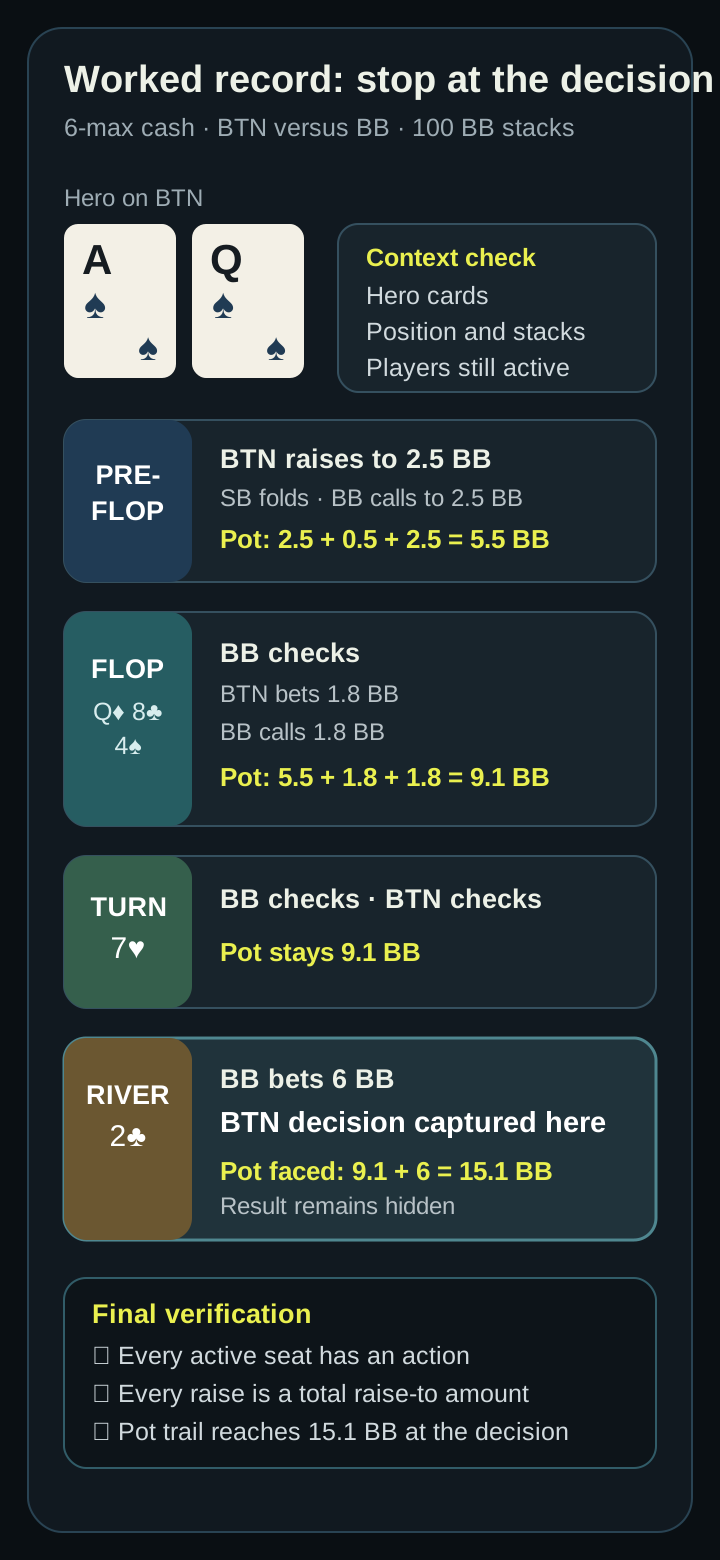
Consider a six-handed cash hand with every player starting 100 BB deep. Hero is on the button with A♠ Q♠. The under-the-gun player, hijack, and cutoff fold. Hero raises to 2.5 BB, the small blind folds, and the big blind calls.
Before rake, the flop pot is 5.5 BB: the button contributed 2.5 BB, the big blind contributed 2.5 BB in total, and the folded small blind left 0.5 BB. Writing the big blind’s action as a call to 2.5 BB keeps the posted blind from being counted twice.
The flop is Q♦ 8♣ 4♠. The big blind checks, hero bets 1.8 BB, and the big blind calls 1.8 BB. The two flop contributions add 3.6 BB, so the turn pot is 9.1 BB.
The turn is 7♥. The big blind checks and hero checks back. No chips enter the pot, so the river pot remains 9.1 BB. That unchanged total is a useful checkpoint: a larger number would reveal a missing or duplicated action.
The river is 2♣. The big blind bets 6 BB into 9.1 BB, and the record stops at hero’s decision. Hero is facing a 15.1 BB pot and would put 6 BB into a 21.1 BB final pot by calling. The raw call threshold is about 28.4% because 6 divided by 21.1 is approximately 0.284, but the actual review still needs a range estimate and blocker context.
The showdown is deliberately absent. The first review can now ask which value hands and bluffs reach the river, how the turn check changes both ranges, and whether calling, folding, or an unusual raise has the best case. Only after those branches are stated should the result be revealed.
Why should you stop at the decision before adding the result?
A result changes the story your mind wants to tell. If the opponent showed a bluff, a call can feel obvious; if the opponent showed a strong hand, the same call can feel careless. Neither reaction proves what the opponent’s full range looked like when the decision was made.
The first pass should use only information available at the decision: positions, stacks, cards, action, sizes, pot, and reasonable range assumptions. Grade the process before learning which single hand happened to appear at showdown.
The result still belongs in the permanent history. Add it after the decision-first review so you can examine execution, note a reveal that informs future assumptions, and remember how the hand ended without allowing one outcome to rewrite the original choice.
How do you verify a poker hand before analysis?
Read the hand once for action order. Every active seat must either act or already be out of the hand. A player cannot check while facing a bet, call when no bet exists, or act after folding. After a raise, earlier players may need another response before the street can close.
Read it again for amounts. Confirm that every raise is a raise-to total, every all-in has the intended amount, and no player contributes more than the stack available. In a multiway hand, check the effective stack separately for each confrontation rather than using one blanket number.
Finally, rebuild the pot. Start with blinds and antes, add each player’s contribution once, and carry the total to the next street. You do not need false precision around rake to catch most transcription mistakes; state whether the example is before rake, after a known rake amount, or approximate.
If the pot trail and action disagree, correct the record before asking for advice. Analysis built on a duplicated call or a mistaken raise size can be internally elegant and still answer the wrong hand.
When is Guided Entry better than Quick Capture?
Guided Entry is useful when structure is the hard part: several players saw the flop, stacks differed by seat, a raise reopened action, or you keep losing track of who responded. One prompt at a time makes the sequence visible and gives you natural checkpoints.
Quick Capture is useful when the sequence is already clear and speed matters. A plain-language typed or spoken account can preserve a completed hand without tapping through every seat. It still needs a fact check after parsing, especially around positions, suits, and whether a number meant a bet, a raise-to amount, or an additional call.
Choose the path that reduces your biggest error. Use speed when memory is fading but the story is coherent. Use structure when the story feels tangled. You can always correct the saved copy before requesting a deeper review.
How does Guided Entry work in Tells Poker?
In the current Tells Poker iOS app, open New hand and choose Guided Entry. The setup begins with a six-max, 100 BB assumption, then lets you choose from two to nine players, set your position and hole cards, use a common stack depth, or enter different starting stacks by seat.
The workflow moves through preflop, flop, turn, and river in table order. On postflop streets, you select the board before entering actions. It shows the running pot, can display a compact table view, and keeps raises and later responses attached to the correct street.
Guided Entry also blocks some internally impossible or incomplete sequences from advancing, such as checking while facing a bet, calling when there is nothing more to call, omitting an active player’s action, or entering a raise below the displayed minimum. Editing an earlier street clears later streets so the timeline does not preserve actions built on an old branch.
You can continue to the end of the hand or stop at the current decision, review the recorded streets, edit a mistake, and save. The saved hand opens with Replay, Table Talk, and Analysis tabs. Review the Replay first, then treat any generated Analysis as a structured second opinion rather than perfect or definitive play.
Which hand-entry mistakes create the most confusion?
The first mistake is recording only hero and the eventual opponent. Folds can explain position, dead money, action order, and why a later player had the chance to squeeze or overcall. Keep the folds that define the branch, even if you shorten routine action elsewhere.
The second is mixing starting stacks with stacks remaining at the decision. Starting stacks let the full pot be reconstructed; remaining stacks describe future room. Label both if both are used, and do not substitute one for the other.
The third is compressing a street into “bet-call” without naming who bet or how much. The sequence may feel obvious today and become ambiguous next month. Write the actor, action, and size whenever chips enter the pot.
The fourth is correcting the memory to match the showdown. A surprising hand at the end does not prove that an earlier remembered size or suit was different. Preserve the original uncertainty, then add the revealed cards as a separate fact.
How do you turn the record into a useful review?
After the facts pass verification, state one question. “Should button call 6 BB on the river?” is better than “Did I play this badly?” A narrow question identifies the decision, price, and seat without asking the reviewer to diagnose the entire session at once.
Build the opponent’s range street by street, compare realistic actions, and note which missing details could change the answer. If you use Tells Analysis, read its range assumptions and alternative line as a structured second opinion. If you share the hand with friends, ask them to decide before revealing the showdown.
Finish with one portable lesson, such as “write every raise as raise-to” or “check the pot before leaving each street.” The best hand record is not merely complete; it makes the next review faster, clearer, and easier to challenge.
Frequently asked questions
Do you need to record every fold in a poker hand?
Record the folds that establish action order, active players, position, or dead money. Routine folds can be shortened when they do not create ambiguity, but never remove a player whose action changes who can bet, call, or raise next.
Should a poker hand history use dollars or big blinds?
Either unit can work if it is used consistently. Big blinds make hands easier to compare across stakes. If you convert from dollars, state the blind size and check every amount with the same conversion.
Can you save a poker hand when the river or result is unknown?
Yes. Save the hand through the last verified street or key decision and mark later information as unknown. A clear partial record is safer than a complete-looking record built from guesses.
Does Guided Entry decide the correct poker action?
No. Guided Entry structures the completed hand and catches some sequence problems. Any later analysis is a structured second opinion based on the recorded facts and assumptions, not a guarantee of perfect play.