
To review a poker bluff after the hand, hide the result, reconstruct the decision, name the better hands you expected to fold, and calculate how often the bet needed to work. Then examine what happens when the bluff is called or raised, compare a check, and reveal the outcome only after grading the plan.
A bluff is not good because it worked or bad because it was called. The result shows one opponent response. The decision depends on the range that reached the spot, the size and price, the cards your hand blocks, the credible value hands you represent, and any future streets still available.
Keep the review educational and post-session focused. When ranges or reads are uncertain, test more than one plausible version and save a conditional lesson. Analysis can provide a structured second opinion, but it cannot turn an estimate into one perfect or definitive play.
What should a poker bluff review answer?
A useful bluff review answers five questions: what better hands were meant to fold, why your line could represent value, how often the size needed folds, what equity or escape routes remained when called, and whether checking had more value. Each answer should use information available at the decision.
Start with the bluff's purpose rather than its label. A bet with a weak hand may still receive calls from worse hands, while a strong draw can bet partly for folds and partly for its chance to improve. Classify the wager by the response it sought and by the branches it created.
The review is complete only when the losing branch is visible. If the plan ends at “they should fold,” it has not considered calls, raises, or later streets. A sound bluff can tolerate an unfavorable result because those responses were part of the decision before the bet was made.
Why should you hide the result first?
Hide the result because it changes how the earlier action feels. After a fold, an improvised bet can look inevitable. After a call, a coherent bluff can look reckless. Neither response reveals the opponent's entire range or proves how every plausible hand would have reacted.
Pause the hand immediately before the bet. Record the board, pot, effective stack, positions, action by street, and your exact cards. Write what you believed about the opponent before revealing a showdown. This recreates the decision instead of asking the result to explain it backward.
Reveal the outcome at the end and use it as one observation. A shown bluff-catcher may update which calls are plausible for this opponent. It does not prove that every similar hand calls, nor that the same bet against a different range has the same quality.
Which better hands was the bluff trying to fold?
Name the target in hand classes before judging the bluff. “Make them fold” is too vague. A river bluff might target one-pair tens, weak ace-x, or missed draws with slightly better high-card value. If you cannot identify better hands that reach the spot and release to the size, the bet lacks a clear win condition.
Then list the hands that continue. Separate likely calls from raises, even when the raise branch seems rare. A bluff can target enough thin bluff-catchers while accepting that two pair and sets continue. The goal is not to fold the opponent's whole range; it is to fold enough of the relevant better region.
Keep arrival logic attached to the list. A hand that could exist preflop may not call the flop and turn in the same way. Work street by street so the river target is made of hands that plausibly survived the earlier action rather than every holding imaginable.
How do you calculate the break-even fold rate?
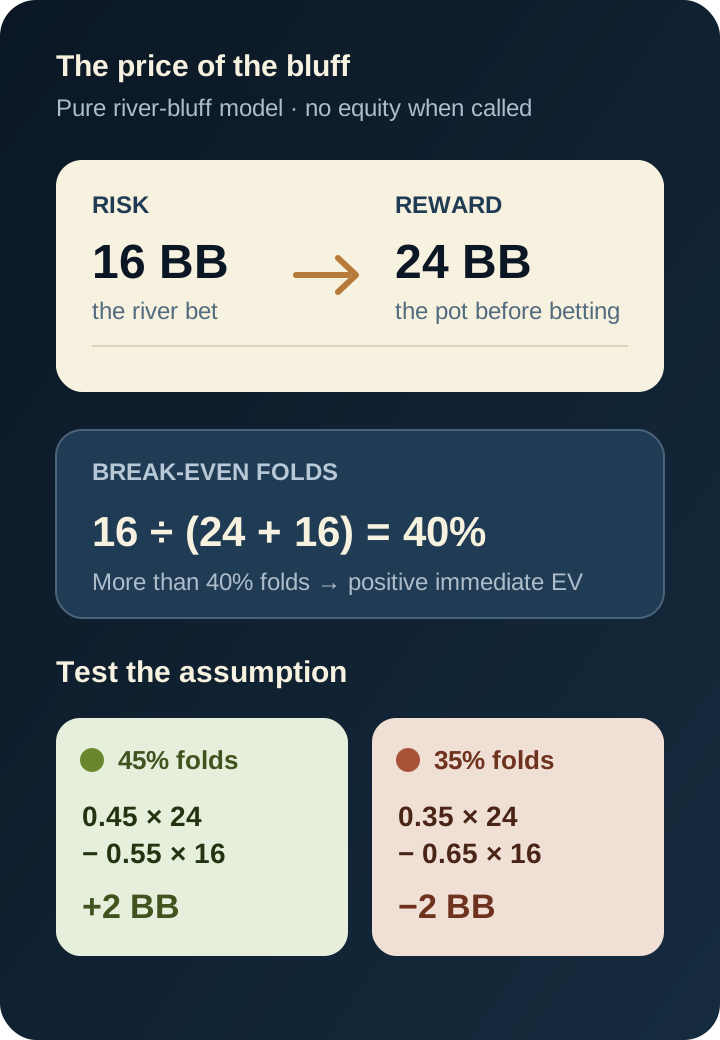
For a pure bluff with no chance to win when called, divide the bet by the pot plus the bet. Betting 16 BB into 24 BB risks 16 BB to win 24 BB. The break-even fold rate is 16 divided by 40, or 40%. Folds above that threshold create a positive immediate expectation under the simplified model.
The formula is a reference point, not a complete verdict. It assumes the bluff loses the bet whenever called, ignores raises, and ends the hand at this decision. Before the river, a called bluff may retain equity and face another choice. A river hand may occasionally beat a worse bluff-catcher at showdown.
Use scenario estimates rather than false precision. If your review model assigns a 45% fold rate, the simplified expected value is 0.45 times 24 minus 0.55 times 16, which equals plus 2 BB. At 35% folds, the same model gives 0.35 times 24 minus 0.65 times 16, or minus 2 BB. The assumption changes the answer; the arithmetic shows where.
What does a complete bluff review example look like?
Take a six-handed cash spot with both players starting 100 BB deep. Holding 9♣ 8♣, the cutoff opens to 2.5 BB and the big blind calls, so 5.5 BB reaches the flop. On T♣ 7♦ 2♠, the big blind checks, the cutoff bets 3.5 BB, and the call grows the pot to 12.5 BB.
The turn is A♥. After another check, the cutoff bets 5.75 BB and receives a call, bringing the river pot to 24 BB. The river is K♠. The big blind checks. The cutoff's nine-high has almost no showdown value and the straight draw missed, so a 16 BB river bet is considered as a bluff.
The review begins by asking which big-blind hands call twice and then fold. Some one-pair tens or sevens may dislike the ace-and-king runout. Strong ace-x, king-x that reached the river, two pair, sets, and slow-played hands may continue. The cutoff can represent strong ace-x, ace-king, sets, and other value hands that used the same three-street line, but that story matters only if those holdings plausibly take the earlier sizes.
The 16 BB bet needs 40% folds in the pure-bluff model. Whether the real estimate clears that threshold is uncertain: the high cards may favor the cutoff's represented range, while two calls may also concentrate the big blind around hands unwilling to fold. Compare the bet with checking and losing most showdowns. Save the conclusion conditionally: the bluff improves when enough one-pair bluff-catchers reach the river and release, and worsens when the double-call range is already strong or sticky.
How do blockers change a bluff review?
A blocker matters only through the combinations it removes. A bluff candidate can be more attractive when it removes likely calls or raises and leaves missed draws available for the opponent. It can be worse when it removes the folds you wanted to target or blocks the missed draws that would have folded anyway.
Do not stop at “I had a blocker.” Name the holding, count or compare the affected combinations, and decide whether the removed hands belonged mostly to the continuing or folding region. The direction matters more than the poker vocabulary.
In the example, 9♣ 8♣ has low showdown value and a natural missed-draw story, but those facts do not automatically make it the best river bluff. Compare it with other missed draws that remove stronger calls or preserve more folds. Candidate selection belongs after the target range is built.
How do future streets change the bluff?
Before the river, a bluff is part of a sequence. Record which turn or river cards support another bet, which cards create showdown value, and which opponent actions end the attempt. A flop bluff without a later plan can become an expensive habit when every call triggers another automatic bet.
Stack depth limits those branches. A turn bet that leaves only a small river wager creates a different response than one that preserves a large final bet. Position also changes what you learn before acting and whether checking can realize equity. Review the pot and remaining stack after every proposed action.
A semi-bluff deserves separate treatment because it can improve when called. Estimate the fold branch and the called branch rather than using only the pure-bluff threshold. If the draw misses, the later decision should be reviewed again with the new board and updated ranges.
How do you grade the plan separately from the execution?
Grade strategy and execution separately. Strategy asks whether the spot contained enough plausible targets, credible value, and suitable bluff candidates. Execution asks whether the chosen hand, size, and timing expressed that plan clearly. A reasonable bluffing spot can still contain a poor candidate or an inefficient size.
Compare at least one alternative. Checking may preserve showdown value or avoid attacking a strong range. A smaller bet may fold the same missed draws but fail against pairs. A larger bet may pressure more one-pair hands while requiring more folds. State which responses change between sizes instead of assuming a larger bet is always more convincing.
Finish with one portable cue, not a universal rule. For example: “Before river bluffing a missed draw, list the better one-pair hands that reach the river and fold to this size, then check whether my cards remove calls rather than folds.” That cue can be tested in the next completed hand.
What is a reliable post-session bluff review sequence?
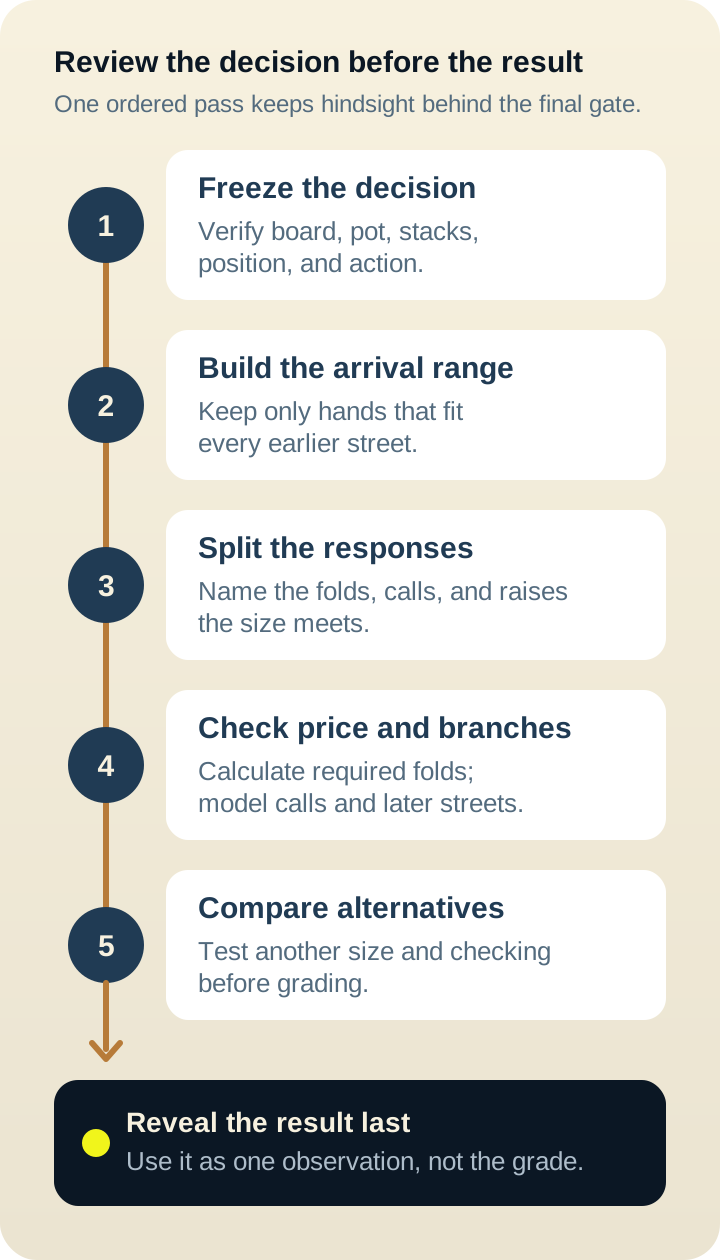
Use a fixed order so the showdown does not take over the review. First freeze the decision and verify the record. Second build the opponent's arrival range. Third split that range into folds, calls, and raises. Fourth check the size, required folds, and called branch. Fifth compare alternatives and reveal the result.
When one assumption is uncertain, branch it. Compare a wider arrival range with a tighter one, or a fold-heavy response with a call-heavy response. If the preferred action changes, the review has found the read that matters. Preserve that dependency instead of averaging it into an unexplained number.
The sequence also prevents double counting. A hand belongs in one response branch for the chosen model. If a holding sometimes calls and sometimes folds, assign a stated weight or run separate scenarios. Do not count the same combination as a full fold and a full call.
Which bluff-review mistakes are most common?
The most common mistake is grading the bluff by the fold or call. Others include naming no specific fold target, using a break-even formula without estimating the response range, and assuming a scary board card helps your story more than the opponent's range.
Another mistake is celebrating low showdown value without checking candidate quality. A hand can be unlikely to win by checking yet still block the opponent's folds, unblock strong calls, or lack useful future cards. “I had to bluff” often hides the comparison among several possible bluffing hands.
Finally, avoid turning one showdown into a permanent player label. Record the observed call and the exact context. Look for repeated, comparable decisions before treating the response as a stable tendency.
How can Tells Poker support a bluff review?
Open the completed hand in Tells Poker Replay and stop on the frame immediately before the bluff. As you scrub through the action, the street selector, seats, board, pot, remaining stacks, and committed wagers stay attached to the saved sequence. That checkpoint helps you write the fold target before seeing the response again.
When the saved hand supports them, the Analysis tab may surface exact spot calculations, conditional range groups, street grades and reasoning, plus another line to consider. Compare that debrief with your own fold-call-raise split. Tells is a post-session study aid rather than live assistance, and its analysis is a structured second opinion rather than a final ruling.
Frequently asked questions
Was a bluff bad if it got called?
Not necessarily. A call is one response from one holding. Review whether enough of the full plausible range would fold, whether the size was efficient, and whether the bluff candidate made sense before judging the decision.
How often does a half-pot bluff need to work?
A pure bluff of half the pot needs folds one-third of the time: 0.5 pot divided by 1.5 pot equals 33.3%. That simplified threshold ignores equity when called, raises, and future streets.
Should the weakest hand always become the bluff?
No. Low showdown value is useful, but blockers, available folds, future equity, and the value range being represented also matter. Compare candidates rather than selecting only by current hand strength.
Can Tells Poker tell me if a bluff was perfect?
No. Tells Poker can organize the completed hand, replay the action, show structured analysis and spot math when available, and offer an alternative line. Use it as a second opinion alongside explicit range and opponent assumptions.