

You can review a poker hand without seeing the opponent’s cards. Verify the facts you do know, pause at one decision, calculate the price, and replace the missing showdown with a range of hands that could have taken the recorded line. Then test how your decision changes as that range changes.
The goal is not to reconstruct one secret holding. It is to decide whether your action made sense against the plausible group of value hands, draws, weaker made hands, and bluffs available at that moment. A review can remain useful even when the opponent folded, mucked, or never showed.
Hidden hole cards and missing hand-history details are different problems. An opponent’s cards are normally unknown information, so range analysis is the correct response. A forgotten bet size, board card, position, or stack is missing evidence. Recover or mark those details before drawing a confident conclusion.
Can you analyze a poker hand without a showdown?
Yes. Poker decisions are made before you know the opponent’s exact cards, so a sound review should preserve that same uncertainty. Use the information available at the decision: positions, effective stacks, prior actions, board, pot, size faced, and your own cards. Those facts narrow the possible holdings without reducing them to one guess.
A showdown can test part of your model, but it is not the model itself. Seeing one bluff does not prove the opponent always bluffs that line. Seeing one strong hand does not remove the missed draws or thinner value hands that were also possible. The review asks what could reasonably arrive, not only what happened once.
This approach is especially useful after a fold. You may never learn whether the bet was value or a bluff, yet you can still calculate the call price, build a betting range, and identify which assumption would make the fold too tight or the call too loose.
What evidence do you need before building a range?
Start with the hand history, not a theory about the opponent. Confirm the game format, number of players, positions, effective stack, hero’s cards, board by street, action order, bet and raise-to amounts, pot at the decision, and amount required to continue.
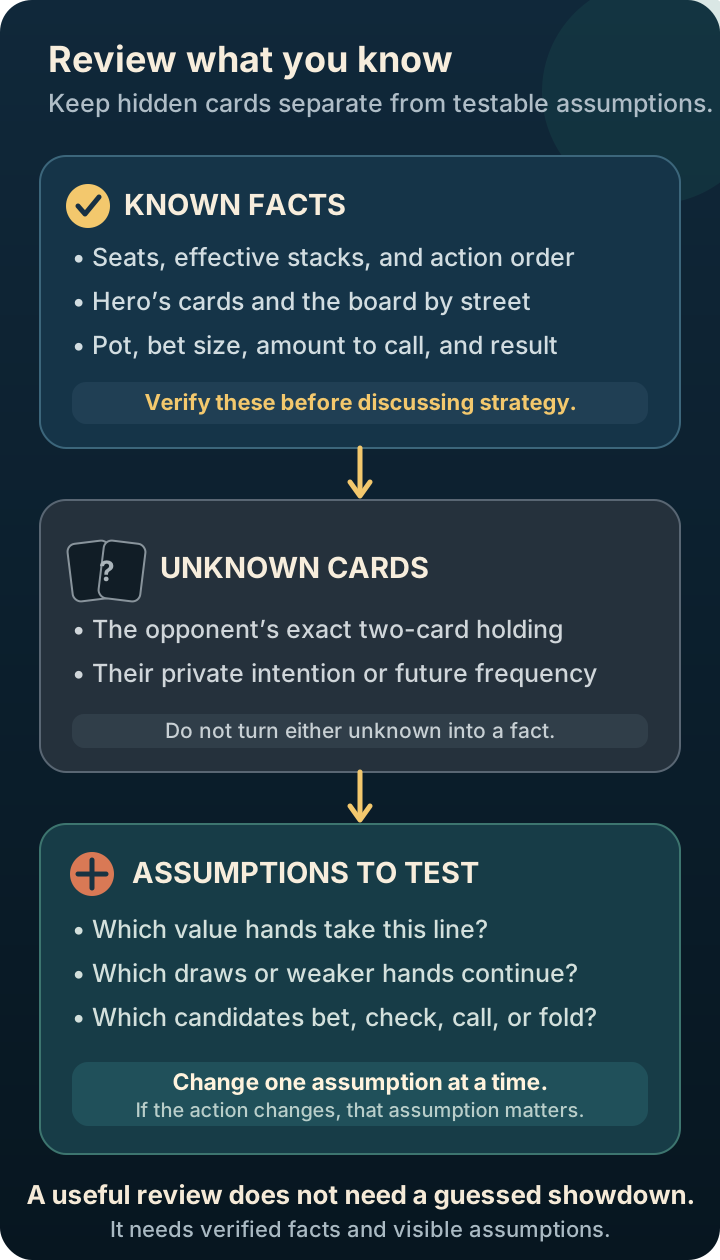
Separate those facts from observations. “The big blind called preflop” is a recorded action. “The big blind seemed frustrated” is an observation that may or may not deserve weight. “The big blind never bluffs” is a conclusion, not a fact. Keeping these categories separate stops a table impression from quietly rewriting the hand.
The opponent’s exact cards belong in the unknown column unless they were exposed. Their private intention is unknown too. What you can test is an assumption such as, “This river bet contains two pair or better plus missed draws.” That statement is useful because you can change either group and see whether your decision changes.
What is the difference between hidden cards and missing details?
Hidden cards are a normal part of the game. You are supposed to reason through them as a range. Missing details are facts that should have been recorded but were forgotten, such as whether the river completed a flush, whether the bet was 20 BB or 50 BB, or which player covered the other.
Do not “solve” missing details by choosing the version that makes your play look best. Mark the uncertainty and review more than one branch. If the bet may have been between 20 and 25 BB, calculate both prices. If a suit is uncertain, compare the board with and without the possible flush. A conclusion that survives both versions is stronger than a precise answer built on an invented detail.
Some missing facts prevent a narrow conclusion. If you cannot recover the amount to call, you cannot calculate exact pot odds. You can still discuss range shape or position, but the price-sensitive part of the review should remain open.
Why should you use a range instead of guessing one hand?
A range keeps every plausible holding visible. Position and preflop action create a starting set. Each check, bet, call, and raise then changes the weight of different parts of that set. Board cards and your hole cards remove impossible combinations. The remaining model may include strong value, thin value, medium hands, draws, and bluffs.
Guessing one hand produces a fragile review. If you decide the opponent “had a flush,” folding looks obvious. If you decide they “had a missed draw,” calling looks obvious. Both stories use the same unknown to prove opposite conclusions.
A range also makes disagreement productive. One friend can argue that a certain value hand rarely bets; another can argue that an extra missed draw bluffs. Those are assumptions you can compare. “They had it” and “they were bluffing” are competing stories with nothing to test.
How do you review the hand step by step?
Use six passes. First, verify the seats, stacks, cards, action, pot, and amount to call. Second, freeze one decision and hide later action. Third, calculate the price; for a call, divide the call by the final pot after calling. Fourth, build the arrival range from position and action, then remove card conflicts. Fifth, divide the range into hands you beat, hands that beat you, ties, and live draws. Sixth, change one uncertain group at a time and note when the preferred action changes.
Keep the price separate from your equity estimate. Pot odds come from recorded amounts. Equity comes from the range you chose. A clean calculation can still support a weak conclusion when the range assumption is unrealistic, and a plausible range cannot repair a pot that was reconstructed incorrectly.
The output should be conditional. For example: “Calling works if at least three missed-draw combinations bet alongside these eight value combinations; if only one bluff arrives, fold.” That lesson is more portable than a verdict tied to one unseen hand.
What does a complete river example look like?
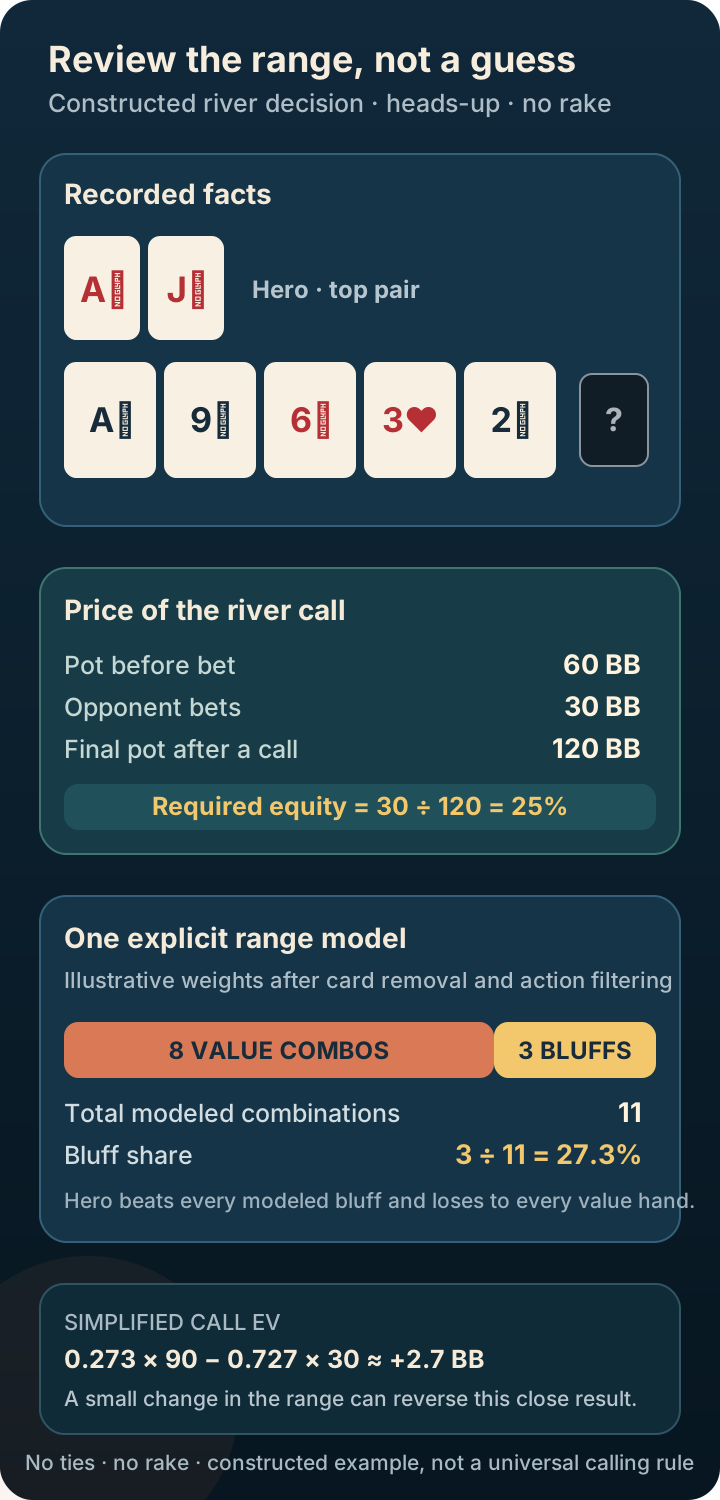
Consider a constructed heads-up river decision. Hero holds ace-jack on an ace-nine-six-three-two board. The verified earlier action has produced a 60 BB pot. The opponent bets 30 BB, and their hole cards are not shown.
Calling 30 BB would create a 120 BB final pot, so the call needs 30 divided by 120, or 25 percent equity, before any rake. That is the price. It does not say how much equity ace-jack has; the range model answers that separate question.
After using the positions, earlier actions, board, and card removal, suppose one illustrative model contains eight weighted value combinations that beat ace-jack and three missed-draw bluffs that ace-jack beats. The bluff share is 3 divided by 11, or about 27.3 percent. In a simplified river model with no ties, the call has an estimated value of 0.273 × 90 BB minus 0.727 × 30 BB, or about +2.7 BB.
That small positive estimate is not a universal calling rule. Remove one bluff and the model becomes two bluffs among ten total combinations, or 20 percent, below the 25 percent price. Add plausible thin value and the call also weakens. The useful lesson is the boundary: this close call depends on whether at least three bluff combinations reach the bet in the model.
What should you do if the opponent’s cards are revealed later?
Reveal the hand only after grading the decision. First save your range and preferred action using the information available at the time. Then compare the exposed cards with that model.
If the hand was inside your range, the reveal confirms that the model allowed that branch; it does not prove the frequency or the final action. If the hand was outside your range, ask why. Perhaps you removed a holding too early, misunderstood the preflop action, or learned that this opponent uses a line you had not considered.
Do not rebuild the whole range around one reveal. Add the observation to a larger set of comparable hands and look for repetition. One unusual showdown is a clue, not a permanent profile.
Which decisions can you review without knowing the cards?
Almost every completed-hand decision can be reviewed with a range. A river bluff-catch compares the call price with the value-to-bluff mix. A turn call compares current equity, future cards, and the next-street plan. A value bet asks which worse hands can call. A bluff asks which better hands can fold. A preflop raise compares the ranges that continue, fold, or re-raise.
The model becomes less exact when more cards remain because future equity and future actions matter. That does not make the review useless. It means the branches need more than a simple river value-versus-bluff count.
Multiway pots require a separate range for every active opponent. Do not merge two unknown players into one imaginary holding. Each position, stack, and action creates a different set of hands, and players still to act can change the value of continuing.
Which no-showdown review mistakes are most common?
The first mistake is treating the opponent’s final hand as the only hand that matters. The second is inventing exact cards when no showdown occurred. Both replace decision analysis with a story.
Another mistake is mixing facts and assumptions. A precise combo count does not help if the pot or bet size is wrong. A correct pot-odds calculation does not prove a call if the modeled range contains too few hands you beat. Verify the record, calculate the price, and estimate the range as three separate jobs.
Players also let the result leak backward. Winning after a call does not make the range model sound, and folding before the opponent shows does not make the hand impossible to review. Grade the choice before revealing later information.
Finally, avoid false certainty. Ranges are estimates. Use weights when some holdings are more likely than others, show which assumption drives the result, and keep close decisions close.
How can Tells Poker support a no-showdown review?
After the hand is complete, save the known cards, positions, stacks, and full action in Tells Poker. Open Replay and step to the decision to verify the board, pot, wagers, folds, and remaining stacks before discussing what the opponent may hold.
When supported by the saved hand, the Analysis view can show calculated decision numbers such as the price of a call, alongside an estimated opponent range and street-by-street reasoning. Keep the labels in mind: pot odds come from the recorded amounts, while a range and equity against that range remain estimates.
Treat the analysis as a structured second opinion, not a perfect or definitive play. Use Tells only after play is complete; the app supports post-session study rather than live assistance. The strongest output is a clearer conditional question you can revisit or share: which plausible hands reach this decision, and what range change would alter the action?
Frequently asked questions
Can you analyze a poker hand if the opponent mucked?
Yes. Use the recorded action and board to build a plausible range, calculate the decision price, and test how many hands in that range you beat. The mucked cards remain unknown rather than becoming a guessed fact.
Should you try to guess the opponent’s exact hand?
No. An exact guess makes the conclusion depend on one unsupported story. Build a range of holdings that fit the position, cards, and action, then vary the uncertain groups.
Does seeing the opponent’s cards prove the decision was correct?
No. A showdown is one realized branch. Grade the decision against the range you could reasonably assign before seeing the cards, then use the reveal to check whether your model omitted a plausible holding.
Can Tells Poker know an opponent’s hidden cards?
No. Tells uses the completed hand information you record. Exact decision math can come from the pot and wager amounts, while opponent ranges and equity against them are estimates to examine as a structured second opinion.