

A capped range in poker is a range that contains few or none of the strongest hands available in the current spot. The range has a ceiling because many top hands would usually have taken a different action earlier, such as raising instead of calling or betting instead of checking.
Capped does not mean weak, empty, or unable to call. A capped range can still contain strong one-pair hands, two pair, draws, bluff catchers, and occasional slowplays. Most real poker ranges are softly capped: the strongest region is less dense, not proven impossible.
Review a possible range cap only after the hand is complete. Rebuild the action, name the hands that may have left through another branch, keep mixed strategies and slowplays visible, and check whether the next board card created new strong hands. Then compare realistic sizes and responses instead of assuming that a capped opponent must fold.
What does capped range mean in poker?
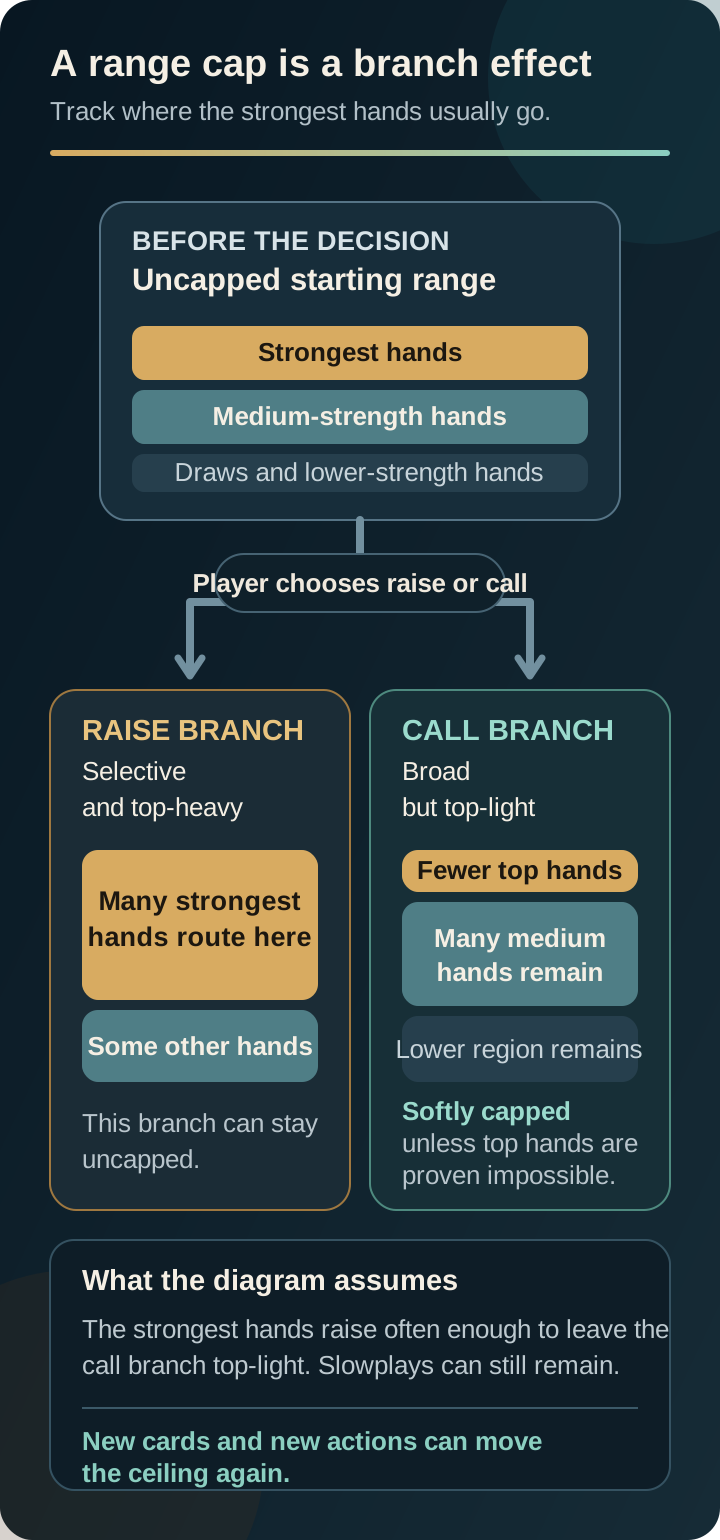
A range is capped when its action history makes the top of the possible hand distribution unusually thin or absent. Imagine a player who calls in a spot where that player's strongest hands would often re-raise. The call can preserve many medium-strength hands while sending much of the strongest region into the raise branch.
The cap belongs to a range at one moment, not to a person for the whole hand. A player may have a capped preflop calling range but reach an uncapped turn after the board creates new straights, flushes, sets, or two pair. Every new action and board card can move the ceiling.
Use the term as a hypothesis. You are estimating which hands remain after a sequence. Unless the strategy is known to take one action every time, the strongest holdings may be unlikely rather than impossible.
How is a capped range different from a weak, narrow, or polarized range?
A weak range contains many low-strength hands. A capped range can still be quite strong; it may hold many top-pair and overpair combinations while lacking the nuts. Strength describes what is present across the range. A cap describes what is missing or scarce at the very top.
A narrow range contains relatively few hand classes or combinations. It may be narrow and uncapped if those few hands include the nuts. A wide range may be capped if it contains many hands but few of the strongest ones.
A polarized range is concentrated around very strong hands and bluffs, with fewer medium-strength hands. That is almost the reverse shape of a classic capped calling range, which can be rich in medium-strength hands but thin at the top. The two labels answer different questions and should not be used interchangeably.
How does a poker range become capped?
A range becomes capped when the action tree routes many top hands elsewhere. If a player frequently four-bets the strongest preflop hands, the call-versus-three-bet branch may contain fewer premium pairs. If a player frequently check-raises sets on a dynamic flop, a later call branch may contain fewer sets.
Checking can also cap a range, but not automatically. A player may check strong hands for protection of the checking range, to induce a bet, or because the board favors the other player's range. You need a reason that the strongest hands prefer another branch before the check says anything useful about the ceiling.
Bet size can matter too. A small bet may be built from a wide range that includes strong hands, while a large bet may be more selective. But size alone never proves a cap. Positions, prior action, board texture, stack depth, and the player's likely strategy all belong in the inference.
What is the difference between a hard cap and a soft cap?
A hard cap means a stronger hand class cannot exist under the model. For example, if a toy strategy always raises every set on the flop, its flop-calling range contains no sets. This kind of certainty usually comes from a defined strategy assumption, not from ordinary live observation.
A soft cap means the strongest hands are possible but less common. A player may raise most sets and slowplay some. The call branch is then set-light rather than set-free. Soft caps are the safer default because poker strategies mix actions and players vary their choices.
Write the distinction into the review. “No sets” is a much stronger claim than “fewer sets because many raise earlier.” If the decision depends on the first statement being perfectly true, test what happens when even a few slowplays return to the range.
What does a simple capped-range action sequence look like?
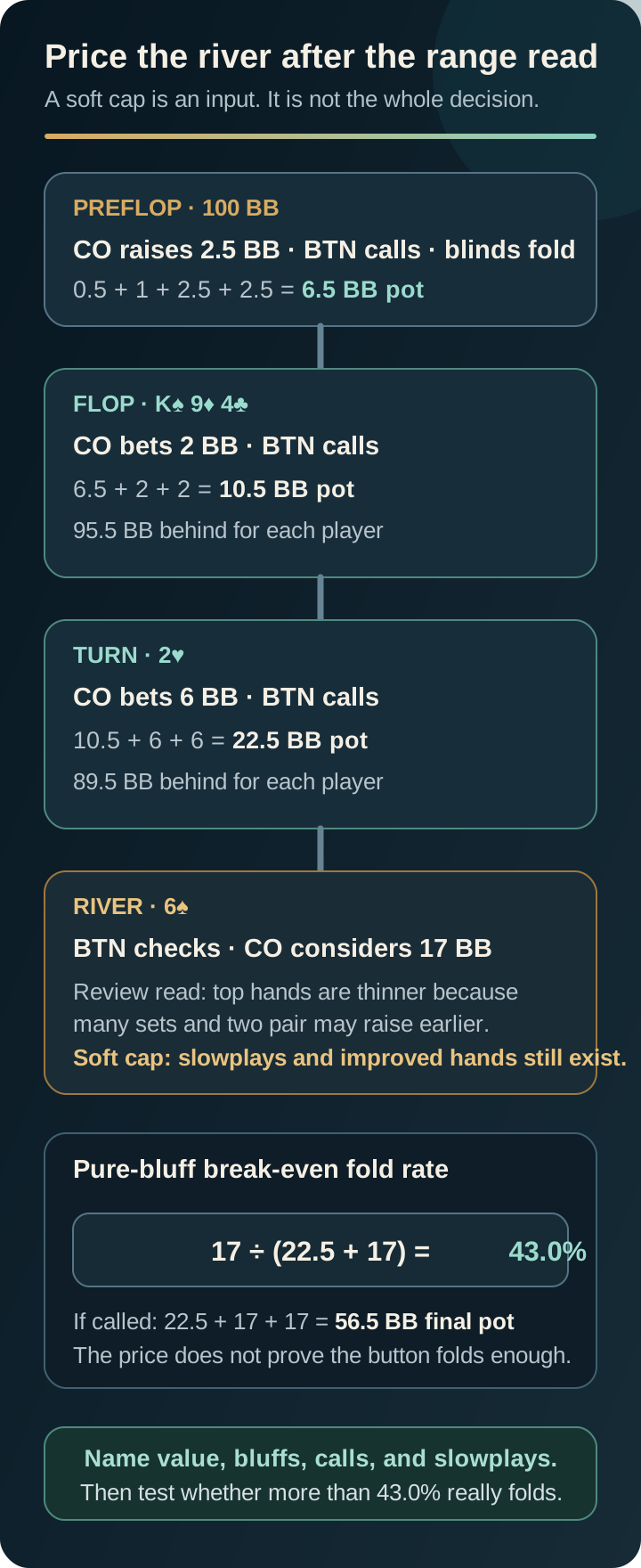
Consider a six-handed cash game at 100 big blinds. The cutoff opens to 2.5 BB, the button calls, and both blinds fold. The flop pot is 6.5 BB, and both active players have 97.5 BB behind.
The flop is K♠ 9♦ 4♣. The cutoff bets 2 BB and the button calls. For this review exercise, assume the button would raise every set and two pair on this flop. Under that exact assumption, the button's call branch is hard-capped below two pair immediately after the call. It can still contain kings, nines, pocket pairs, straight draws, backdoor draws, and floats.
Change the assumption and the conclusion changes. If the button sometimes slowplays 99, 44, or K9 suited, the range is only softly capped. The same call is observed, but the model now preserves a few top hands. That sensitivity is the lesson: the action supports a range estimate, not certainty about hidden cards.
Can the board remove or change a range cap?
Yes. A new card can create strong hands inside a range that previously lacked them. A turn card can complete a straight, make two pair, or give a pocket pair a set. The old ceiling described the prior board and cannot simply be carried forward.
Return to the K♠ 9♦ 4♣ flop. If the button's call branch contains QJ, QT, and JT, a ten on the turn changes which straights and draws are available. If it contains 98 suited, an eight can make two pair. The exact range must be re-sorted on the new board before anyone claims the cap remains.
Actions on the new street matter as much as the card. A player who was capped after a flop call may lead a turn that strongly filters the range again. Track the sequence one street at a time rather than carrying a permanent label from preflop to river.
How should you play against a capped range?
Start by identifying the value hands that can bet and still be called by worse. A thinner top end may let you value bet hands that would check against an uncapped range. It may also support a larger size with a polarized range when you hold hands above the opponent's likely ceiling and have credible bluffs to pair with them.
Do not jump from “capped” to “overbet every hand.” The opponent's range can contain many bluff catchers that call, and your own range needs enough strong hands to support pressure. Board coverage, blockers, effective stack, position, and response to a raise still matter.
Compare several sizes instead of treating aggression as the conclusion. A smaller bet may receive calls from more second-best hands. A larger bet may win more with the top of your range but isolate you against stronger continues. The useful question is which worse hands call and which better hands fold at each size.
How should you defend when your own range is capped?
A capped range does not have to surrender. Keep the strongest remaining hands, the best bluff catchers, and any credible raises visible. Your response should depend on the price, the bettor's value and bluff regions, blockers, and how your range reached the spot.
If you always fold the top of a capped range to pressure, an opponent can bluff too freely. If you call every decent-looking hand merely to avoid exploitation, you can overpay against a range that is not bluffing enough. Post-session review should compare both risks rather than forcing a universal defense rule.
Some strategies protect earlier branches by slowplaying a small number of top hands. That does not make every slowplay correct. It shows why a range can remain resilient even when its common action pattern looks capped.
How does a complete capped-range river example work?
Extend the hand. After the button calls 2 BB on K♠ 9♦ 4♣, the pot is 10.5 BB and both players have 95.5 BB. The turn is 2♥. The cutoff bets 6 BB, the button calls, and the river pot becomes 22.5 BB with 89.5 BB behind.
The river is 6♠, and the button checks. Suppose the review model says the button usually raised sets and two pair before the river, while missed straight draws and several one-pair hands reached this check. That is a soft-cap hypothesis. Slowplayed 99, 44, K9 suited, and newly improved hands are still tested rather than deleted.
The cutoff considers betting 17 BB. A pure bluff risks 17 BB to win 22.5 BB, so it must produce folds more than 17 divided by 39.5, or about 43.0%, before other effects. If called, the final pot is 56.5 BB. Those numbers describe the price; they do not prove the button folds enough.
Now name the ranges. Which cutoff value hands sit above the button's likely calls? Which missed draws make coherent bluffs? Which button hands call 17 BB, and which slowplays can raise? If the bluff works only after deleting every strong hand and making every one-pair hand fold, the capped-range story is doing too much work.
Which capped-range mistakes are most common?
The first mistake is treating a cap as proof. Seeing a call does not erase every strong hand. Ask how often those hands raise, whether slowplays exist, and whether the board created new top hands after the action that suggested the cap.
The second mistake is confusing capped with weak. A range full of top pair and overpairs can be capped below the nuts yet still call many bets. Pressure works only when the bettor represents credible value and the defender releases enough of the remaining range.
Other mistakes include ignoring multiway action, assuming every player uses the same branch strategy, and using a result to validate the read. A fold does not prove the range was capped. A surprise slowplay does not prove the inference was useless. Grade the reasoning using the information available at the decision.
How should you review a capped range after the hand?
Use six passes. First, hide the result. Second, reconstruct positions, stacks, cards, and every action. Third, build the range before the suspected cap. Fourth, route hands into fold, call, bet, and raise branches. Fifth, re-sort the remaining range after each new board card. Sixth, compare your candidate actions against both a soft-cap model and a stronger uncapped model.
Save a conditional lesson rather than a slogan. “When a player calls twice, overbet” is too broad. “After two calls, test which top hands usually raise earlier and which new strong hands the river creates before choosing a polarized size” is reusable and honest.
If one reasonable slowplay assumption reverses the conclusion, mark the spot as sensitive. That is not a failed review. It identifies the piece of the model that deserves more study or a more cautious size next time.
How can Tells Poker support a capped-range review?
Once play has ended, capture the hand in Tells Poker with guided step-by-step entry, typed text, or voice. Replay the saved sequence to confirm positions, cards, pot growth, and the street where the possible ceiling appeared. Fix uncertain details before asking the record to support a precise branch story.
When the hand supports it, Analysis can arrange the pivotal choice, deterministic spot numbers, range reasoning, street grades, and an alternative line. Set that structured second opinion beside your own soft-cap and uncapped models rather than treating one output as perfect play.
Tells belongs in a post-session workflow for hands that are already over; it is not a live decision aid. The useful outcome is a faithful sequence and a sharper range question for later study.
Frequently asked questions
Does a capped range mean the player cannot have the nuts?
Not usually. Most caps are soft, so nut hands may remain as slowplays or mixed actions. Treat the top of the range as less dense unless a defined strategy makes those hands impossible.
Is a checking range always capped?
No. Strong hands may check for several reasons, and some strategies deliberately protect the checking range. A check suggests a cap only when many top hands clearly prefer another branch.
Can a capped range become uncapped on a later street?
Yes. A new board card can create straights, flushes, sets, trips, or two pair inside the range. Rebuild the top of the range after every card and action.
Should you always use a large bet against a capped range?
No. Compare which worse hands call, which better hands fold, how your value and bluff regions are built, and how the opponent can respond. A smaller bet or check may fit the spot better.