

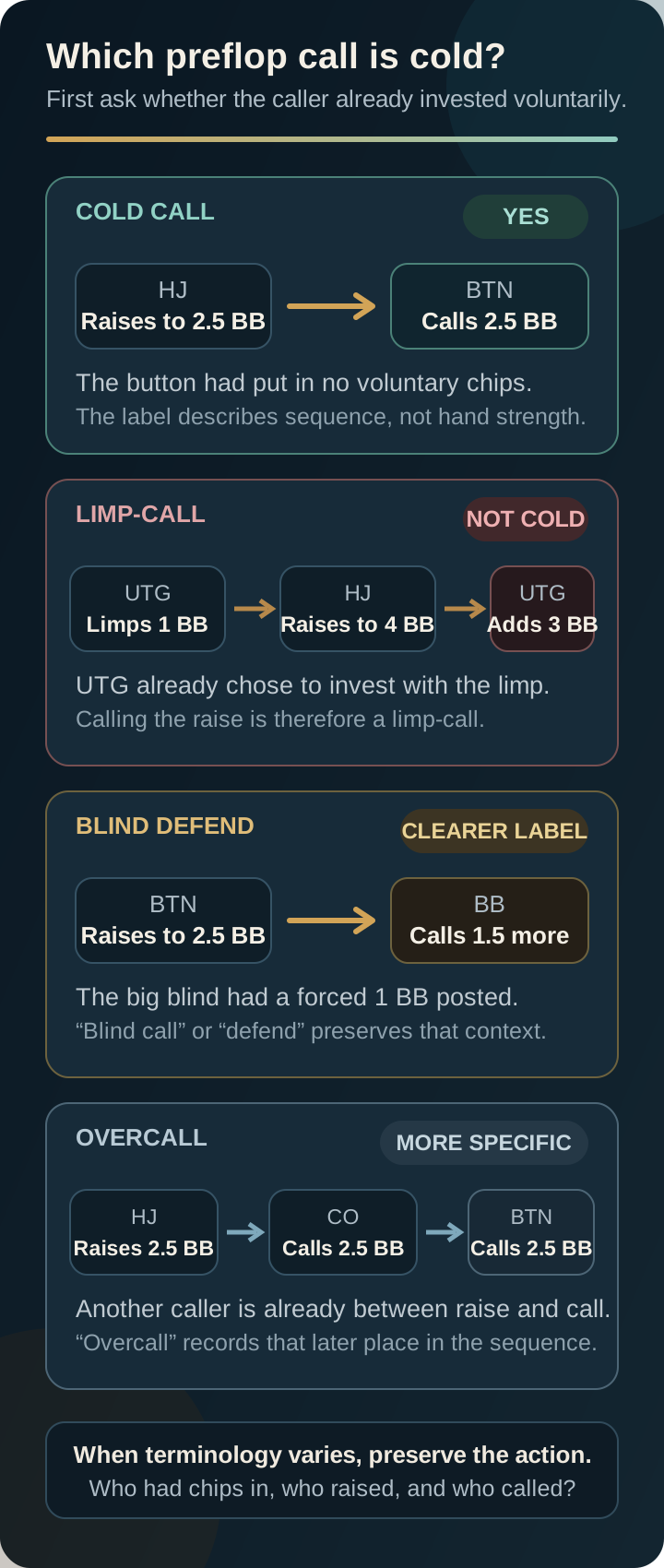
A cold call in poker is a call of a raise made without earlier voluntary investment on that betting round. The common preflop example is simple: the hijack raises to 2.5 big blinds, the cutoff folds, and the button calls 2.5 big blinds. The button has cold-called the open raise.
The label describes action order, not hand strength. A cold caller may hold a pair, a suited hand, a strong broadway hand, or another candidate chosen for that exact position and lineup. The name alone does not show whether calling was better than folding or re-raising.
Review a cold call only after the hand is complete. Reconstruct who raised, whether the caller had already invested voluntarily, which players were still behind, and what the effective stack would be in every branch. Then compare folding, calling, and any realistic re-raise without letting the flop or showdown decide the preflop story.
What does cold call mean in poker?
To call cold means entering against a raise without having voluntarily put chips into the current betting round. Before the flop, an open raise creates the most familiar version. If the hijack opens and the button's first voluntary action is a call, the button cold-calls.
The same action pattern can appear after the flop. Suppose one player bets the turn, a second player raises, and a third player calls the raise without having bet or called earlier on that turn. The third player has cold-called the raise. Calling the first bet alone would be an ordinary call because no raise existed yet.
Forced blind money should stay visible in the hand record. A big blind did not voluntarily choose the original 1 BB, so players often describe a call there as a blind defend or blind call. When terminology feels ambiguous, the exact sequence—blind posted, raise to 2.5, call 1.5 more—communicates more than the label.
Why is it called a cold call?
The caller is cold because they join an already-raised betting round without warming up through an earlier voluntary bet or call. The phrase preserves a useful fact: the caller's range entered at the raised price rather than continuing from a limp, bet, or earlier call.
That history changes the review. A player who limped and then called a raise has already revealed one action and invested one amount. A cold caller has made one voluntary decision at the raised price. Those ranges may contain different hands even when both players finish preflop with the same total chips in the pot.
How is a cold call different from other calls?
A flat call means choosing to call instead of raise. It is a broad action label. A flat call can also be cold when the caller had no earlier voluntary investment, but not every flat call is cold. A player who opens and then calls a 3-bet is calling without re-raising, yet that player already invested with the open.
A limp-call begins when a player voluntarily limps, faces a raise, and adds the difference. An overcall happens after at least one other player has already called the same wager. The later caller may still be cold relative to the original raise, but overcall is the more specific label because it records the intervening caller and the extra range already in the pot.
A 3-bet is a re-raise rather than a call. A squeeze is a later 3-bet after an open raise and at least one call. That means a cold call can create the sequence that gives a player behind the opportunity to squeeze, but the cold call and squeeze are different actions by different seats.
What does a complete cold-call example look like?
Consider a six-handed cash-game hand with every player starting at 100 BB. The small blind posts 0.5 BB, the big blind posts 1 BB, and the hijack raises to 2.5 BB. The cutoff folds. The button calls 2.5 BB as its first voluntary action. That button call is a cold call.
If both blinds fold, the flop pot is 6.5 BB: 0.5 from the small blind, 1 from the big blind, 2.5 from the hijack, and 2.5 from the button. The hijack and button each have 97.5 BB behind, so the flop stack-to-pot ratio is 97.5 divided by 6.5, or 15.0.
Nothing about a 15.0 SPR proves the call was good. It shows the branch the call created if the blinds folded. A review still needs the opener's likely range, the button's hand, position after the flop, the possibility of a blind re-raise, and the alternatives available before the call.
What does a cold call change before the flop?
A cold call adds chips without taking the betting lead. The opener remains the last player to have raised, while every player behind the caller still receives a decision. Those seats can fold, call, or re-raise, and a re-raise sends the action back through the opener and cold caller.
The call can also make a multiway pot more likely. The blinds receive a better immediate price than they would against the open raise alone because another 2.5 BB is now in the middle. A better price does not guarantee a call, but the extra branch belongs in the cold caller's original decision.
Finally, the cold call keeps the initial pot smaller than a re-raise would. That usually leaves a deeper SPR if the hand goes heads-up to the flop. The remaining room is not automatically an advantage; it creates more future-street decisions that depend on position, board changes, and how both ranges connect.
Why do position and players behind matter?
Position changes both the immediate and postflop branch. A button cold caller may act after the opener on later streets if the blinds fold. A caller in the cutoff still has the button and both blinds behind, so the pot can become multiway or be re-raised before the flop is settled.
Count the seats behind instead of treating them as empty space. For each one, note the stack, whether a call would close the action, and whether a re-raise would force the cold caller to invest more or fold the original call. The risk is not only that someone has a strong hand; it is that the decision tree is still open.
Effective stacks can differ by opponent. A short-stacked opener, a deep cold caller, and a medium-stacked blind do not share one useful average. Write the relevant effective stack beside each possible heads-up or multiway branch before comparing the call with a re-raise.
Which hands can make reasonable cold-call candidates?
There is no permanent list that makes every cold call reasonable. Start with the opener's position and likely range, then ask how the exact hand performs if the pot stays heads-up, becomes multiway, or gets re-raised. A hand that is comfortable against one opening range may be dominated or difficult to continue with against another.
Playability is a branch description, not a magic label. Suitedness, connected ranks, pair value, card removal, and position can all affect how often a hand makes useful later-street decisions. They do not erase the price paid now or the players who can still act.
Also compare the hand's role in the alternatives. Some hands may prefer a re-raise for value or as a bluff candidate; others may retain more useful weaker hands in the opener's range by calling. If neither the call nor the re-raise has a clear plan for likely responses, folding remains part of the comparison.
How do fold, cold-call, and 3-bet branches compare?
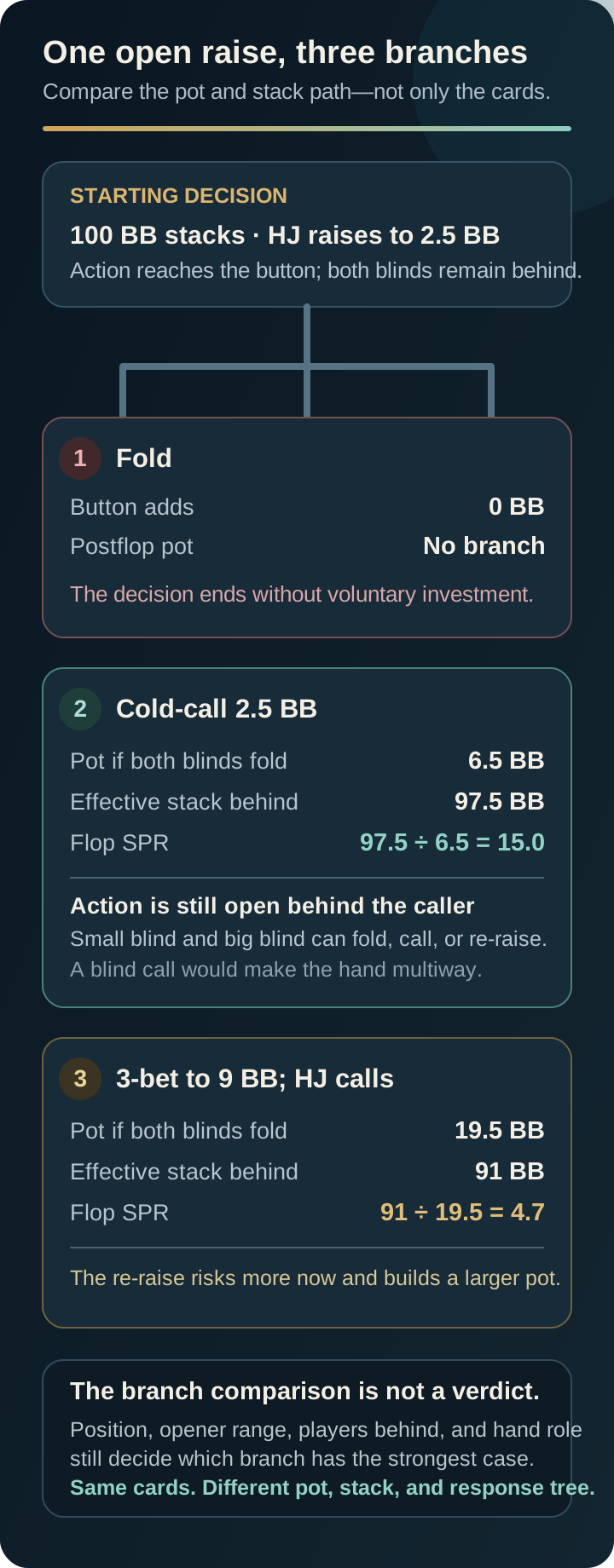
Return to the 100 BB example where the hijack opens to 2.5 BB and action reaches the button. Folding adds no voluntary chips and ends the button's branch. Cold-calling adds 2.5 BB and, if both blinds fold, creates a 6.5 BB pot with 97.5 BB behind and a 15.0 flop SPR.
Now compare a 3-bet to 9 BB. If both blinds fold and the hijack calls the extra 6.5 BB, the pot is 19.5 BB: the 1.5 BB in blinds plus 9 BB from each active player. Both players have 91 BB behind, so the flop SPR is 91 divided by 19.5, or about 4.7.
The arithmetic reveals different commitment paths. The call risks less now and preserves a smaller, deeper pot. The re-raise risks more, changes the opener's response range, and creates a larger pot when called. Those facts do not make either branch universally best.
A sound review assigns likely responses to each branch. Which hands continue against the call by entering from the blinds? Which hands from the opener call, fold, or 4-bet against the re-raise? What happens to the exact hand after each response? The comparison becomes useful when it describes ranges and later decisions rather than only pot size.
How does a cold call change when a blind joins?
Suppose the small blind folds but the big blind calls after the button's cold call. The preflop pot becomes 8 BB: 0.5 from the folded small blind and 2.5 each from the hijack, button, and big blind. Each active player has 97.5 BB behind, so the immediate flop SPR is about 12.2.
The smaller SPR is only one change. The button now acts between the hijack and big blind after many flops, and a bet must pass through two continuing ranges. A hand that looked comfortable heads-up may lose value when two opponents can make stronger pairs, draws, raises, or calls.
Review each opponent separately. The opener's range reached the flop by raising and receiving calls. The blind's range entered after seeing the raise and cold call. Combining both into one generic range hides who acts when and which hands can continue in each position.
Which cold-call mistakes are most common?
The first mistake is judging the call from the flop. A favorable board or winning showdown does not repair a preflop call that lacked a sound range and branch plan. An awkward flop does not prove the call was wrong. Grade the choice using information available before the cards were dealt.
The second mistake is looking only at the opener. Players behind can call or re-raise, and their stacks affect what the cold caller must do next. A review that assumes both blinds disappear has removed part of the original decision.
Other mistakes include calling because a hand looks attractive without comparing domination, using one fixed cold-calling chart in every position, and treating the call as the passive or safe choice. Calling is an active investment that creates a specific pot, range interaction, and future response tree.
How should you review a cold call after the hand?
Use seven passes. First, hide the result. Second, verify the raise size, positions, blinds, and stacks. Third, confirm that the caller had no earlier voluntary investment. Fourth, build the opener's range. Fifth, list every player behind and the responses each could take. Sixth, compare fold, call, and re-raise branches. Seventh, reveal the runout and save one conditional lesson.
Make the lesson specific enough to reuse. Instead of writing “cold-call less,” write a condition such as: “Before cold-calling from the cutoff, count the three seats behind and state how this hand responds to a squeeze.” The second version identifies a future trigger and the missing plan.
If the conclusion changes when one assumption moves, keep that sensitivity visible. A close call may depend on the opener's range, a short stack behind, or whether a hand can continue against a re-raise. A conditional conclusion is more honest and more useful than false certainty.
How can Tells Poker support a cold-call review?
After the hand is complete, record it in Tells Poker through step-by-step entry, text, or voice, then use Replay to confirm the open raise, cold call, players behind, pot, and later action in order. Correct uncertain details before asking the hand record to support a precise conclusion.
The Analysis tab can organize the key decision, pot, amount to call, effective stack, range groups, graded streets, and an alternative line when the saved hand supports them. Use that output to compare the call with folding or re-raising and to challenge the assumptions behind each branch.
Use the analysis as a structured second opinion; it cannot establish perfect or definitive play. Tells is designed for completed-hand review and post-session study, not assistance during a hand.
Frequently asked questions
Does a cold call have to happen before the flop?
No. It can happen after the flop when a player calls a raise without having voluntarily invested on that street. For example, one player bets, another raises, and a third player calls the raise cold.
Is a cold call the same as a flat call?
Not exactly. A flat call means calling instead of raising. It is cold only when the caller had no earlier voluntary investment on that betting round.
Is calling from the big blind a cold call?
Terminology varies, but blind call or blind defend is usually clearer because the forced blind was already posted. Preserve the exact sequence and the extra amount called.
Is cold-calling always a mistake?
No. The decision depends on position, the opener's range, the exact hand, effective stacks, players behind, and the alternatives. Review the full branch rather than grading the action from its label.