

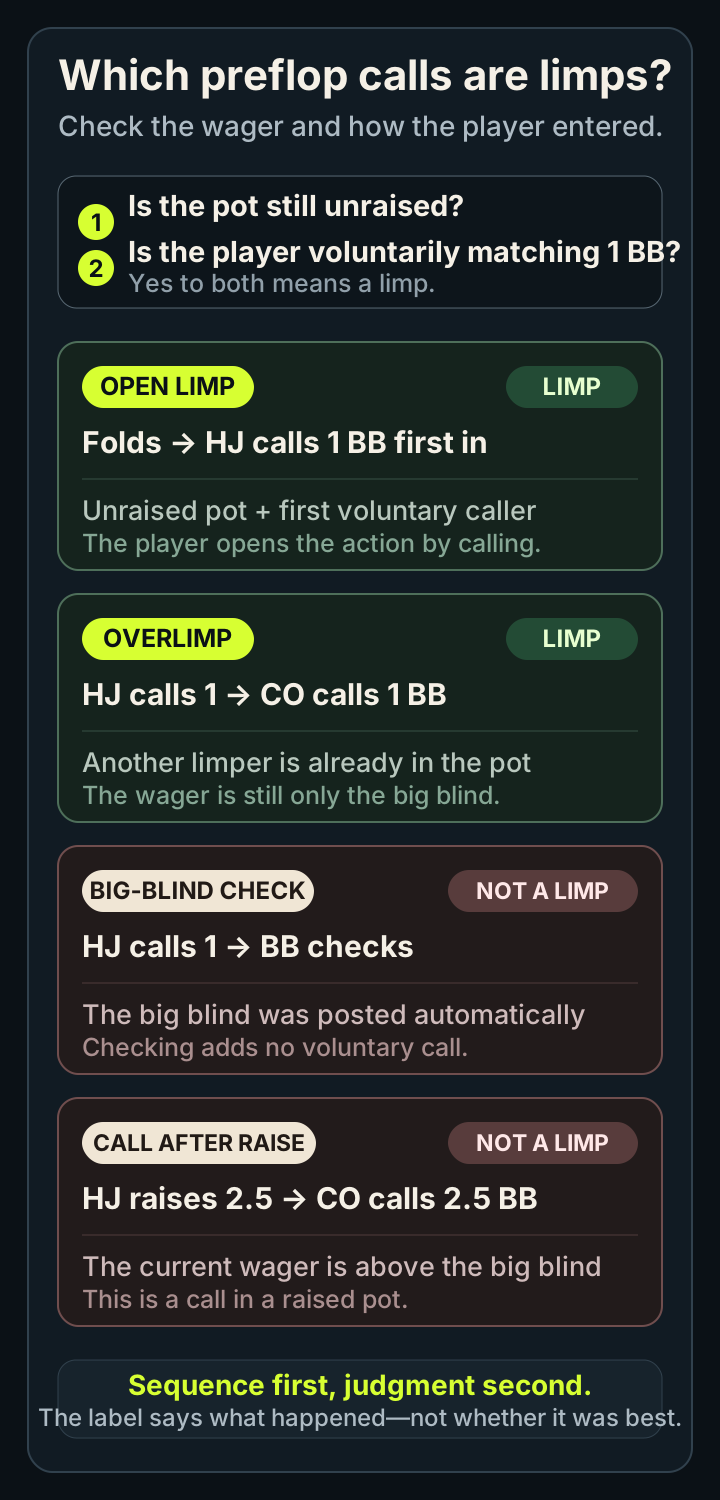
Limping in poker means entering an unraised pot before the flop by calling the big blind instead of raising. The first voluntary caller open limps. A later player who calls behind one or more limpers overlimps. Checking in the big blind is not limping, and calling after someone has raised is a call in a raised pot, not a limp.
The label describes the action sequence, not whether the play is automatically good or bad. A useful review asks what the limp was trying to accomplish, which players could still act, how often the pot would become multiway or raised, and whether folding or raising would have created a better branch.
Use that review only after the hand is complete. Limping can look inexpensive because the immediate call is small, but the real decision includes the raise you may face, the positions you invite into the pot, the effective stack, and the postflop situations created by each response.
What does limp mean in poker?
A limp is a preflop call of the current big-blind amount in a pot that has not been raised. In a 0.5/1 BB game, a player who voluntarily enters for 1 BB is limping. The action remains a limp whether that player has a strong hand, a speculative hand, or no clear plan.
The word sometimes carries a negative tone in poker conversations, but the name itself does not grade the decision. To judge the play, compare the limp with folding and raising under the actual positions, stacks, players behind, and expected responses.
What is the difference between an open limp and an overlimp?
An open limp is the first voluntary entry into an unraised pot. If action folds to the hijack and the hijack calls 1 BB, the hijack has open limped. “Open” means no player has voluntarily entered before that action.
An overlimp happens after at least one player has already limped. If the hijack calls 1 BB and the cutoff also calls 1 BB, the cutoff has overlimped. Both players matched the current big blind, but their decisions are different because the cutoff already knows one extra player is likely to see the flop.
The small blind can complete by adding the amount needed to match the big blind when the pot remains unraised. Players often group that action with limping, but “complete” is the more precise description because part of the small blind was posted before the cards were dealt.
Which preflop calls are not limps?
A big-blind check is not a limp. The big blind did not voluntarily call to enter; the blind was posted, and checking simply accepts a free option when no one raises. If several players limp and the big blind checks, the other callers limped while the big blind checked.
A call after a raise is also not a limp. If the hijack raises to 2.5 BB and the cutoff calls 2.5 BB, the cutoff has called a raise. The amount, range, pot size, and incentives differ from calling the unraised big blind.
The clean test is simple: was the pot still unraised, and did the player voluntarily match only the current big blind? If both answers are yes, the action is a limp.
What does a complete limping example look like?
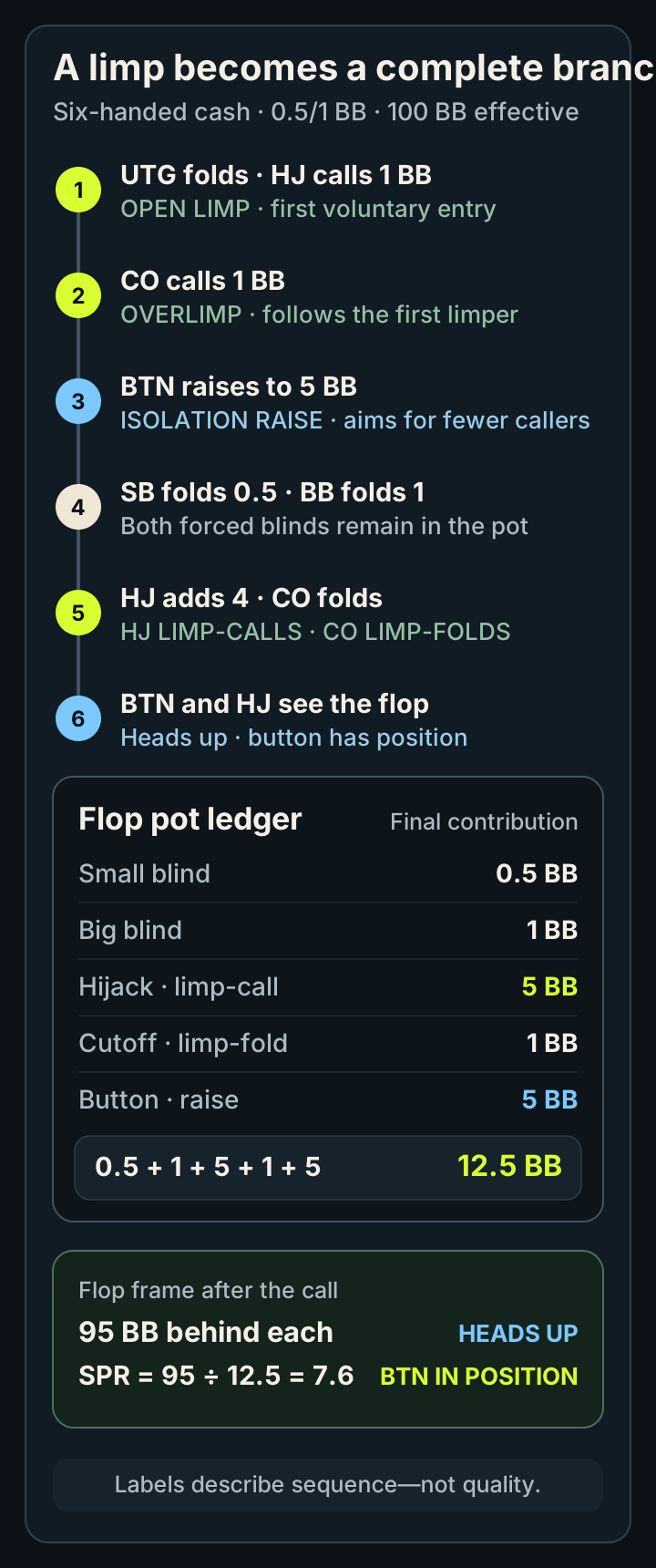
Consider a six-handed 0.5/1 BB cash hand with 100 BB effective stacks. Under the gun folds. The hijack calls 1 BB as the first voluntary entrant, so that action is an open limp. The cutoff calls 1 BB behind and therefore overlimps.
The button raises to 5 BB. Because the raise follows one or more limpers and is intended to contest the pot against them, it is commonly called an isolation raise. The small blind folds its posted 0.5 BB, the big blind folds its posted 1 BB, the hijack calls 4 BB more, and the cutoff folds.
The flop pot is 12.5 BB: 0.5 from the small blind, 1 from the big blind, 5 total from the hijack, 1 from the cutoff, and 5 from the button. The hijack and button each have 95 BB behind, so the flop stack-to-pot ratio is 95 divided by 12.5, or 7.6.
The sequence creates three useful labels. The hijack open-limped, then limp-called the raise. The cutoff overlimped, then limp-folded. Those labels summarize what happened; they do not yet explain whether either decision was sound.
What does limping change before the flop?
Limping keeps the entry price at one big blind for the moment, but it also leaves every later player with the option to fold, overlimp, or raise. That can produce a multiway pot, a heads-up pot after an isolation raise, or a larger pot in which the limper must decide again.
The action can also make the limper's range easier to describe if that player uses a predictable split between limps and raises. That does not mean every limper is weak. A limp can contain traps, medium-strength hands, speculative hands, or an inconsistent mix. Review the observed sequence instead of assigning one automatic story.
Position matters throughout. An early-position open limper acts before many players who can raise. A late-position overlimper has more information about who has entered, but may still face pressure from the button or blinds. The same 1 BB call creates different trees from those two seats.
When can overlimping be reasonable?
Overlimping can be a coherent option when the hand benefits from seeing a flop, the price is still one big blind, the players behind are unlikely to raise often, the effective stacks leave room after the flop, and the hand can make strong holdings without relying on one fragile pair. Those conditions are assumptions to test, not a universal recipe.
Compare the full branch. A suited or connected hand may look attractive behind several limpers, but a raise from behind can erase the apparent discount. A dominated hand can make an expensive second-best pair. A shallow effective stack can leave less room to realize the hand's drawing potential.
Folding can still be the best overlimp alternative. An inexpensive call is not automatically profitable just because other players have already entered.
How should you respond when someone limps?
When action reaches you after a limp, the realistic choices are fold, overlimp, or raise. Start with your position and the players still behind. Then estimate how the limper and later players may respond to each option.
Overlimping preserves the low immediate price but accepts a higher chance of a multiway pot. Raising can win the pot immediately, isolate one player, or build a larger multiway pot if several players call. Folding avoids entering a branch that may be difficult to navigate.
Do not choose by slogan. “Always punish limpers” ignores hand quality, stack depth, position, and the table's response pattern. “It is only one blind” ignores future raises and postflop reverse implied odds. Name the branch you expect before selecting it.
What is an isolation raise after a limp?
An isolation raise is a raise made after one or more limpers, usually with the goal of playing against fewer opponents. The name describes the goal, not a guaranteed result. If the blinds and multiple limpers call, the raise did not isolate anyone even though that may have been the plan.
A post-session review should compare several raise sizes by the responses they are likely to create. A smaller size may invite many calls. A larger size risks more chips and can be called by a different range. The useful question is not “What is the standard size?” but “Which folds, calls, and reraises did this size target, and what pot would each response create?”
The worked example above uses a raise to 5 BB after two limpers. That number is an example, not a rule. Position, stacks, number of limpers, and player tendencies can all change the useful size.
What are limp-fold, limp-call, and limp-reraise?
These labels describe what a limper does after facing a raise. A limp-fold means the player limps and then folds. A limp-call means the player matches the raise. A limp-reraise means the player limps and then raises after someone else raises.
The second action should be part of the first decision. Before limping, ask what you will do against a likely raise size from each player behind. If the answer is improvised only after the raise arrives, the original limp did not include a complete plan.
A limp-reraise may represent a very strong range in one game and a wider or erratic range in another. The sequence alone does not reveal exact cards. Keep the range assumption separate from the action label.
Which limping mistakes are most common?
The first mistake is treating the 1 BB call as the whole cost. The relevant tree includes possible raises, multiway flops, and difficult later-street decisions.
The second is calling a big-blind check a limp. That confuses a forced blind with a voluntary preflop call and can distort a hand history.
The third is assuming every limper is weak. A useful range starts broad, then narrows through the player's later response and the rest of the action.
The fourth is overlimping without checking who can raise behind. Button and blind behavior can change the value of the call.
The fifth is reviewing only the flop. If the preflop branch created an awkward pot, stack-to-pot ratio, or position problem, the lesson may belong to the limp decision rather than the later card.
How should you review a limp after the hand?
First, label the action precisely: open limp, overlimp, small-blind complete, big-blind check, or call in a raised pot. Then rebuild every contribution so the preflop pot is correct.
Second, list the players who could still act and the raise sizes you realistically expected. Third, describe the limper's plausible continue, fold, and reraise branches without reducing the range to one hand.
Fourth, compare the available actions. For an open limper, compare limp, raise, and fold. For a player behind, compare overlimp, isolation raise, and fold. Carry each branch through likely responses, position, effective stack, and the flop pot it creates.
Finally, save one conditional lesson. “Never limp” is too broad to transfer well. “From early position, avoid this open limp when two aggressive players remain behind and the hand cannot comfortably continue to their usual raise” is narrower and testable.
How can Tells Poker support a limped-pot review?
After the hand is complete, record the positions, blinds, stack sizes, and exact preflop order in Tells Poker. Replay can help you verify who limped, who overlimped, whether the big blind checked, and how a later raise changed the contributions before you judge the flop.
The Analysis tab can provide a structured second opinion when analysis is available. Treat it as another view of the saved hand, not a perfect or definitive ruling. The strongest review still checks the recorded facts, the ranges you assumed, and the alternatives that would change your conclusion.
Tells Poker is built for post-session study, not real-time assistance. Use the completed hand to turn a vague label such as “I limped and got punished” into a specific preflop branch you can compare and discuss.
Frequently asked questions
Is calling the big blind always a limp?
Only when the pot is unraised and a player voluntarily calls the current big-blind amount before the flop. A big-blind check is not a limp, and a call after a raise is not a limp.
Is limping always bad in poker?
No action label is automatically good or bad. Judge a limp by position, effective stack, players behind, expected raises, the limper's response plan, and the postflop branches created by folding or calling.
What is the difference between limping and calling?
Every limp is a type of call, but not every call is a limp. A limp specifically calls the big blind in an unraised preflop pot. Calls after raises and calls on later streets are simply calls.
Can the big blind limp?
The big blind normally checks when no one raises, because its blind already matches the current wager. If the big blind voluntarily adds chips after a raise, that action is a call or reraise, not a limp.