

A cooler in poker is a strong-hand-versus-stronger-hand collision in which losing a meaningful pot may be difficult to avoid under reasonable ranges, stack depths, and action. A cooler is not simply a large loss. The useful question is whether the decision still holds up before the stronger hand is revealed.
The label should describe the situation, not end the review. Pocket kings running into pocket aces can look like a clear cooler, but position, stack depth, raise sizes, and the opponent's reraising range still determine whether every action was supported. A powerful made hand can also become an avoidable loss when the range that keeps adding chips is too narrow.
Review a possible cooler only after the hand is complete. Hide the showdown, rebuild the action, test both ranges, and compare realistic alternatives. Reveal the result last. The goal is not to find a fold that exists only in hindsight; it is to separate an unavoidable range collision from extra loss caused by a decision you can improve.
What does cooler mean in poker?
A cooler means two unusually strong holdings meet in the same hand and one is stronger. The player who loses may have made a reasonable decision against the full range even though the exact hand shown was near the top of that range. The term applies to the collision, not automatically to every bet, call, or raise that came before it.
A cooler does not have to be an all-in. A full house can call a large river bet and lose to a higher full house. A set can face another set in a pot that never reaches the maximum stack. The size of the loss changes the emotion, but the classification comes from the strength and plausibility of both ranges at the decision.
Difficult to avoid also needs context. It does not mean folding was physically impossible. It means the fold would require an opponent-range assumption that the available information did not reasonably support. If the action makes the stronger hand overwhelmingly likely, continuing may be overplay even when your own hand looks impressive in isolation.
How is a cooler different from a bad beat or overplay?
A cooler is about two strong holdings colliding. A bad beat is about a hand that was ahead losing after an unfavorable later card or runout. The same hand can contain both ideas, but they answer different questions: a cooler describes the range collision; a bad beat describes how the result changed.
Overplay means committing more than the hand supports against the range and available alternatives. A player can be dealt a cooler and still overplay one street. For example, calling a river bet with a very strong hand may be reasonable while reraising and then calling another raise may expose the hand to a range that contains almost nothing worse.
Do not use the final pot as the definition. A small pot can contain a genuine cooler when both players correctly keep the pot controlled. A large pot can come from an avoidable bluff catch, an unsupported stack-off, or a size that only stronger hands continue against.
Does a cooler mean you played the hand perfectly?
No. Calling a hand a cooler says the final holdings created a difficult collision; it does not grade the entire line. Earlier streets may contain a loose call, a raise without a clear target, a size that folds worse hands, or a missed chance to control the pot against a narrowing range.
Grade each decision at the point it occurred. Ask what hands could call, fold, or raise, what price the action offered, how much remained in the effective stack, and which future branches were likely. A sound decision can lose to the top of the range. An unsound decision can still happen to run into a hand that makes the story feel inevitable.
The best conclusion may be mixed: the preflop call was too loose, but once the flop produced set over set, the remaining loss was difficult to avoid. That is more useful than calling the whole hand a cooler or the whole hand a mistake.
How can you tell whether a poker hand was a cooler?
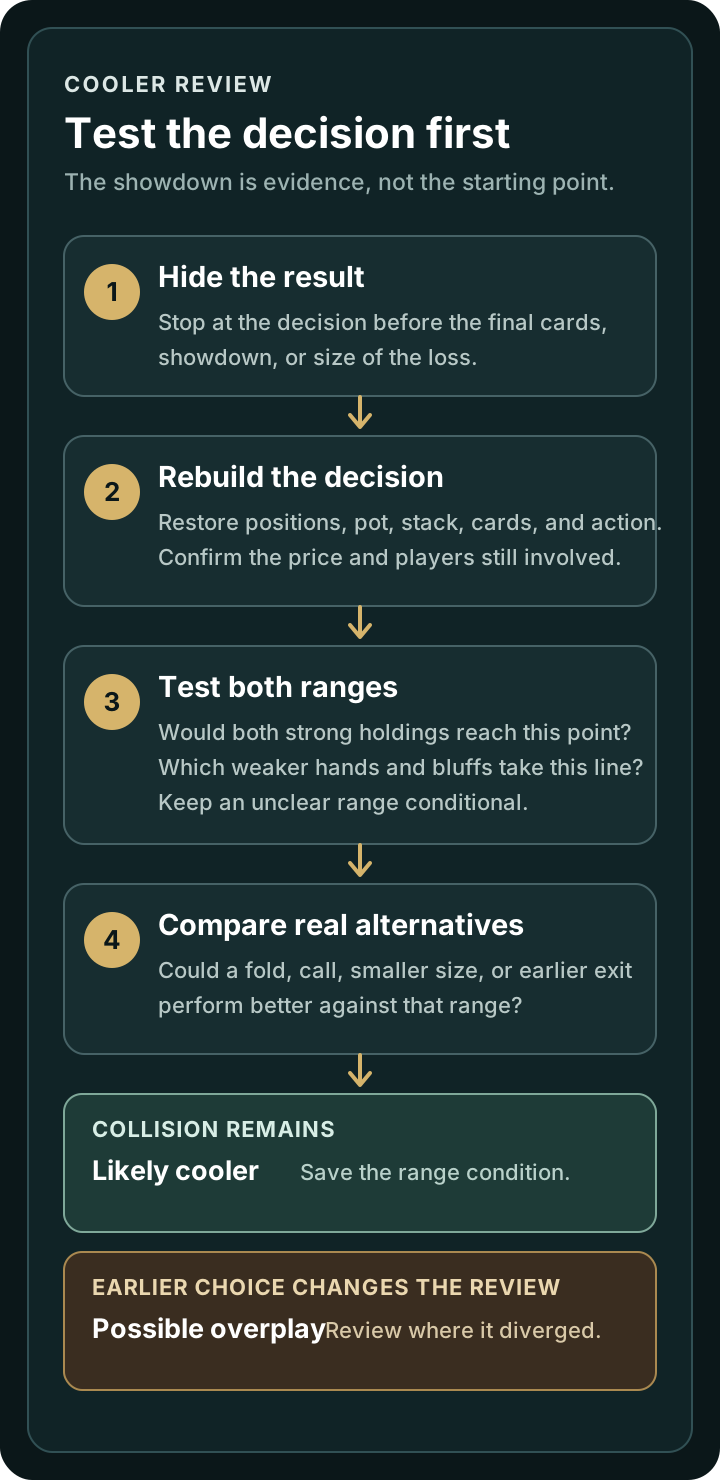
Use four passes. First, hide the result and stop at the decision where the pot became large. Second, rebuild the positions, pot, effective stack, board, action order, price, and players still involved. Correct any missing or inconsistent detail before making the range precise.
Third, build both ranges from the action. Ask whether your strong holding reaches this point, whether the stronger holding also reaches it, and which weaker value hands or bluffs take the same line. The exact showdown hand belongs inside the range only if the earlier action supports it.
Fourth, compare realistic alternatives. Test folding, calling, raising, checking, or a smaller size where those actions were actually available. If your chosen action remains supported across reasonable range versions, the loss is likely a cooler. If one earlier choice performs better once the range is rebuilt, save that decision as possible overplay.
What does a complete cooler review example look like?
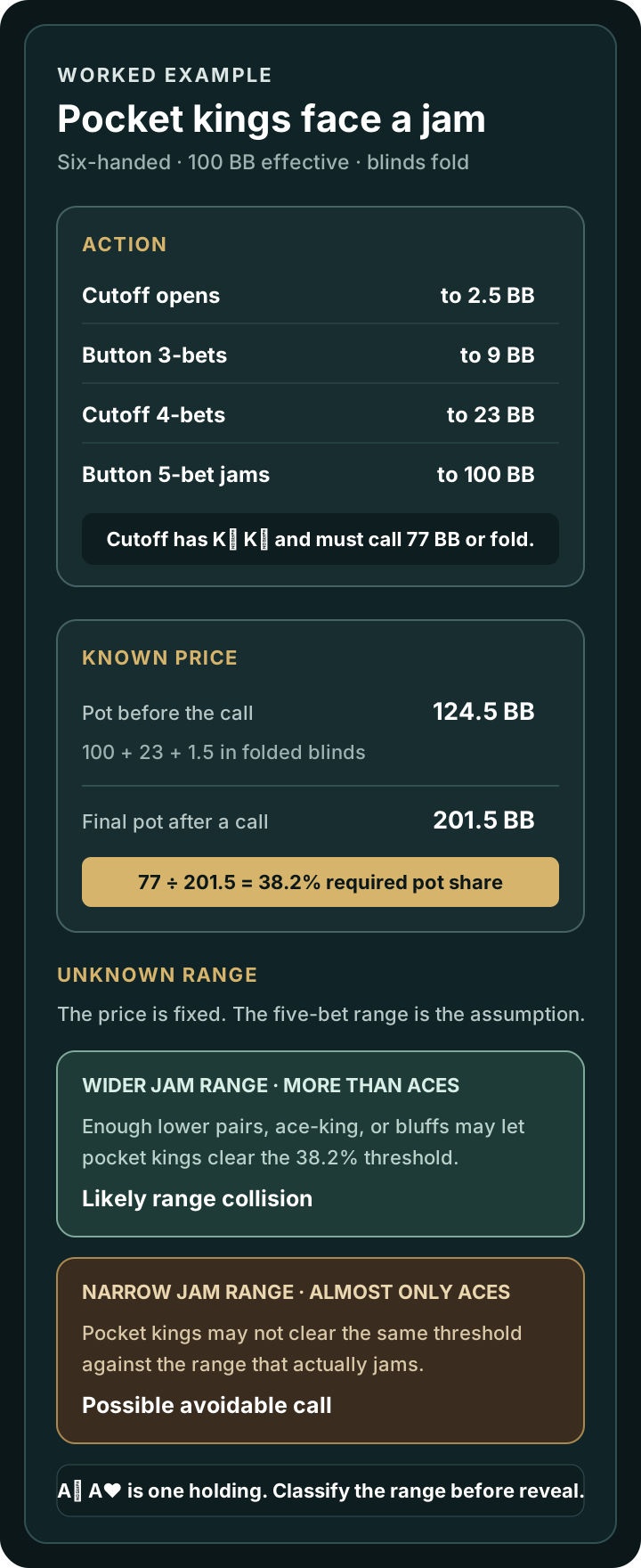
Consider a constructed six-handed hand with 100 BB effective stacks. The cutoff holds K♣ K♦ and opens to 2.5 BB. The button 3-bets to 9 BB, both blinds fold, and the cutoff 4-bets to 23 BB. The button moves all-in to 100 BB, so the cutoff must call 77 BB or fold.
Before the call, the pot is 124.5 BB: 100 BB from the button, 23 BB from the cutoff, and 1.5 BB from the folded blinds. Calling creates a 201.5 BB final pot. The immediate threshold is therefore 77 divided by 201.5, or about 38.2% pot share. That arithmetic is fixed; the cutoff's share against the button's jam range is not.
Now build the range without looking at the showdown. If the button jams aces plus enough lower pairs, ace-king, or bluffs, pocket kings may clear the threshold and the call can be supported. If the button's five-bet range in this exact position and stack configuration is almost only aces, the same pocket kings may not clear the price.
Suppose the button reveals A♠ A♥. The showdown confirms one holding, not the entire jam range. Classify the hand from the plausible range before reveal: if the call was supported, the loss is a strong-range collision; if the jam range was credibly much narrower, the hand may contain an avoidable call. The example does not prescribe a universal preflop rule. It shows which assumption controls the label.
Can you fold a cooler?
Sometimes, but the fact that a fold was available does not prove it was reasonable. A player can always imagine the exact stronger hand after seeing it. The review must ask whether the action and prior information narrowed the opponent enough to justify folding against the full range at the time.
The decision can also change across streets. A hand may be too strong to fold on the flop against bets from value hands and draws, then become a fold on the river after the range narrows through a large bet and a raise. Calling the final result a cooler should not freeze the earlier range in place.
When two reasonable range versions lead to different actions, label the spot assumption-sensitive. That is a better study result than forcing certainty. Save the read or frequency that would make the fold defensible and look for that condition in later completed hands.
Why should you review the streets before the collision?
The expensive decision often depends on how the pot and range were built. A preflop call changes which hands can appear on the flop. A flop raise removes some medium holdings and may concentrate the range around strong value and draws. A turn size can make the river stack shallow enough that the final call looks automatic even when the earlier size deserved scrutiny.
Recalculate the pot and remaining stack after each wager. A wrong raise-to amount can change the price, stack-to-pot ratio, and available alternatives. If the hand record is uncertain, preserve two branches rather than choosing the detail that makes the loss look most unavoidable.
Stop the review at the first decision that meaningfully changes the conclusion. The lesson may be about entering the pot, choosing a size, or interpreting a raise—not about escaping the final showdown.
Which cooler-review mistakes are most common?
The first mistake is starting with the revealed hand and building the opponent's range backward around it. The second is treating a strong hand as proof that every later chip had to go in. Hand strength matters only against the range created by the action.
Another mistake is using standard as the entire reason. A familiar stack-off can be a useful baseline, but positions, stack depth, player-specific information, and raise sizes can move the decision away from that baseline. State the range that makes the action standard.
Finally, do not hunt for a heroic fold simply because the pot was lost. A review distorted toward avoiding every rare stronger hand will create overly tight lessons. Compare the action with the full plausible range and keep the conclusion conditional.
What should you save after reviewing a cooler?
Save the exact decision, the range condition that made it close or clear, and one checkpoint for the next similar spot. A useful note is: when a river raise leaves almost no worse value hands, rebuild the raising range before calling the second bet.
Avoid notes such as never fold kings or always fold when the third raise comes. Those rules erase position, stack depth, size, and opponent range. The portable lesson should tell you what to inspect, not pretend one result solved every future hand.
If the action remains supported, save that too. Do not change a reasonable range decision only because the opponent showed the top of the range. That protects the next review from result-based overcorrection.
How can Tells Poker support a cooler review?
After the hand is complete, save it in Tells Poker and open Replay. Move action by action to restore the seats, board, pot, committed wagers, folds, and remaining stacks before the showdown. Pause at the decision that created the large pot and review it without letting the final holding lead the range.
The Analysis tab can organize street feedback, deterministic spot math when supported, range reasoning, and an alternative line. Use those pieces to challenge the price and the range that made the loss feel unavoidable. Analysis is a structured second opinion for post-session study, not perfect or definitive play and never real-time assistance.
Keep the conclusion tied to the recorded hand. A clearer record and an explicit range assumption are more useful than the cooler label by itself.
Frequently asked questions
Is a cooler the same as a bad beat in poker?
No. A cooler is a collision between strong holdings in a spot that may be difficult to avoid. A bad beat describes a hand that was ahead losing after a later card or runout. One hand can contain both, but the ideas are different.
Does losing with pocket aces always count as a cooler?
No. Pocket aces are a strong starting hand, but the action, board, ranges, stack depth, and alternatives determine whether the later loss was difficult to avoid or included an avoidable decision.
Should you review poker coolers?
Yes. Review them briefly to verify the hand record, ranges, price, and earlier decisions. If the line remains supported, save the condition and move on. If an earlier action changes the result of the review, study that decision instead of hiding it behind the label.
Can a cooler still contain a mistake?
Yes. The final holdings can form a genuine cooler while an earlier call, raise, or bet size is still weak against the range. Grade each decision separately.