

A delayed continuation bet, or delayed c-bet, is a postflop bet made by the last preflop aggressor after that player declined the first usual chance to bet. The common sequence is raise preflop, check back the flop, then bet the turn after the caller checks again.
The delay matters because the flop action changed both ranges. The caller checked, the preflop raiser checked behind, a new card arrived, and the pot stayed the same. Before betting the turn, rebuild the value, bluff, and checking regions instead of treating the wager as a c-bet that merely arrived one street late.
Perform this analysis only once the hand has finished. The goal is not to prove that checking the flop or betting the turn was perfect. It is to understand what the check-through revealed, which hands the later bet targeted, and how checking again would have changed the river branch.
What does delayed c-bet mean in poker?
A delayed c-bet is a later-street bet from the player who made the last aggressive action before the flop, after that player checked instead of betting on the first postflop street. In the most common heads-up example, the button raises, the big blind calls, both players check the flop, and the button bets the turn after another big-blind check.
The term identifies the sequence, not the hand strength or quality of the play. The delayed bet can be for value, as a bluff, as a semi-bluff, or with a hand that combines several purposes. It can also be unnecessary if checking again creates a better branch.
A delayed c-bet can happen after more than one checked street. If the preflop aggressor checks back the flop and turn, then bets the river after the opponent checks a third time, players may describe that river wager as a delayed continuation bet. The turn version is simply the clearest and most common pattern to study.
How is a delayed c-bet different from a c-bet, double barrel, and probe bet?
A standard continuation bet happens on the flop: the last preflop aggressor bets at the first postflop opportunity. A delayed c-bet skips that opportunity and bets later. Both labels follow the same preflop aggressor, but they describe different street sequences.
A double barrel is different because the same player bets both the flop and turn. There is no flop check-through. The turn bettor reaches a larger pot against a range that already called one postflop bet.
A probe bet usually comes from the out-of-position caller after the prior street checked through. If the big blind checks the flop, the button checks back, and the big blind leads the turn, that turn lead is a probe. If the big blind checks the turn and the button bets, the button has made the delayed c-bet.
What does the flop check-through change?
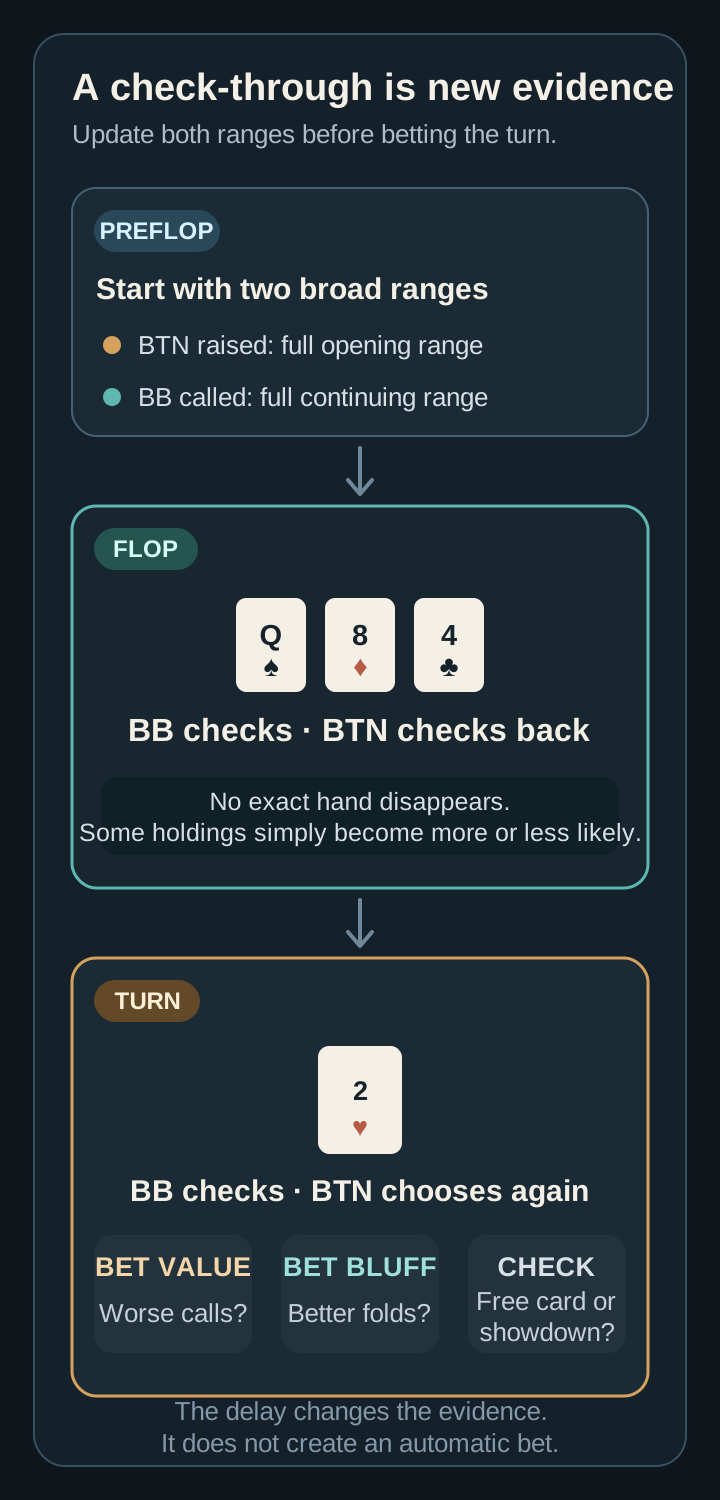
The flop check-through adds information without making either range empty. The out-of-position player's first check may contain weak hands, medium-strength hands, draws, traps, or a broad checking range. The preflop raiser's check-back can contain hands with showdown value, missed hands, slow-played strength, and hands that prefer a different turn card before building the pot.
Do not remove every strong hand from the raiser's range just because the flop checked back. Some strong hands check for protection of the checking range, to keep worse hands involved, or because the board gives the caller meaningful check-raise possibilities. The exact weights depend on the positions, board, stacks, and player tendencies.
The second check on the turn adds more evidence. The caller declined to probe, but that does not prove weakness. Before the delayed c-bet, identify likely calls and raises, the stronger holdings that might fold, and the part of the raiser's range that benefits more from checking again.
Which turn cards support a delayed c-bet?
A useful turn card changes the relationship between the two ranges in a way the bettor can explain. A high card may strengthen more of the preflop raiser's value range. A low connecting card may improve more of the caller's pairs and draws. A suit-completing card can create new made hands while removing some natural semi-bluffs.
Classify the turn before choosing the action. Does it improve your exact hand? Does it create value hands you can credibly represent? Which hands in the caller's range gained equity? Which likely flop checks now become calls or raises? The answer can support a bet, but it can also reveal why another check is better.
A blank-looking turn is not automatic permission to bet. Even a card that changes few made hands may leave the caller with enough pairs, traps, or bluff-catchers to continue. The useful question is which responses the card creates, not whether the card looks harmless in isolation.
Which hands make reasonable delayed c-bet candidates?
Value candidates should name the worse hands expected to call. A strong top pair may collect from weaker pairs or draws, while a thin value hand needs a narrower and more careful target. If worse hands mostly fold and better hands mostly continue, checking may preserve more value than betting.
A bluff candidate needs a specific fold target among the stronger holdings. Cards that remove likely calls or preserve improvement on the river can help, but a blocker or draw does not make the bet automatic. The hand still needs a coherent target and a plan for calls and raises.
Checking candidates matter just as much. A medium-strength hand may already beat many of the hands that would fold. A weak hand may have too little fold equity. A draw may prefer a free river if a raise would force it to fold. Build the delayed betting range together with the range that checks again.
What does a complete delayed c-bet example look like?
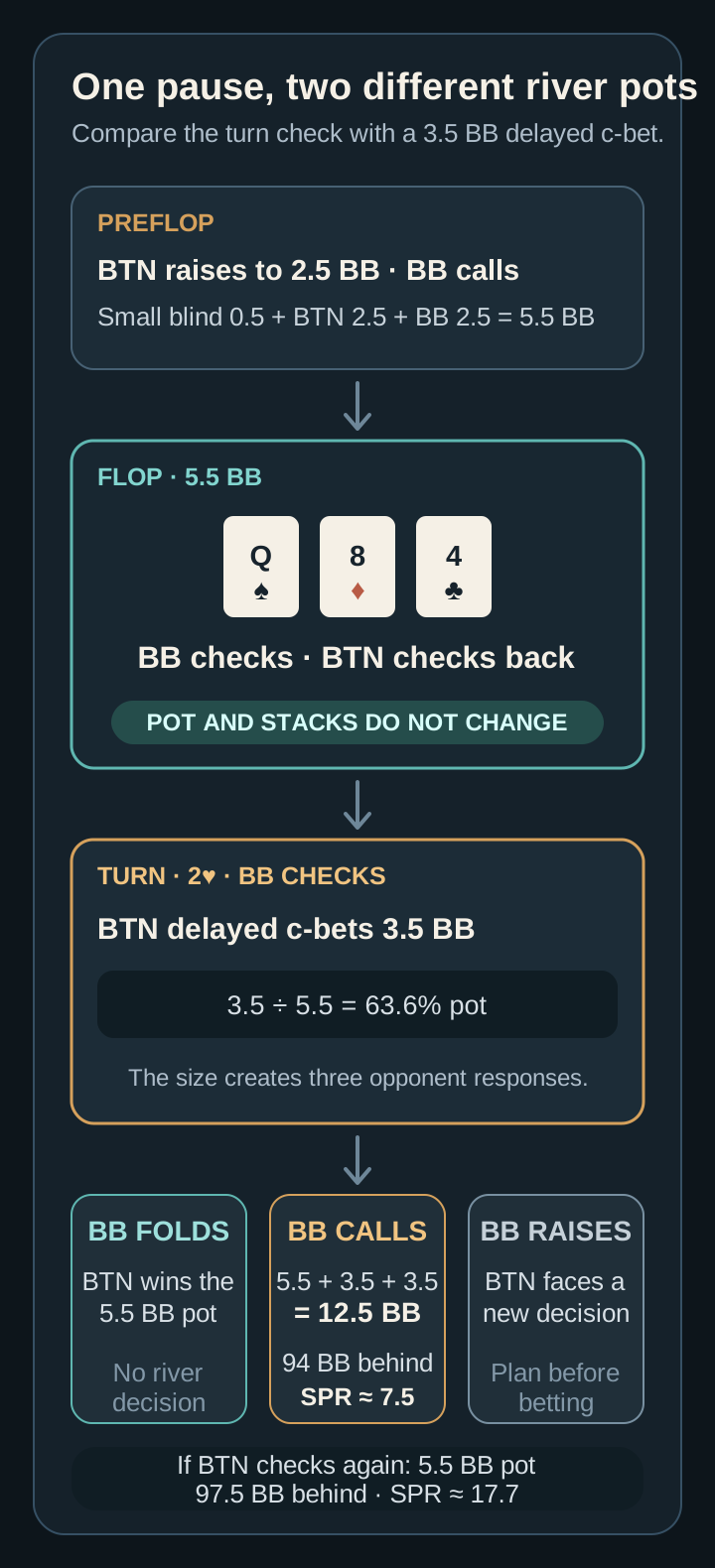
Use a six-handed cash example in which every player begins with 100 BB. After the first three seats fold, the button opens for 2.5 BB. The small blind releases its hand, leaving the posted 0.5 BB behind, and the big blind matches the raise. Contributions of 0.5, 2.5, and 2.5 produce a 5.5 BB flop pot before rake.
The dealer spreads Q♠ 8♦ 4♣. After the big blind checks, the button declines the first betting opportunity. The unchanged pot leaves 97.5 BB in each active stack. A 2♥ arrives on the turn, the big blind checks, and the button considers 3.5 BB. That delayed c-bet is 3.5 divided by 5.5, or about 63.6 percent of the pot.
If the big blind folds, the button wins the existing 5.5 BB pot. If the big blind calls, the river pot becomes 12.5 BB: 5.5 plus the button's 3.5 plus the big blind's 3.5. Both players have 94 BB behind, so the river stack-to-pot ratio is 94 divided by 12.5, or about 7.5.
If the button checks again instead, the river pot remains 5.5 BB and both players keep 97.5 BB behind, an SPR of about 17.7. If the big blind raises the delayed c-bet, the button faces a new decision. Those branches belong in the turn plan before the 3.5 BB goes into the pot.
How should you choose a delayed c-bet size?
Choose the size from the response you want, not from a need to make up for the missed flop wager. Start with the pot before the turn bet. Then name which worse hands should call, which better hands may fold, and which raises the size could face.
A smaller size risks less and can collect calls from a wider region, but it also gives draws and marginal hands a lower price. A larger size builds the river pot and asks more of the caller, but it risks more against a range that may still contain strong hands after checking twice.
Carry the size into the next street. Calculate the called pot, remaining effective stack, and likely river options. A turn size is not complete when its only explanation is that the flop checked through.
When is checking the turn again better?
Check again when the bet lacks a clear value or fold target, when the turn helps the caller's range more, or when your hand benefits from reaching the river without facing a raise. Hands with modest showdown value often lose more from folding out worse hands than they gain from being called by better ones.
Checking can also keep the river range wider. The opponent may bluff later, call a river value bet with a weaker hand, or reveal more information through a river lead. That does not make checking passive; it chooses a different sequence with a smaller pot and more stack behind.
Strong hands may sometimes check again too. If the caller's range is weak and likely to fold the turn, a river bet may collect more. Treat that as a range and opponent assumption to test, not a reason to slow-play automatically.
What should happen after the delayed c-bet is called or raised?
After a call, rebuild the caller's range again. Remove or reduce the hands that were unlikely to continue for that size, then sort river cards by which player they help. Decide which rivers support value, bluff, or a check before judging the turn bet in isolation.
After a raise, ask what value and bluff hands plausibly checked the flop, checked the turn, then raised. Compare folding, calling, and re-raising from the current price and remaining stack. Do not defend the turn bet merely because folding to the raise feels inconsistent.
The plan can be conditional. You do not need one action for every river or every raise size. You do need to know which features change the answer so the delayed c-bet is part of a complete branch rather than a one-street guess.
How do multiway pots change a delayed c-bet?
The label still applies when the last preflop aggressor checks a flop against several callers and bets a later street after the action checks through again. The review becomes harder because every check belongs to a different range, and the delayed bet must pass through more than one player.
Do not combine the callers into one imaginary opponent. One player may hold many pairs, another may retain more draws, and a player behind can still raise after the first call. Value needs enough worse continuing hands across the field, while a bluff needs all remaining players to fold often enough for its purpose.
When the pot is multiway, record the action order and each effective stack before comparing sizes. A heads-up shortcut such as “the flop checked through, so both ranges are weak” becomes even less reliable with several players.
Which delayed c-bet mistakes are most common?
The first mistake is betting every turn after checking back the flop. The skipped wager changed the decision; it did not store permission for later. The second is assuming the caller's second check means weakness without preserving traps, medium-strength hands, and draws in that range.
Other mistakes include confusing a probe with a delayed c-bet, choosing a size without a response target, forgetting that the pot stayed smaller on the flop, and reviewing only whether the turn bet worked. A fold does not prove the bluff was well chosen, and a call does not prove the value bet was too thin.
Another mistake is using the turn card as a slogan. “Good card for the raiser” is incomplete until you explain which value hands improved, which calls became less likely, and how your exact hand fits the betting or checking region.
How should you review a delayed c-bet after the hand?
First, confirm the last preflop aggressor and reconstruct the pot, stacks, positions, board, and exact check sequence. Second, rebuild both flop ranges before looking at the turn. Third, explain what the turn card changed for each range.
Fourth, divide the raiser's hands into value bets, bluffs or semi-bluffs, and checks. Fifth, compare at least two sizes with checking again, then carry each branch through a fold, call, or raise. Sixth, test one assumption at a time instead of changing the board, range, and opponent response together.
Finish with one conditional lesson. “Delayed c-bet more” is too broad. “After checking this high-card flop, bet the blank turn only when I can name worse calls or better folds and still have a river plan” is narrow enough to reuse and revise.
How can Tells Poker support a delayed c-bet review?
After the hand is complete, save the positions, stacks, board, and action in Tells Poker. In Replay, step through the saved sequence to confirm that the flop checked through, the pot stayed unchanged, and the same preflop aggressor made the later bet.
When analysis is available, the Analysis tab can provide a street-by-street debrief and a structured second opinion. Use it to challenge the recorded turn plan, not as a perfect or definitive ruling. The quality of the review still depends on accurate hand facts and visible range assumptions.
Keep the workflow after the action is over: Tells Poker supports completed-hand and post-session study rather than real-time assistance. A saved delayed c-bet gives you a concrete sequence to replay, compare, and discuss instead of a vague memory that you “waited and fired.”
Frequently asked questions
Can a delayed c-bet happen on the river?
Yes. If the last preflop aggressor declines earlier postflop betting opportunities and later bets the river after the action permits it, that wager may be described as a delayed continuation bet. The turn version is more common and easier to recognize.
Is every turn bet after a checked flop a delayed c-bet?
No. The bettor must be the last preflop aggressor who checked instead of betting the flop. A turn lead from the out-of-position caller after a flop check-through is usually called a probe bet.
Does a delayed c-bet have to be a bluff?
No. A delayed c-bet can be for value, as a bluff or semi-bluff, or with a hand that combines value and protection. The action sequence defines the term, not the hand's strength.
What is the difference between a check-back and a delayed c-bet?
A check-back is the in-position player's decision not to bet after an opponent checks. If that player later bets after another check, the later wager can become a delayed c-bet. The check-back creates the delay; the later bet completes the sequence.