

A double barrel in poker is a turn bet made by the same player who bet the flop. The common sequence is raise preflop, continuation-bet the flop, get called, then bet the turn. The first bet creates the opportunity; the second bet creates the double barrel.
The turn wager should not be automatic. The flop call removed some hands, the turn card changed the board, the pot is larger, and the remaining stacks are smaller. Before betting again, rebuild the caller's range and ask which worse hands can call, which better hands can fold, which hands can raise, and what happens on the river.
Use double-barrel analysis after the hand is complete. The label describes an action sequence, not proof that the line was strong, weak, aggressive, or correct. A useful review treats the turn as a new decision and any analysis as a structured second opinion rather than perfect or definitive play.
What does double barrel mean in poker?
A player double barrels by betting two consecutive postflop streets, usually the flop and turn. If the cutoff raises preflop, bets the flop after the big blind checks, and bets again on the turn after a call, the cutoff has double barreled.
The second bet does not have to be a bluff. Strong hands can barrel for value, draws can barrel as semi-bluffs, and some hands can bet because a turn card changes which better hands may fold. Classify the turn bet by the response it is trying to earn, not by whether the bettor eventually wins.
A delayed continuation bet is different. It follows a flop check and a later bet, so there was no flop bet from the same player. A triple barrel adds a river bet after the flop and turn bets. A double barrel stops describing the sequence at the turn, even if the hand later checks down or produces a third wager.
Why is the turn bet a new decision?
A flop call changes the ranges. Hands that would have folded are mostly gone, while made hands, draws, and occasional slow plays continue. Your own flop betting range also narrows because some hands would have checked. The turn comparison begins with those updated ranges, not the full ranges that saw the flop.
The turn card can strengthen one range, complete a draw, create a new draw, pair the board, or change very little. Even a blank-looking card matters because one street has disappeared: a draw has less time to improve, and a made hand has fewer future cards to navigate.
The pot and stack geometry also changed. A second bet risks more chips and may leave a much smaller river stack. Write the turn pot and effective stack before choosing a size. A wager that looks ordinary as a percentage of the pot may create an awkward river amount or commit too much of the range to one branch.
How should you decide whether to double barrel?
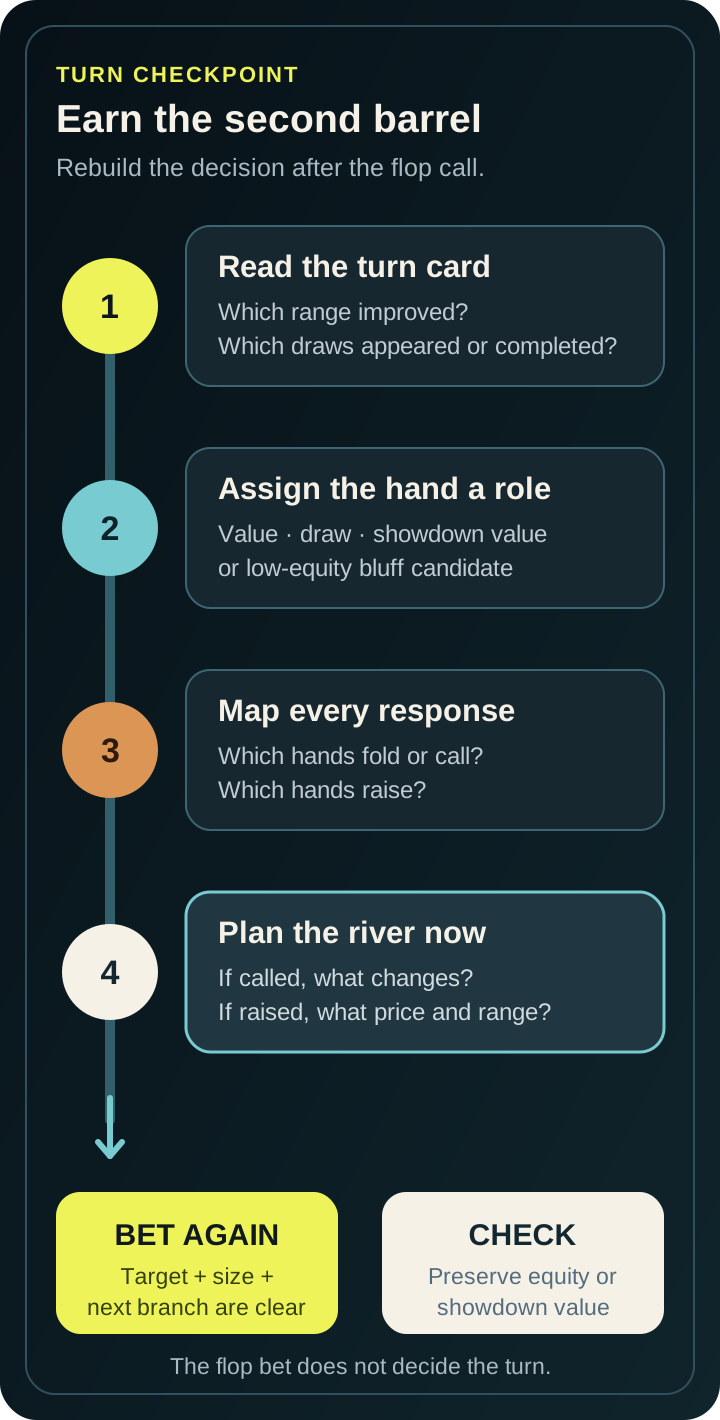
Use four checkpoints. First, identify what the turn card changed for both ranges. Second, give your exact hand a role: value, draw, medium-strength showdown value, or low-equity bluff candidate. Third, map the opponent's plausible folds, calls, and raises. Fourth, state the river plan before placing the turn bet.
A double barrel has a coherent case when its target and follow-up are clear. A value hand can name weaker calls. A bluff can name stronger folds. A semi-bluff can explain both the immediate fold branch and the useful river cards when called. If none of those branches is convincing, checking may preserve more value or avoid an expensive automatic line.
Run the checkpoints in order. Starting with a favorite size can tempt you to invent a purpose afterward. Starting with the turn card and ranges makes the amount serve a plan that can be challenged.
Which turn cards support a second barrel?
A useful barrel card often changes the response boundary in a way you can explain. An overcard may strengthen more of the flop bettor's value range than the caller's range. A card that completes a draw may support some value hands and bluffs, but it may also strengthen the caller who continued with that draw. A board pair can reduce some combinations while making other hands less comfortable.
Do not call a card scary and stop there. Name the better hands expected to fold, the worse hands expected to call, and the draws or made hands that improved. If the new card strengthens the caller's continuing range more than your betting range, the second barrel may need a tighter set of hands or no bet at all.
Blank turns can still support a barrel, especially when the flop plan already included value hands and draws that benefit from another wager. But a blank is not permission to repeat the flop automatically. The opponent's call itself is new information that must be reflected in the turn range.
Which hands make reasonable double-barrel candidates?
Strong value hands are natural candidates when enough weaker made hands or draws can continue. The review should name those calls and consider whether a raise is welcome, manageable, or a sign that the hand's value region is narrower than expected.
Draws with little showdown value can make useful semi-bluffs when they benefit from folds and retain meaningful ways to improve when called. Candidate quality depends on the exact cards. A blocker that removes likely calls can help a bluff, while a card that removes missed draws or weaker continues can work against it.
Medium-strength hands often deserve a careful check comparison. If betting folds out most worse hands and gets action mainly from better hands, the second barrel may turn usable showdown value into an isolated losing branch. Some low-equity hands should also give up when they have poor fold targets, unhelpful blockers, or no credible river follow-through.
What does a complete double-barrel example look like?
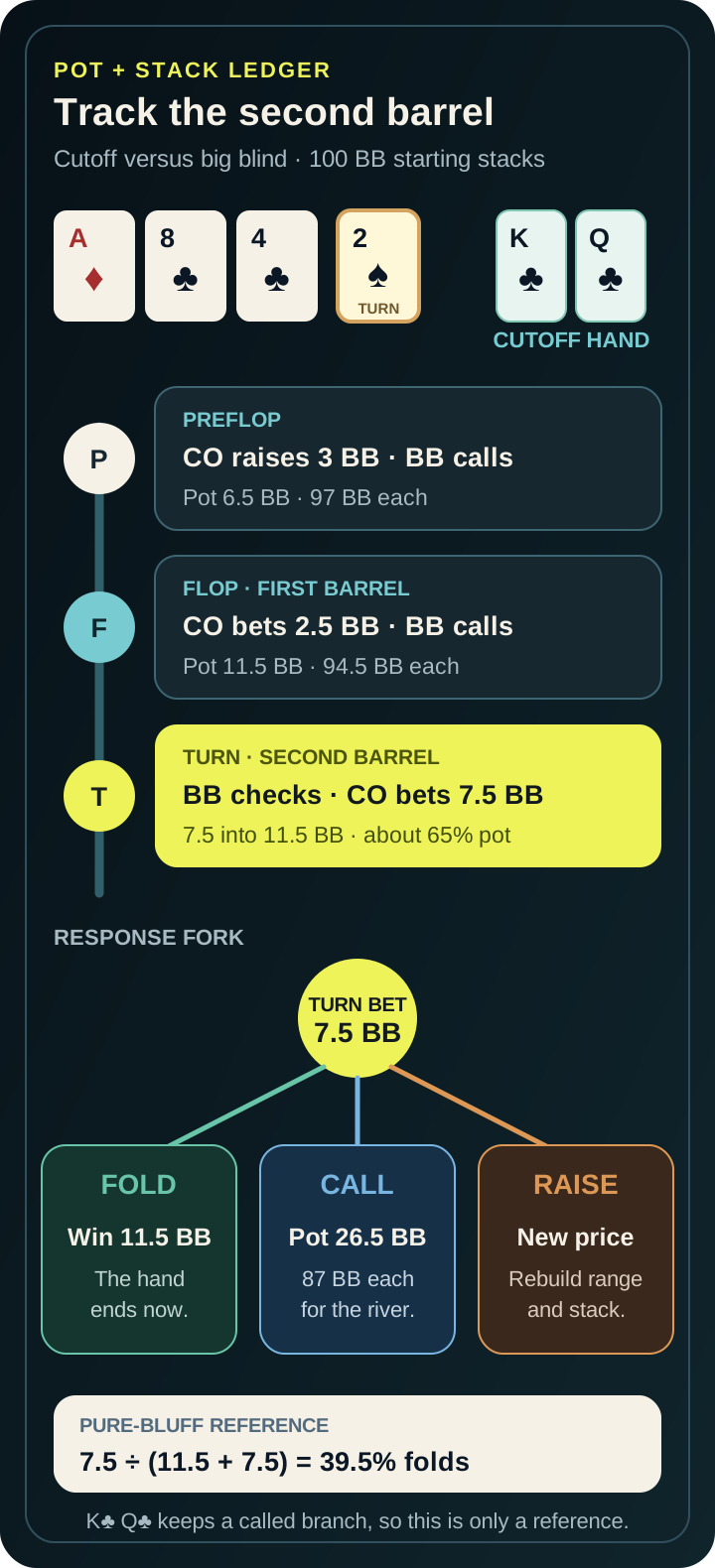
Consider a six-handed 100 BB cash hand. The cutoff holds K♣ Q♣ and raises to 3 BB. The small blind folds and the big blind calls to 3 BB. Before rake, the flop pot is 6.5 BB: 3 BB from each active player plus the folded small blind's 0.5 BB.
The flop is A♦ 8♣ 4♣. The big blind checks, the cutoff bets 2.5 BB, and the big blind calls. The two flop contributions add 5 BB, so the turn pot is 11.5 BB. The cutoff has king-high with a club flush draw, while the big blind's calling range can include aces, eights, fours, club draws, straight draws, and occasional stronger hands.
The turn is 2♠ and the big blind checks. Suppose the cutoff considers betting 7.5 BB, about 65% of the pot. If the big blind folds, the cutoff wins the 11.5 BB pot. A pure bluff of 7.5 BB would need folds about 39.5% of the time because 7.5 divided by 19 is approximately 0.395.
K♣ Q♣ is not a pure bluff, so that threshold is only a reference. When called, the hand can still improve on some rivers, and the exact called branch depends on the big blind's range, the cleanliness of the outs, and the river action. If the 7.5 BB bet is called, the river pot becomes 26.5 BB and each player has 87 BB behind.
The review now has concrete branches. Which one-pair hands fold to 7.5 BB? Which club draws continue, and which of those are dominated or dominating? What raises the turn? Which river cards support a third bet, a value bet after improving, or a check? The double barrel is reasonable only if those answers make a stronger case than checking behind.
How should you choose a double-barrel size?
Choose the turn size by working backward from the response range and forward to the river. A smaller bet risks less and can keep weaker hands and draws calling. A larger bet offers a worse price, may pressure more medium-strength hands, and builds a larger river pot. Neither effect proves that one size is best for every turn.
Compare at least two plausible sizes with checking. For each bet, list which hands call, fold, and raise. Then calculate the river pot and stack if called. If two sizes produce almost the same folds, the larger risk needs another reason. If a smaller size collects calls from hands you beat, that difference may matter more than the headline percentage.
Keep the betting range coherent. A size chosen for strong value hands needs enough bluffs or semi-bluffs to avoid describing only one part of the range, while a bluff-heavy size still needs credible value. The goal is not mechanical balance in every live spot; it is to prevent the chosen amount from contradicting the story told by the available hands.
When is checking the turn better than firing again?
Checking becomes attractive when the turn helps the caller, the flop call leaves few realistic folds, or your hand has showdown value that dislikes being raised. It can also preserve a draw's equity when a bet would face an uncomfortable check-raise or create a river pot that does not fit the remaining stack.
A check is not necessarily surrender. In position, it guarantees a river card and keeps weaker hands or bluffs in the opponent's range. Out of position, it can protect a checking range and prepare a call, fold, or raise depending on the size faced. The value of checking comes from its branch, not from avoiding a difficult decision.
Compare honestly. Ask what you gain when the opponent folds, what you lose when worse hands fold, what calls, and what raises. If the barrel explanation relies only on momentum—"I bet the flop, so I had to keep going"—the turn review has not found a strategic reason yet.
What should happen after the second barrel is called or raised?
A call creates a river plan, not a promise to bet again. Rebuild the range after the turn call and sort rivers into useful groups: cards that improve your hand, cards that favor your value range, cards that complete the caller's draws, and cards that leave the relative ranges mostly unchanged. Decide again on the river.
A raise demands a separate price and range review. Do not continue only because the hand began as a semi-bluff or because folding feels inconsistent with the previous bet. Record the raise size, final pot if called, remaining stacks, value region, bluff region, and the equity your exact hand may retain.
The planned response matters even when it never occurs. A turn bet with no answer to a likely raise or call is incomplete. Writing the branch before judging the outcome reveals whether the second barrel was a decision or merely a continuation of the first bet.
How do multiway pots change a double barrel?
A multiway double barrel must pass through more than one continuing range. The flop bet and call may leave a player behind who can still hold strong made hands, draws, or traps. A bluff wins immediately only if every remaining opponent folds, while a value bet may be called or raised from more than one seat.
Build each opponent's range separately and respect action order. One player's fold does not validate the bet if another player's range is strong enough to continue. The additional ranges often narrow the useful bluff region and make stack relationships more complicated, though the exact adjustment still depends on positions and cards.
Which double-barrel mistakes are most common?
The first mistake is betting the turn because the flop bet was called. The second is calling every overcard a good barrel card without checking which range it actually helps. The third is using the flop range again after the call instead of removing hands that folded or took another action.
Other mistakes include choosing the size before the target, counting a semi-bluff as though it were a pure bluff, ignoring the hands that raise, and planning no river branch. Results create another trap: a turn fold does not prove the barrel was sound, and a call followed by a missed draw does not prove it was poor.
Finish with one conditional lesson. For example: "After a flop call, rebuild the continuing range before deciding whether the turn card earns another bet." That cue is portable without turning one completed hand into a rigid rule.
How should you review a double barrel after the hand?
Reconstruct the hand through the turn and hide the river result. Verify the positions, effective stack, board, flop pot, flop bet and call, turn pot, and amount considered or wagered. Then write the opponent's flop calling range before looking at the turn action.
Run the four checkpoints: turn-card change, hand role, response map, and river plan. Compare checking with at least two realistic sizes. If one uncertain assumption changes the preferred action, keep the lesson conditional and record which read matters.
In Tells Poker, Replay can move through the completed hand one action at a time with the board, seats, pot, remaining stacks, and wagers attached to the sequence. Pause after the flop call and again before the turn bet. When available, the Analysis tab can organize deterministic spot math, conditional range reasoning, street-by-street feedback, and an alternative line. Use it as a post-session structured second opinion, not live assistance or a final ruling.
Frequently asked questions
Does a double barrel have to be a bluff?
No. A double barrel only describes the same player betting the flop and turn. The turn bet may be for value, a semi-bluff, a pure bluff, or a mixed-purpose wager depending on the hand and expected responses.
Is a turn bet always a double barrel?
No. The same player must also have bet the flop. A player who checked the flop and bets the turn is making a delayed bet or delayed continuation bet when the preflop action fits, not a double barrel.
What is the difference between a double barrel and a triple barrel?
A double barrel is a flop bet followed by a turn bet from the same player. A triple barrel adds a river bet from that player after the flop and turn bets.
Should you double barrel every good turn card?
No. First ask how the card changes both ranges, which hands call, fold, or raise, what your exact hand gains from betting, and what river branch the chosen size creates.