
A probe bet in poker is a bet made from out of position on a later postflop street after the previous street checked through. The classic example is a big blind checking the flop, the preflop raiser checking back, and the big blind leading the turn. The skipped bet changes both ranges, so a probe should be reviewed as a new decision rather than an automatic attack on weakness.
A probe can be for value, protection, or as a bluff or semi-bluff. Its defining feature is the action sequence, not the strength of the bettor's hand. The player who acts later declined to bet the prior street, then the out-of-position player leads when a new card arrives.
Use the term as a label, not a verdict. A checked-back flop can make some strong hands less likely, but it does not make the in-position range empty or capped in exactly the same way every time. Board texture, positions, stack depth, prior sizing, and the new street all decide whether the probe has a clear purpose.
What does probe bet mean in poker?
A probe bet means the out-of-position player leads after the immediately previous street checked through. In a common single-raised pot, the preflop caller checks the flop, the preflop raiser checks back, and the caller bets the turn. A river lead after both players check the turn can also be described as a probe.
The checked-through street is essential. If the caller leads the flop before the preflop raiser has acted, that is usually called a donk bet or flop lead. If the preflop raiser bets the flop, receives a call, and the caller leads the turn, that is also a lead into the previous aggressor rather than the standard probe sequence.
Poker terms can vary between players, so preserve the action instead of arguing over a label. “Big blind checked, button checked back, big blind bet the turn” is unambiguous and gives a review everything it needs.
How is a probe bet different from a continuation bet or donk bet?
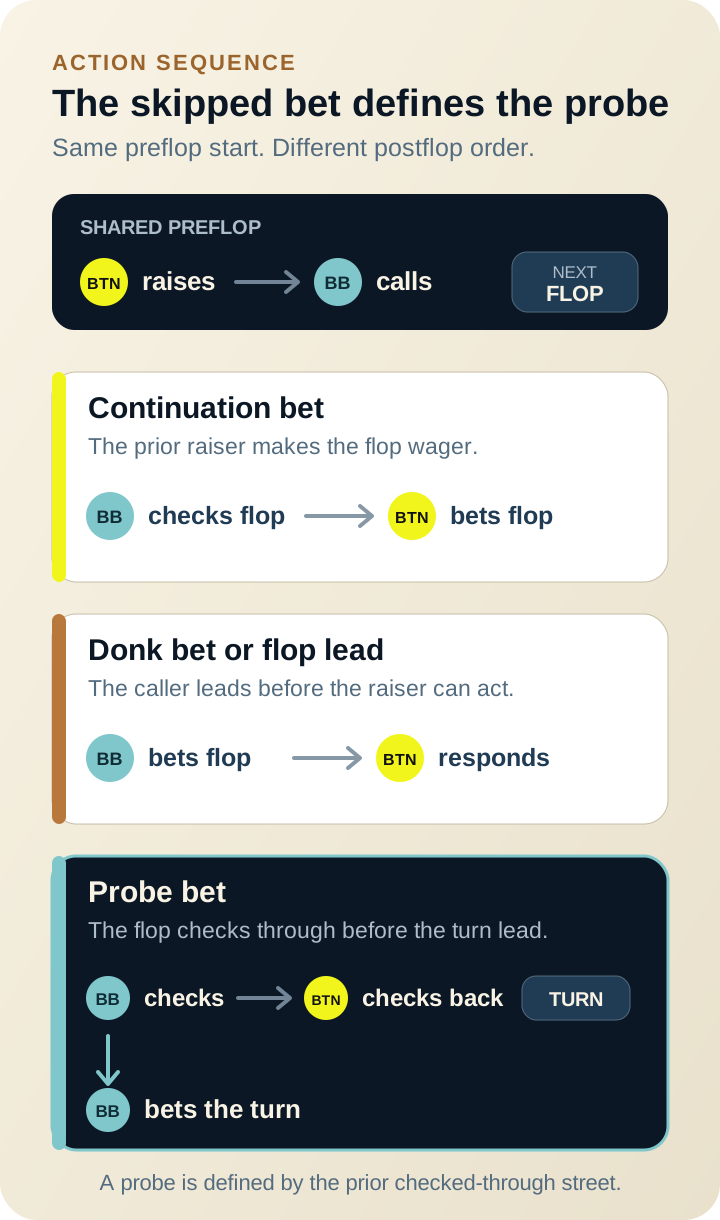
A continuation bet is made by the player who took the last aggressive action before the flop. A donk bet is made into that aggressor before the aggressor can act on the next postflop street. A probe follows a street on which the aggressor had the opportunity to bet but checked instead.
Consider three sequences after the button opens and the big blind calls. If the big blind checks and the button bets the flop, the button made a continuation bet. If the big blind bets the flop first, the big blind led into the preflop aggressor. If both players check the flop and the big blind bets the turn, the big blind made the classic probe bet.
The distinction matters because each sequence contains different information. A probe happens only after both players reveal something through a check: the big blind declined to lead the flop, and the button declined to continuation-bet it. The turn bet responds to that new range information and to the turn card.
What does the checked-back flop change?
The flop check-back makes some hands less likely in the button's remaining range, but not every strong hand. The button may check medium-strength made hands, weak showdown value, draws that prefer a free card, or occasional traps. Which hands check depends on the board and on how both players reached the flop.
The big blind's flop check matters too. Some hands may have checked with the intention of calling, some were giving up, and some were waiting for a favorable turn. The turn card can promote a draw, make two pair, add a scare card, or leave the board nearly unchanged. A sound probe range grows out of those specific transitions.
Avoid the shortcut “they checked, so they are weak.” A better question is: which value hands, medium hands, draws, and misses plausibly checked back this flop, and how does the turn change their responses? That creates a range to bet into rather than a story about one exact hand.
Which hands can make a reasonable probe bet?
A reasonable probe range can contain hands that want calls from worse, hands that benefit when overcards or weak pairs fold, and draws that can improve when called. It should also keep enough checks to protect the hands that do not want to build the pot.
Value probes need a response target. Ask which worse pairs or draws can call. A hand is not automatically a value bet because it improved on the turn; if only better hands continue, checking may preserve more value. Protection can support a bet when many worse hands still have useful river equity, but protection is not a substitute for naming the likely calls and folds.
Semi-bluffs are natural candidates when the turn adds equity and the hand has little showdown value. They can win when better high-card hands or weak pairs fold and still improve on some rivers when called. Pure bluffs need an even clearer fold target because their called branch offers fewer ways to recover.
Medium-strength hands often belong in the checking region. They may be ahead of the opponent's misses but uncomfortable against calls and raises. Keeping some strong hands in the check branch also prevents every check from announcing weakness.
What does a complete probe-bet example look like?
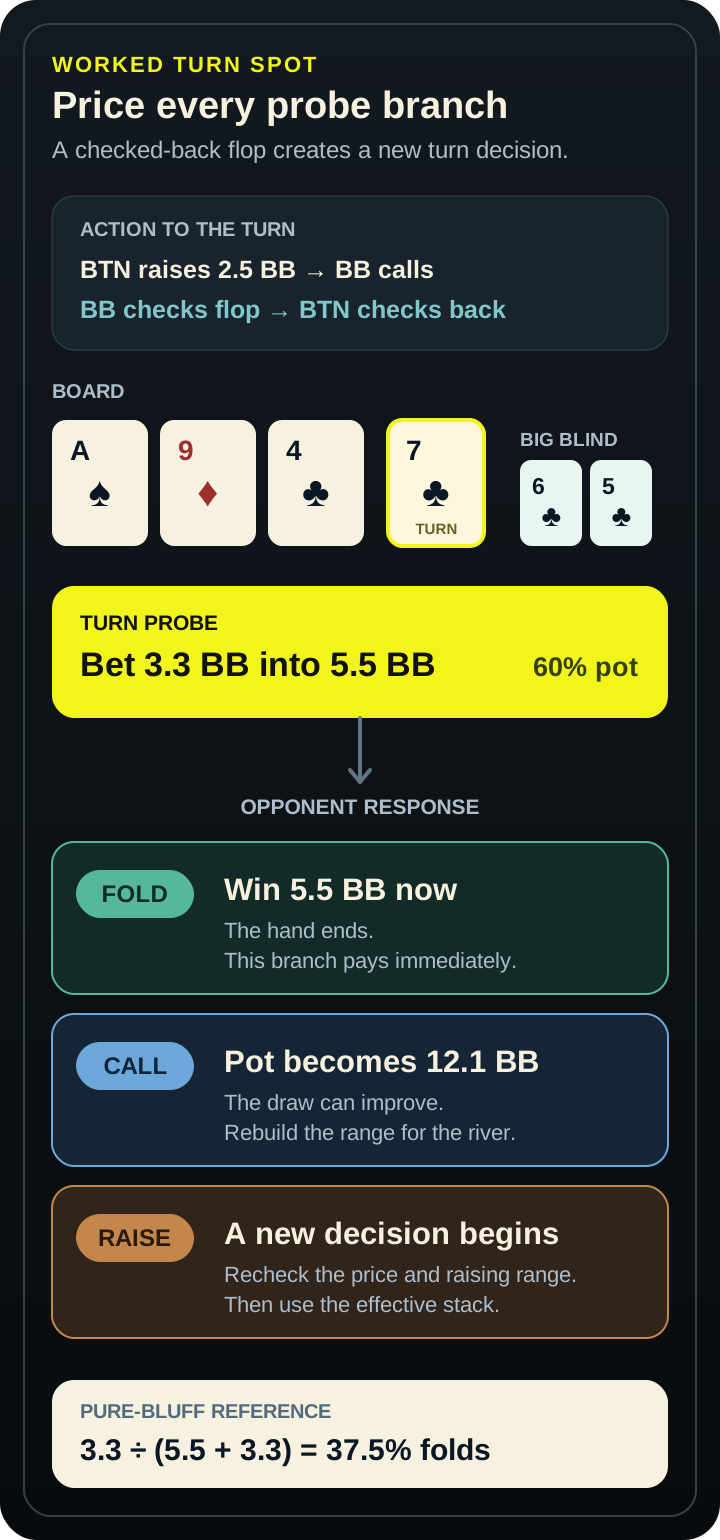
Take a six-handed cash hand with both players starting 100 BB deep. The button opens to 2.5 BB and the big blind calls, creating a 5.5 BB flop pot before any rake. The flop is A♠ 9♦ 4♣. The big blind checks, and the button checks back.
The turn is 7♣. Holding 6♣ 5♣, the big blind now has a straight draw and a flush draw but only six-high at showdown. A 3.3 BB probe into 5.5 BB is considered. The size is 60% of the pot because 3.3 divided by 5.5 equals 0.60.
The bet has three response branches. A fold wins the 5.5 BB pot immediately. A call creates a 12.1 BB pot and leaves a river decision; some clubs, threes, and eights improve the hand, while other rivers may lead to a check or a carefully selected follow-through. A raise creates a new decision that must be considered before betting, not improvised afterward.
The target range may include unpaired broadway hands and some pocket pairs that checked back once. Ace-x, many nine-x hands, stronger draws, and slow-played hands can continue. The turn 7♣ helps the big blind hold more two-pair, pair-plus-draw, and straight-draw candidates, but the button can still retain strong checks. The probe is reasonable only if the estimated folds, called-branch equity, and future plan compare well with checking.
For a simplified pure bluff that always loses when called, 3.3 BB risked to win 5.5 BB needs folds 3.3 divided by 8.8, or 37.5% of the time. That is only a reference point here because 6♣ 5♣ has meaningful equity when called and the hand still has a river. The formula exposes the immediate fold assumption; it does not solve the full decision.
How should you choose a probe-bet size?
Choose the size from the range you are targeting, the value hands you represent, and the branches you want to create. There is no single automatic probe size. A smaller bet risks less and can value-bet more broadly, but it gives calls a better price. A larger bet asks more of bluff-catchers and draws, while requiring a range that can support the pressure.
Keep the pot and remaining stack visible. In the example, betting 3.3 BB makes a 12.1 BB pot after a call and leaves 94.2 BB effective for the river. That is very different from probing in a low-SPR pot where one bet may commit a large share of the remaining stack.
Do not choose the number only because it looks standard. Write the hands expected to call, fold, and raise at that size. Then compare at least one smaller or larger option and a check. If the target barely changes while the risk grows sharply, the larger size needs a stronger reason.
How should the turn card affect a probe?
The turn card should change the probe range through both players' likely holdings. A card that improves many big-blind calls while connecting less often with the button's check-back range can create more credible value and semi-bluffs. A card that strongly improves the button's checks may make indiscriminate probing expensive.
Think in hand classes rather than slogans such as “good card for me.” Ask which two pair, straights, flushes, pairs, and draws each player can now hold. Then compare those groups with the flop hands that were likely to bet or check. The useful insight comes from the transition, not from the turn rank by itself.
Some blank turns can still support a probe when the flop check-back leaves many hands that dislike pressure. Some dramatic turns should still be checked when they improve the opponent's continuing range or leave the bettor without credible value. The action history and the card work together.
What should happen after a probe gets called?
A called probe creates a new range filter. Remove or reduce hands that would usually fold the turn, keep the hands and draws that can call, and plan the river against that narrower group. Do not fire a second bet merely because the turn plan failed to end the hand.
Before probing, sort rivers into broad groups. Some improve the hand. Some favor the story represented by the turn bet. Some add showdown value but make another bet unattractive. Others strengthen the caller's range or leave too few better hands that can fold. The plan can be conditional without pretending every river is known in advance.
If the opponent raises the turn, revisit the price, stack, and raising range. A draw with strong equity may continue in one configuration and fold in another. The probe label no longer answers the decision once a raise changes the pot and the range.
How do multiway pots change a probe bet?
Multiway probes need more restraint because a checked-through street contains information from several players, not just one. One player may have checked a medium hand while another checked a trap. A bluff must get through every range that remains, and a value bet must identify worse hands that can call from more than one seat.
Preserve the action order. If the first player checks, a second player checks, and a third player checks behind, the first player may lead the next street. Review each player's check separately by position and prior action. Do not combine the field into one vague “weak range.”
Effective stacks can also differ by opponent. The shallowest relevant stack may constrain one branch while a deeper player still has room to raise or continue on the river. Record the remaining stack for each active player before judging the lead.
Which probe-bet mistakes are most common?
The first mistake is probing every time the preflop raiser checks back. The check changes the range; it does not surrender the pot. Automatic betting turns a useful option into a visible habit.
The second mistake is using one size with every hand. Value, protection, and bluff candidates may prefer different pressure, and the board may support a narrow large-bet range or a broader small-bet range. Start with the target and response branches, then select the size.
The third mistake is planning only for a fold. Calls and raises are part of the turn decision. A probe without a river map or raise response can look attractive only because its expensive branches were left blank.
The final mistake is grading the probe by the result. A fold does not prove the range and size were coherent. A call or raise does not prove they were wrong. Review the assumptions first and use the result as one observation afterward.
How should you review a probe bet after the hand?
Review a probe bet in six passes. First, rebuild the exact action and confirm that the prior street checked through. Second, construct both players' ranges before the new card. Third, identify what the new card changes. Fourth, divide your possible bets into value, protection, semi-bluffs, and pure bluffs. Fifth, compare sizes and a check across fold, call, and raise branches. Sixth, reveal the result and save one conditional lesson.
Keep the conclusion narrow. “Probe more turns” is too broad. “After this flop checks through, this turn gives my low-showdown draws more equity and leaves enough better unpaired hands to target” is tied to a repeatable structure while preserving its assumptions.
In Tells Poker, capture the completed hand with the positions, board, sizes, and action in order. Use Replay to stop at the checked-through flop and the turn lead, then use Analysis to inspect the price, range groups, street-by-street review, and an alternative line when those outputs are available. Treat that analysis as a structured second opinion, not a perfect or definitive play.
Frequently asked questions
Is a probe bet always a bluff?
No. A probe range can include value bets, protection bets, semi-bluffs, and pure bluffs. The action sequence defines the probe, while the hand and expected responses define its purpose.
Can a probe bet happen on the river?
Yes. An out-of-position river lead after the turn checks through can be described as a probe. The same review applies: rebuild the checked-through street, update both ranges for the river, and identify the worse calls or better folds the bet targets.
Is a probe bet the same as a donk bet?
No. A classic donk bet leads into the prior aggressor before that player acts on the next street. A classic probe comes after the aggressor had a chance to bet the previous street and checked back.