
A donk bet in poker is a postflop bet made by a player who called the aggression on the previous street and now acts before that aggressor. The classic example is a big blind who calls a button raise preflop, then bets the flop before the button can make a continuation bet.
The term describes action order, not decision quality. A donk bet can be a thoughtful value bet, bluff, semi-bluff, or range-based lead. It can also be a mistake. You cannot grade the play from the label alone; you have to compare the leading range, the checking range, the size, and the likely responses.
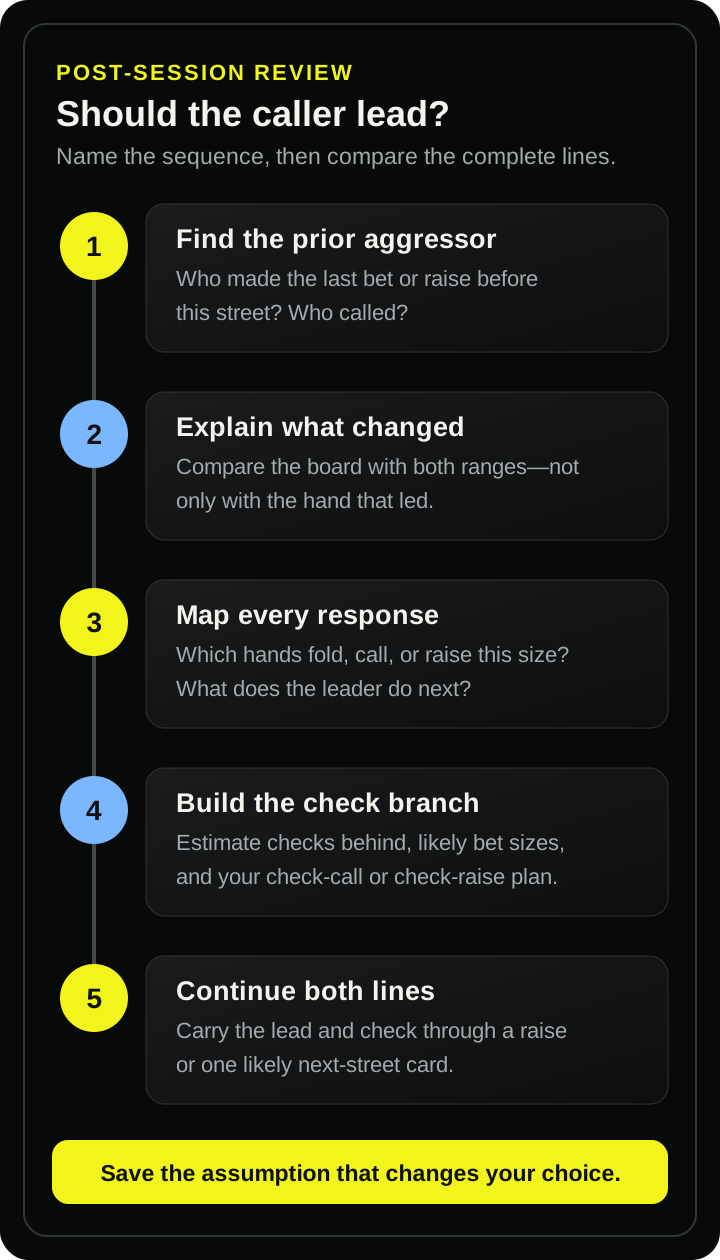
Review a donk bet after the hand is complete. Identify the previous aggressor, rebuild both ranges, ask what changed on the new street, and compare leading with checking through the call, fold, and raise branches. Treat any analysis as a structured second opinion rather than proof of one perfect line.
What does donk bet mean in poker?
A donk bet is a lead into the player who made the last aggressive action on the previous street. Most often, the phrase refers to a flop bet by a preflop caller into the preflop raiser. The caller acts first and bets instead of checking to the player who could have made a continuation bet.
The same sequence can appear later. A player may call a flop bet, then lead the turn before the flop bettor acts. In each case, the defining feature is not the cards, size, or intention. It is the transfer of initiative from the previous aggressor to the previous caller at the start of a new street.
If nobody raised preflop, the first flop bet is simply a bet or lead because there is no preflop aggressor to lead into. If the preflop raiser bets the flop, that action is a continuation bet. Naming the sequence correctly keeps the review focused on what actually happened.
What is the difference between a donk bet and a continuation bet?
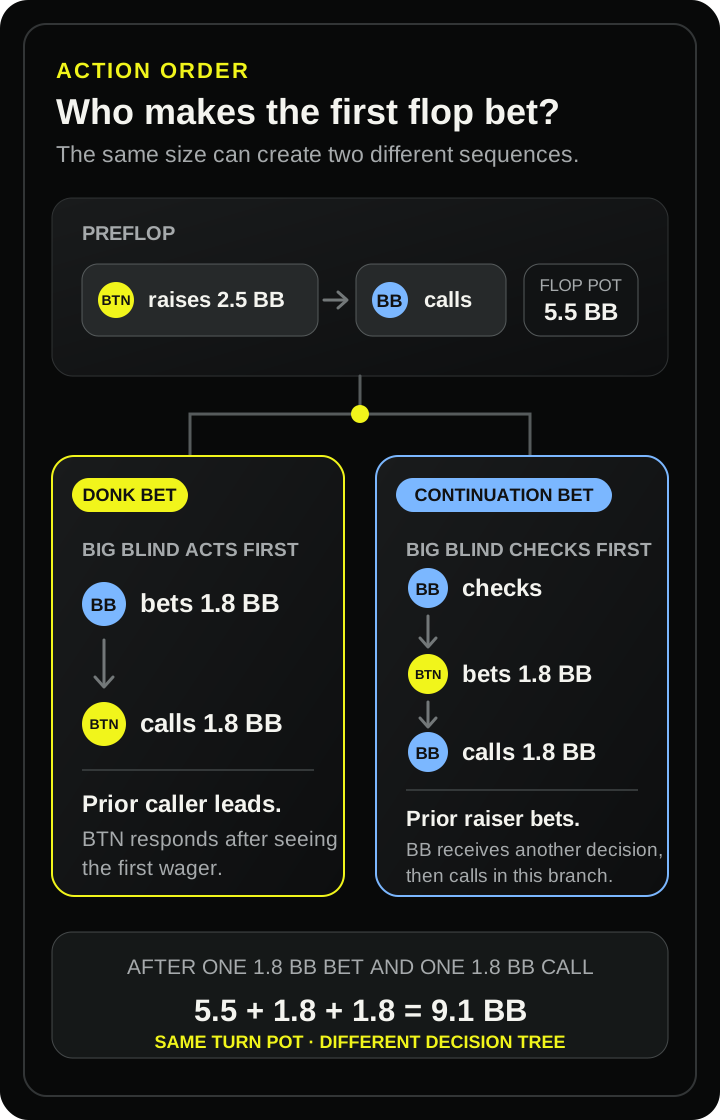
A continuation bet continues the prior aggression; a donk bet interrupts it. Suppose the button raises to 2.5 big blinds, the small blind folds, and the big blind calls. Ignoring rake, the flop pot is 5.5 BB. A button bet after a big-blind check is a c-bet. A big-blind bet before the button acts is a donk bet.
Action order, not bet size, creates the distinction. In the simplified example below, both branches use a 1.8 BB flop wager and both reach a 9.1 BB turn pot after one call. The label changes because a different player makes the first wager.
That difference also changes the decision tree. When the big blind leads, the button can fold, call, or raise. When the big blind checks, the button may check behind or choose a bet, after which the big blind gets another decision. Equal final pot sizes do not make those strategic branches equal.
Is a donk bet automatically a bad play?
No. The name is historical poker slang, not a verdict. A lead is useful when its range and purpose make more sense than checking. It is poor when it is chosen from habit, reveals one narrow hand class, uses a size without a target, or ignores how the prior aggressor can respond.
Avoid evaluating the action by whether it won the pot. A weak lead can receive a fold, and a coherent lead can run into the top of a range. Post-session review should ask whether the information available at the time supported the line, not whether the next card or showdown rewarded it.
The most productive question is not “Are donk bets good?” Ask: “Which hands lead here, what do they expect to call or fold, and why is betting now better than checking?” That version can be answered from the specific board, ranges, stacks, and size.
Why might a player lead into the previous aggressor?
A player may lead to collect value before the opponent checks behind, to set a price with a draw, to apply pressure with a bluff, or to represent a part of the board that fits the caller's range. These are possible reasons, not automatic justifications. Each one needs a credible target and a plan for resistance.
Board changes can create a clearer leading candidate. A turn card may improve hands that commonly called the flop while weakening the prior bettor's strongest region. A connected low flop may also give the big blind plausible two-pair, straight, pair-plus-draw, and strong-draw combinations. But range assumptions must follow the actual positions and action rather than the board alone.
Leading can also prevent a check-back, but that benefit has a cost. Betting may fold hands that would have bluffed, face a raise from stronger holdings, or build a pot with a hand that preferred a cheaper route to showdown. Compare the lost and gained branches together.
What should a donk-betting range contain?
Start with purpose. Value leads need worse hands that can continue. Bluff leads need better hands that can fold. Semi-bluff leads need both realistic fold targets and useful equity when called. Medium-strength hands may lead at some sizes or remain in the checking range, depending on how both ranges interact with the board.
Do not build the range from one memorable hand. If only the strongest made hands lead, observant opponents can fold too often. If only draws lead, calls and raises become easier. A coherent leading strategy normally considers strong hands, draws, and selected weaker hands together, while leaving enough playable hands behind in the checking range.
This does not require inventing exact frequencies during a casual review. Group hands by role, note the uncertain boundary cases, and test whether the proposed range still makes sense when the opponent calls or raises. Clear categories are more useful than false decimal precision.
How should you choose a donk-bet size?
Choose the size from the objective and the expected response. A small lead may keep weaker pairs and draws involved, offer the bettor's bluffs an inexpensive raise, or let many hands continue. A larger lead asks more of the opponent's medium range but risks isolating the bettor against stronger calls and raises.
Measure the wager against the current pot and the effective stack. In the earlier 5.5 BB flop, a 1.8 BB lead is about one-third pot. If called once, the turn pot becomes 9.1 BB: 5.5 plus the 1.8 BB bet plus the 1.8 BB call. That arithmetic describes the pot; it does not prove the size is best.
Before approving a size, name at least one worse hand that calls, one better hand that might fold if bluffing is part of the purpose, and the hands likely to raise. Then inspect the remaining stack and the next street. A lead without a response to a raise or a blank turn is only half a plan.
What does a complete donk-bet example look like?
Consider a heads-up pot in which the button raises preflop and the big blind calls. The flop is 8-spades, 6-diamonds, 3-clubs. The big blind holds 8-hearts, 6-hearts for top two pair and acts first. Betting now would be a donk bet because the preflop caller leads into the preflop raiser.
A lead can seek calls from overpairs, top-pair hands, and straight draws. A check can allow the button to continuation-bet bluffs and value hands, but it also permits a free card when the button checks behind. The review should estimate both branches rather than declaring that a strong hand must always take one of them.
Now change only the big blind's holding to 7-hearts, 5-hearts. The same lead becomes a draw-driven aggressive action rather than a value-heavy one. Its case depends more on fold equity, clean improvement cards, and how it handles a raise. The board and action label stayed fixed; the hand's role and branch values changed.
How do position and multiway pots change a donk bet?
In a heads-up postflop pot, the donk bettor acts before the prior aggressor and is therefore out of position in that matchup. The lead takes the first decision on the street, but the prior aggressor still receives the final immediate response and can call or raise after seeing the bet.
Multiway pots add more response points. If the big blind leads into a cutoff raiser while the button also called preflop, the wager must pass through the cutoff and the button. The button may continue even if the original raiser folds, so a heads-up estimate of calls, folds, and raises is incomplete.
Track each eligible player separately. Identify which player was the prior aggressor, who acts between the leader and that aggressor, and who remains behind. One label cannot replace the full action order.
Which donk-bet mistakes are most common?
One mistake is treating every out-of-position bet as a donk bet. The prior-street action matters. Another is assuming the term itself means weak play. That shortcut prevents a real comparison of ranges and branches.
Players also lead only when they improve, choose a size from hand strength alone, or focus on the opponent's fold while ignoring calls and raises. Those patterns can make the line narrow and easy to respond to. The correction is to build the leading and checking ranges together.
A final mistake is stopping at the first wager. When a lead is called, the turn pot, remaining stack, and changing board create another decision. When it is raised, the bettor needs a continuing plan. Review the first bet as the opening of a line rather than its conclusion.
How should you review a donk bet after the hand?
First, reconstruct the previous street and identify the last aggressor. Second, freeze the new street before the lead and describe how the board interacts with both ranges. Third, sort the opponent's plausible hands into folds, calls, and raises against the chosen size.
Fourth, build the check branch. Estimate how often the prior aggressor checks behind or bets, which sizes are plausible, and how your hand responds. Fifth, continue both lead and check branches through one likely next-street card or a raise. Save the assumption that changes your preference.
Finish with a narrow lesson, such as: “When the turn improves more of my flop-calling range, compare a small lead with check-call before defaulting to another check.” A conditional cue transfers to future study without pretending every similar-looking board is the same.
How can Tells Poker support a donk-bet review?
Tells Poker is built for completed-hand study, not real-time assistance. After the hand, capture the positions, cards, stacks, and action. Use Replay to verify who made the last aggressive action and who placed the first wager on the next street.
In the Analysis tab, the current debrief can organize the key decision, deterministic spot math when available, range groups, a street-by-street review, and an alternative line. Use that output as a structured second opinion. It cannot know hidden cards or turn an estimated opponent range into certainty.
Bring a precise comparison to the review: “What continued against my lead, what would have bet after I checked, and how did the size change the next street?” That question keeps the action order, range assumptions, and alternative branch attached to the saved hand.
Frequently asked questions
Is a donk bet the same as a continuation bet?
No. A continuation bet is made by the prior aggressor. A donk bet is made before that player can act by someone who called the prior aggression and now leads the new street.
Can a donk bet happen on the turn or river?
Yes. The term can describe a player who calls a bet on one street and leads into that bettor on the next. The common textbook example remains a preflop caller leading the flop into the preflop raiser.
Does the size make a bet a donk bet?
No. A small, medium, or large wager can be a donk bet. The label comes from the previous aggression and the order of action on the new street, not from the percentage of the pot wagered.
Can there be a donk bet in a limped pot?
Not under the usual definition because no player made a preflop raise to become the prior aggressor. The first postflop wager in a limped pot is simply a bet or lead.