
A float in poker is a postflop call made partly with the plan to win the pot on a later street, often by betting after the original bettor checks. The common example is an in-position player calling a flop continuation bet, then betting the turn when checked to.
The flop call alone does not prove that a player floated. A normal call may be made for value, with a draw, or to reach showdown. A float has a later-street plan: the caller expects some turn cards and checks to create a credible opportunity to apply pressure. That plan can still be abandoned when the next card or action is unfavorable.
Review a float only after the hand is complete. Rebuild the flop ranges, price, position, turn cards, and opponent responses before deciding whether the call created a useful branch. Treat any analysis as a structured second opinion, not proof of one perfect play.
What does float mean in poker?
To float means to call a postflop bet with more than immediate hand strength in mind. The caller intends to contest the pot later when the bettor slows down or when the board changes in a useful way. Most textbook examples begin with an in-position flop call and a turn bet after the flop bettor checks.
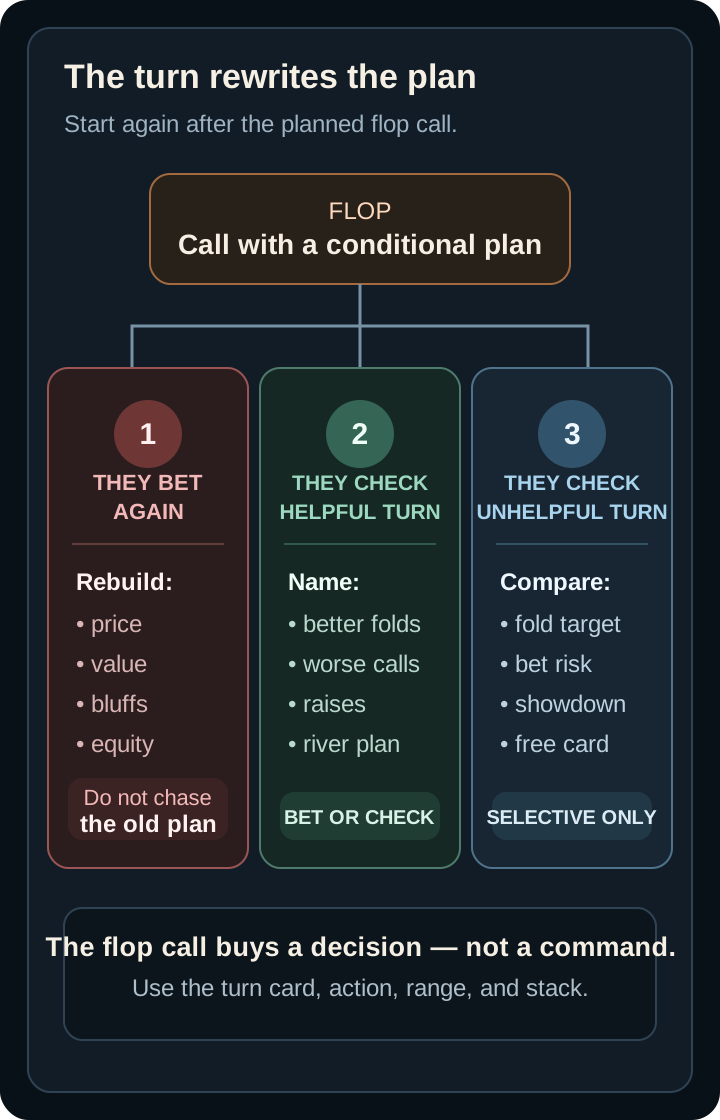
A float is a sequence, not a single button press. The flop call keeps the hand alive; the later action tries to convert position, range pressure, or improving equity into a chance to win. If the opponent bets again, the caller must reassess instead of following the original plan automatically.
The term describes an intention, not a verdict. A float can be thoughtful or poorly chosen. It can win immediately on the turn and still have been too loose on the flop, or it can lose after a sound call because the opponent continued with a strong range.
How is a float different from an ordinary call?
An ordinary call may continue because the hand is already strong enough against the betting range, because the price supports drawing, or because raising would fold out too many worse hands. Those calls do not need a planned bluff on the next street to make sense.
A float gives meaningful weight to a later opportunity. The caller may have overcards, backdoor draws, a weak pair, or occasionally very little immediate showdown value. What matters is that the call comes with a conditional plan: which turn cards help, which checks invite a bet, which better hands might fold, and which continued bets end the attempt.
Do not relabel every flop call followed by a turn bet as a float. A player who calls with a strong made hand and later bets for value is not using the same idea. A player who calls a draw and bets after improving may simply be value betting or semi-bluffing the new hand. Intent and range purpose separate the lines.
Why is position useful when floating?
Position lets the caller see the opponent's turn action before choosing what to do. After calling the flop in position, a check from the bettor provides new information and gives the caller the choice to check back or bet. That extra observation makes the later-street plan easier to control.
Position does not make the float free. The flop call still costs chips, and the opponent can bet again, check-raise the turn, or check with a hand that plans to call. A player who floats only because acting last feels comfortable has not yet identified a target or a profitable branch.
Out-of-position floats are harder to define and execute because the caller acts first on the next street. Betting into the prior bettor becomes a lead rather than a reaction to a check. The line can exist, but it gives up the informational advantage that makes the common in-position float easier to explain.
What makes a reasonable float candidate?
Start with the opponent's flop betting range. A float needs some better hands that can stop betting and later fold. If the opponent's range is narrow, strong, and likely to keep applying pressure, calling only to take the pot away later has little room to work.
Next, examine your exact hand. Useful candidates often have ways to improve: overcards, backdoor straight or flush possibilities, or a weak made hand that may reach showdown when both players check. That equity is not a requirement for the label, but it gives the call another path besides forcing a fold.
Then inspect the board. A dry flop may make a small continuation bet easier for the bettor to use with a wide range, but it may also leave few credible turn improvements for the caller. A connected flop creates more developing draws, yet it can also give the bettor more strong hands and barrels. Use the actual ranges and runouts rather than treating one texture as an automatic float signal.
What does a complete floating example look like?
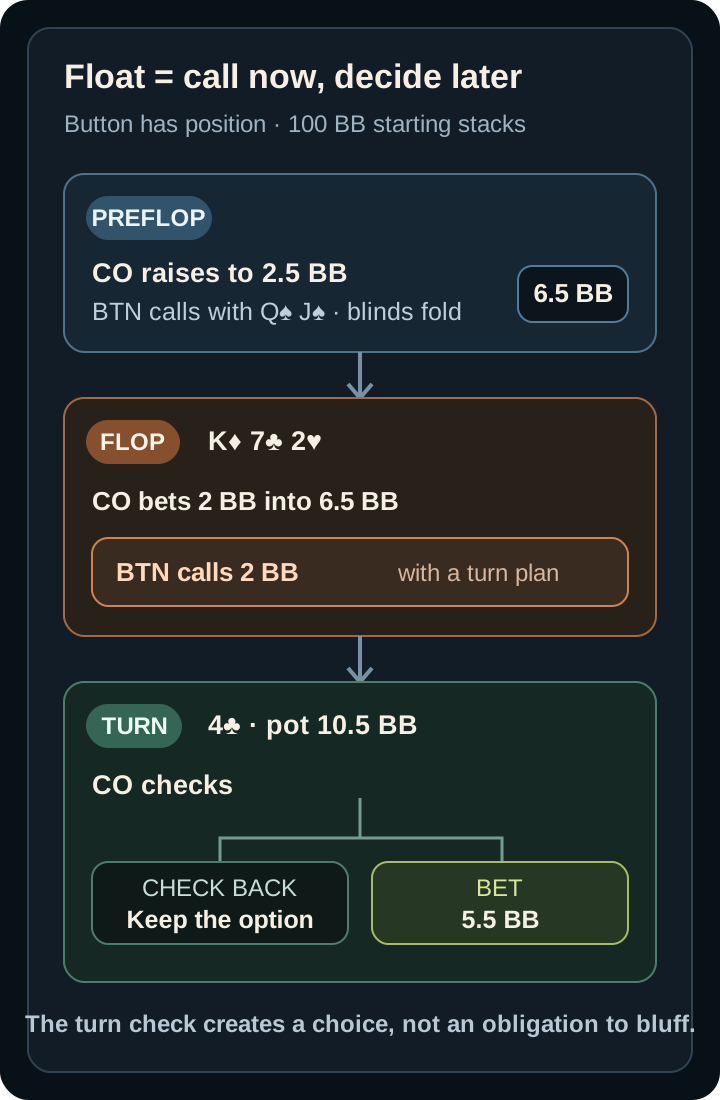
Consider a six-handed cash game with 100 BB starting stacks. The cutoff raises to 2.5 BB, the button calls with Q♠ J♠, and both blinds fold. The flop pot is 6.5 BB. On K♦ 7♣ 2♥, the cutoff bets 2 BB and the button calls, bringing the pot to 10.5 BB.
The button does not have a made hand, but the call has several possible branches. An ace or ten adds a straight draw, a queen or jack may improve to a pair, and some turns may cause the cutoff's weaker continuation bets to check. Those possibilities do not prove the call is good; they explain what the button must evaluate before paying 2 BB.
The turn is 4♣. The cutoff checks. The button bets 5.5 BB, a little more than half of the 10.5 BB pot, and the cutoff folds. This is a floating line because the flop call was made partly to contest later and the button used the turn check to bet. The fold is the result, not the proof. A proper review still asks which cutoff hands check-fold, check-call, or check-raise and whether Q♠ J♠ was a suitable flop call against the original betting range.
Which turn cards support a float?
A useful turn can improve your hand, improve your draw, or change how both ranges meet the board. Pairing an overcard may create showdown value. Adding an open-ended draw or flush draw gives a bet equity when called. A high card that fits the caller's preflop range may also pressure some of the bettor's one-pair or unpaired hands.
A scary-looking card is not automatically yours to represent. If the earlier action makes the opponent more likely to hold that card or a stronger made hand, betting it may apply pressure to the wrong range. Name the better hands expected to fold and the value hands you can credibly represent before using the turn as a reason to bet.
Blank turns can still produce floats when the opponent checks too much of a weak range, but the burden shifts toward range and sizing assumptions. With less added equity, the button depends more heavily on folds. That makes the opponent's check-calling region and the cost of being raised especially important.
How should you choose the turn bet size?
Choose the turn size by naming its target. A smaller bet risks less and may fold out unpaired hands that gave up after one continuation bet. A larger bet can pressure stronger pairs but must succeed more often and may run into a narrower, stronger continuing range.
In the example, betting 5.5 BB to win 10.5 BB needs folds 5.5 divided by 16, or about 34.4% of the time, if the hand has no equity when called and no later betting. Q♠ J♠ may retain some improvement chances, so that pure-bluff threshold is a reference point rather than the complete expected-value calculation.
Plan for every response. If the opponent calls, what river cards support another bet and which ones favor checking? If the opponent raises, does the hand have enough equity and the right price to continue? If those branches are blank, the turn bet may be an impulse rather than the second half of a float.
When should you abandon a float?
Abandon the plan when the new information removes its purpose. A strong turn barrel can represent a range that no longer contains enough give-ups. A turn card may improve the bettor more than the caller. A second player may remain in the pot, reducing the chance that one bet gets through both ranges.
You can also check back when the turn gives your hand enough showdown value or a useful draw that dislikes a check-raise. Calling the flop does not create a debt to bluff later. The value of the float comes from keeping a conditional option, not from forcing the planned action after the conditions change.
Stack depth matters as well. If a turn bet would commit most of the effective stack, the opponent can respond with stronger pressure and the river plan may disappear. Compare the amount at risk with the pot and remaining stack before carrying a low-equity idea across another street.
How do multiway pots change a float?
Multiway pots make floating more demanding because the flop call must pass through more than one continuing range. A player behind can call or raise, and a later turn bet may need folds from two opponents instead of one. The original bettor also has less reason to continuation bet weak hands into several players.
Position becomes relative. The button may act last against both opponents, while a middle-position caller can be in position on the bettor and out of position against someone behind. Record every remaining player before deciding that the flop call creates a clean turn opportunity.
Use a higher evidence bar in multiway reviews. Identify which value hands and draws each opponent can hold, who acts after you, and whether the turn card helps one range more than the others. A heads-up float rule should not be copied into a three-way pot without rebuilding those branches.
Which floating mistakes are most common?
The first mistake is calling because a flop bet looks small without naming the later plan. The second is betting every turn check, even when the new card helps the bettor or the check protects a strong range. A float requires both a plausible flop call and a selective turn decision.
Other mistakes include ignoring players behind, relying on one vague scary card, choosing a size without a folding target, and judging the float by whether it worked. Another is choosing hands with no equity, no useful blockers, and no credible river path when better candidates are available.
Results can hide both errors. A successful turn bet can reward a weak flop call, while a failed float can still reveal a sensible plan that ran into the strong part of the range. Grade the assumptions and branches separately from the pot won or lost.
How should you review a float after the hand?
First reconstruct the preflop action, positions, effective stack, flop pot, bet, and call. Then build the flop betting range and ask what your hand beat, what it could improve to, and what later checks you expected. Keep those assumptions visible before looking at the turn result.
Second, review the turn as a new decision. Record the card, opponent action, pot, remaining stack, and possible responses. Name the hands expected to fold to your chosen size, the hands that call or raise, and whether checking back preserves equity or showdown value.
Finally, compare the actual line with folding the flop and with calling then checking back the turn. Save a conditional cue such as: “Before floating in position, name the turns that add equity or credible pressure, then abandon the plan when the bettor's second action removes those targets.”
How can Tells Poker support a floating-line review?
After the hand is complete, Tells Poker Replay moves through the saved action step by step with the streets, seats, board, pot, stacks, wagers, and action together. Pause before the flop call and again before the turn decision so the later fold does not rewrite what was known at either point.
The Analysis tab can present the key decision, deterministic spot math when available, conditional range groups, a street-by-street debrief, and an alternative line. Use those pieces to challenge the flop price, the proposed turn targets, and the check-back branch. The analysis is a structured second opinion for post-session study, not live assistance or a definitive answer.
Frequently asked questions
Does a float have to be a bluff?
A float usually includes a plan to win later without relying only on current hand strength, but the caller may have overcards, backdoor draws, or a weak made hand. If the hand improves, the later bet may become value or a semi-bluff rather than a pure bluff.
Can you float out of position?
You can call with a plan to contest a later street out of position, but you must act before the bettor on the next street. The common in-position float is easier to control because it sees whether the opponent checks or bets first.
Is every flop call followed by a turn bet a float?
No. The player may have called with a strong hand, a direct draw, or enough showdown value and then bet after improving. A float specifically gives meaningful weight to a later opportunity to take over the betting.
Should you always bet when a flop bettor checks the turn?
No. Reassess the turn card, both ranges, your equity, the hands that could fold, the risk of a check-raise, and the remaining stacks. Checking back can be better when the conditions that supported the float are absent.