
Dead money in poker is chips already in the pot that are no longer backed by a live hand. The clearest example is money contributed by a player who has folded. Forced bets can also become dead money once their posters fold, but a wager from a player who can still call, raise, or win at showdown is not dead money yet.
The distinction matters because dead money increases the pot available to win without adding another live range. It can improve the reward for a call or raise, but it does not make an opponent more likely to fold and it does not guarantee that aggression is profitable. Price, ranges, position, stack depth, and the called branch still control the decision.
Review dead money only after the hand is complete. Rebuild the action in order, mark the moment each player folds, separate matched chips from any uncalled excess, and calculate the pot at the decision. That keeps a useful accounting idea from turning into a vague excuse to chase or attack a large pot.
What does dead money mean in poker?
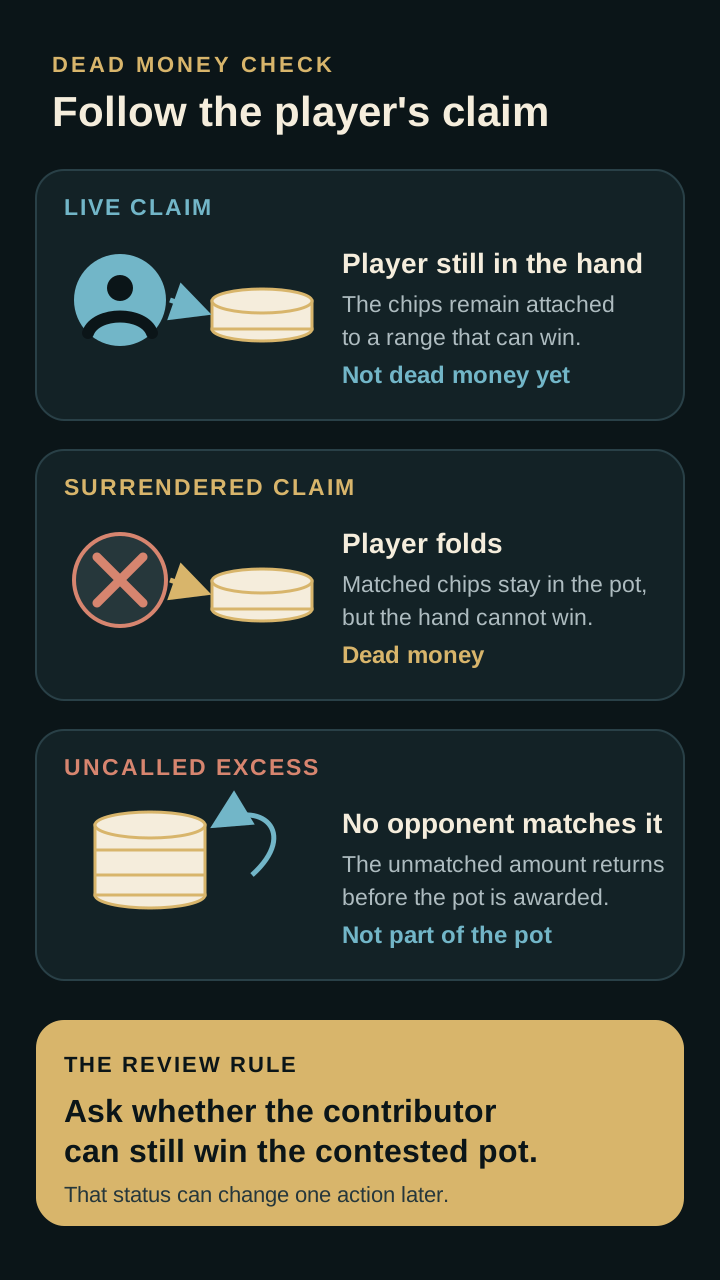
Dead money means committed chips whose contributor no longer has a live claim to the pot. When a player folds, the chips that player already posted, called, bet, or raised remain in the pot for the surviving players. Those chips are dead because the folded hand cannot win them back.
The phrase is sometimes used more loosely for a player or range that is expected to fold often. That is a prediction, not completed accounting. A loose caller's chips are still attached to a live hand until that player folds. In a careful review, use dead money for a surrendered claim and describe a likely fold as fold equity.
Dead does not mean irrelevant. Once the chips are in the pot, they help set the reward for the next decision. It only means the original contributor is no longer competing for them.
Is every chip already in the pot dead money?
No. Chips in the pot can still be backed by live hands. If three players see a flop, each player's preflop contribution remains connected to a hand that can win. The pot is large, but none of those contributions is dead merely because the chips have crossed the betting line.
The status changes with the action. If one player folds to a flop bet, that player's earlier contribution stays in the pot while the hand loses its claim. The same chips that were live one action earlier are now dead money for the players who remain.
Uncalled excess is different again. If a player moves all-in for 80 BB and the only opponent can call just 50 BB, the unmatched 30 BB is returned. It never becomes part of the contested pot, so it should not be counted as dead money or as part of the caller's price.
Where does dead money come from?
The most common source is a fold after a player has already invested. An open raiser can fold to a three-bet, a caller can fold to a squeeze, or a player can call the flop and fold the turn. Every matched chip left behind remains in the pot without that player's hand.
Blinds and antes are forced contributions, but they are not automatically dead while the posters remain active. A big blind who calls still has a live claim. If both blinds fold, their forced contributions become part of the dead money the winner collects.
A forfeited contribution can come from any street and any action. The label does not depend on whether the player posted, called, bet, or raised. It depends on whether that player can still win the contested pot.
How does dead money affect a poker decision?
Dead money increases the reward available to the surviving hands. For a call, all contested chips already in the pot belong in the pot-odds calculation. For a bet or raise, the existing pot is part of what can be won if every opponent folds.
Past contributions are sunk at the current decision. Do not ask how to recover chips already invested. Ask what the next action risks from this point and what it can win across the realistic branches. Folding can still be correct even when your own earlier chips have become part of the pot for someone else.
A larger reward can support wider competition, but it does not erase range strength. If one opponent remains with a strong continuing range, the fact that another player left chips behind may improve the price without making a weak hand strong enough to continue.
What is the difference between dead money and fold equity?
Dead money is the reward already in the pot without a live owner. Fold equity is the value created by the chance that a live opponent will fold. One describes chips; the other describes a possible response to an action.
They often appear together. A raise may target a pot containing blinds and contributions from players expected to fold. The existing pot makes winning immediately valuable, while the probability of those folds determines how often that immediate result occurs.
Keep the inputs separate in a review. Count the pot from the action record. Estimate folds from the live ranges and circumstances. Calling a live player's contribution dead money before that player acts quietly assumes the very fold you are trying to evaluate.
What does a complete dead-money example look like?
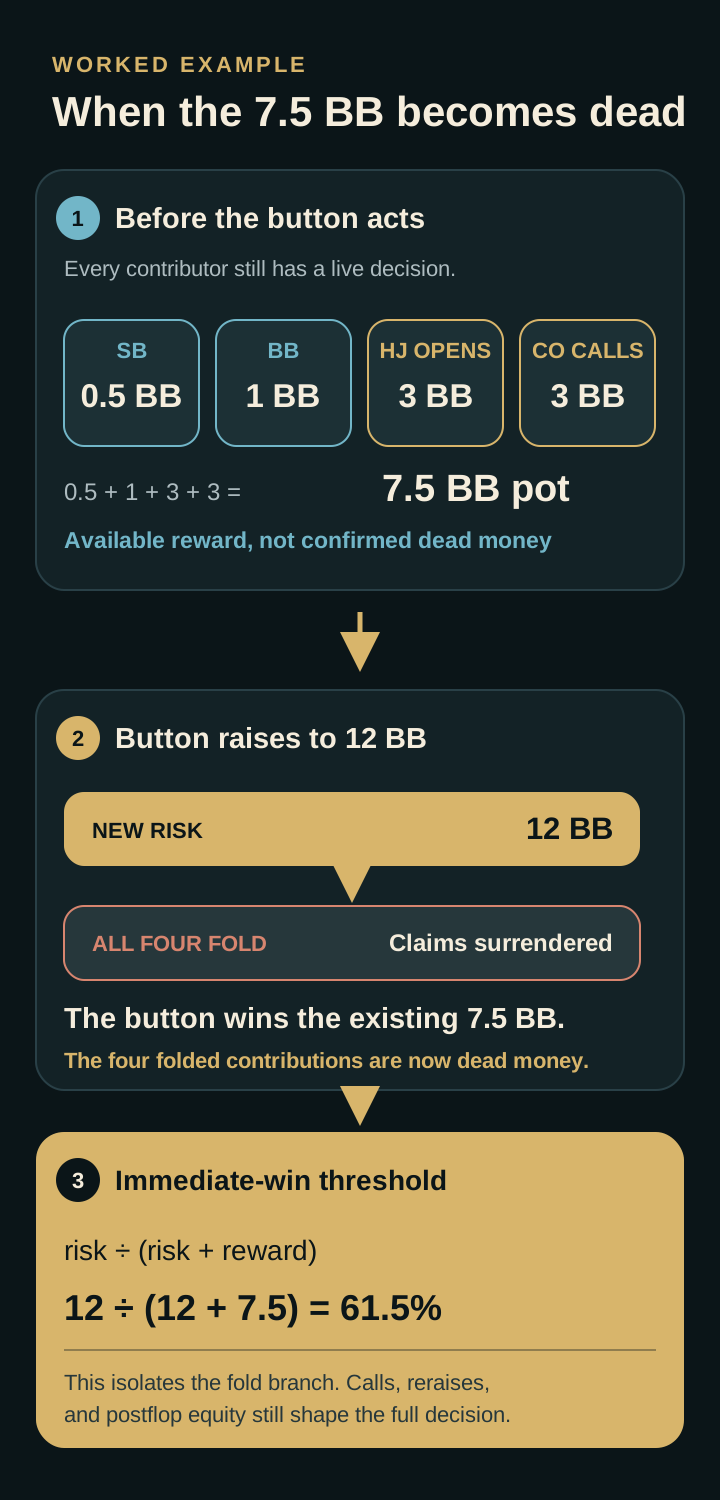
Consider a constructed six-handed cash-game hand with 100 BB stacks. The small blind posts 0.5 BB and the big blind posts 1 BB. The hijack opens to 3 BB, the cutoff calls 3 BB, and the button considers a raise to 12 BB.
Before the button acts, the pot is 7.5 BB: 0.5 plus 1 plus 3 plus 3. Those chips are the available reward, but they are not all dead yet. The hijack, cutoff, and both blinds still have live decisions. Treating their full contribution as dead would assume four folds before they happen.
The button raises to 12 BB and all four players fold. Now their 7.5 BB is dead money, and the button wins the pot. If the raise were a pure immediate-win attempt with no value when called, it would need everyone to fold more than 12 divided by 19.5, or about 61.5% of the time. The 19.5 BB denominator is the 12 BB risk plus the 7.5 BB reward.
That threshold describes only the immediate-win branch. A real raising hand can have equity when called, the opponents can reraise, and position and ranges can change the full expected value. The example shows when the chips become dead and how they enter one clean calculation; it does not prescribe a universal button raising range.
Does dead money always justify a call or raise?
No. Dead money improves the reward side of a decision, but an action still needs enough equity, folds, or future value to justify its cost. A player can notice extra chips correctly and still make a losing call against a range that is too strong.
For a call, compare the amount to call with the final pot after calling, then test your hand against the betting range. For a raise, include what can be won immediately, but also examine what calls, what reraises, and how much equity the raising hand has when the pot continues.
Multiway pots require extra care. One player's likely fold does not remove the ranges of players behind. Their chips are not dead, and they can call or raise. Count the reward precisely without deleting live opponents from the tree.
Which dead-money mistakes are most common?
The first mistake is calling every chip in the middle dead money. Existing pot and dead money are related but not identical. A live hand still owns a chance to win its contribution back.
The second is counting uncalled chips. Only matched, contested amounts belong in the pot. Return any excess before calculating the price or claiming that a large all-in created more dead money.
The third is using dead money as permission to ignore the called branch. A raise can win an attractive pot often and still perform poorly when calls or reraises come from a narrow, strong range. State the fold assumption and inspect the remaining branches.
Finally, do not chase your own previous investment. Your earlier chips affect the current pot, but they cannot make a new call profitable by themselves. Grade the next decision from the amount still at risk.
How should you review dead money after the hand?
Start with the action order, not the final pot. Record each forced bet and voluntary contribution, then pause at the decision you want to grade. Mark which hands are live at that exact moment and which players have already folded.
Reconcile matched amounts and return uncalled excess. Calculate the current pot once, then separate fixed arithmetic from uncertain range assumptions. If the decision is a call, find the price. If it is a bet or raise, map the fold, call, and reraise branches.
Save a conditional lesson such as: when an earlier caller folds, include the surrendered chips in the price but keep the remaining bettor's range intact. That is more reusable than a rule to attack every pot containing dead money.
How can Tells Poker support a dead-money review?
After the hand is complete, open it in Tells Poker and use Replay to move through the actions in order. Replay shows the total pot, chips committed in front of each seat, folded states, the active players, and remaining stacks, which helps identify the exact step when a contribution loses its live claim.
Then use the Analysis tab to inspect the key decision, street-by-street feedback, range assumptions, and deterministic pot or call math when the recorded spot supports it. Compare those pieces with the replay instead of treating the phrase dead money as a conclusion by itself.
Tells Poker analysis is a structured second opinion for post-session study, not perfect or definitive play and never real-time assistance. A complete action record is what makes the accounting and the range discussion useful.
Frequently asked questions
Are blinds always dead money in poker?
No. Blinds are forced contributions, but the players who posted them still have live hands until they fold. Once a blind folds, that committed amount remains in the pot as dead money for the surviving players.
Is a caller's money dead before the caller folds?
No. A caller still has a live claim to the pot and may call again, raise, or win at showdown. Calling that contribution dead early assumes a fold that has not happened.
Does dead money improve pot odds?
Yes. Contested chips left by folded players increase the current pot without adding another live hand, so they improve the reward relative to a new call. The hand still needs enough equity against the remaining range.
Is an uncalled bet dead money?
No. The unmatched part of a bet or raise is returned to the bettor before the pot is awarded. It is not contested and should not be included in dead money or pot-odds calculations.