

To review a poker hand you won, hide the result and return to the most uncertain decision. Rebuild the pot, stacks, positions, cards, and action; assign plausible ranges; compare the action you took with realistic alternatives; then reveal the outcome only after you have written a conditional lesson.
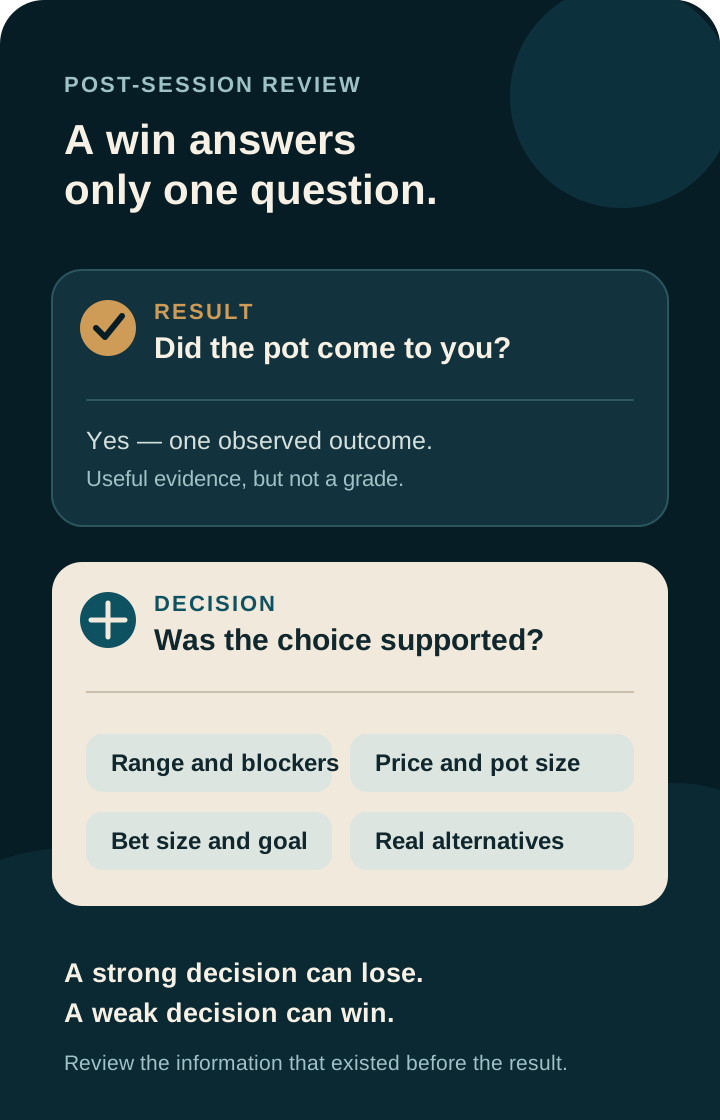
Winning the pot does not prove every choice was strong. A weak call can beat one bluff, a large value bet can make all worse hands fold, and a bluff can work against a hand that was going to fold to a smaller size. The result tells you what happened once. Review asks what your decision was trying to accomplish across the range.
This is post-session study, not a way to seek help during a live hand. The goal is not to talk yourself out of a win. It is to keep the useful evidence, notice value you may have left behind, and make the next similar decision with a clearer process.
Why should you review a poker hand you won?
Won hands often receive less scrutiny because the result feels like confirmation. That can hide the same problems players notice immediately after a loss: an inaccurate range, a size without a clear target, a call that relied on too few bluffs, or a strong hand that missed a street of value.
A win can also contain a strong process that deserves to be saved. Perhaps you checked a medium-strength hand, induced a river bluff, and called at a price supported by the range you built. The review should preserve why the line worked without turning one result into a rule for every opponent and board.
Treat the won pot as evidence, not a grade. It reveals one holding, one sequence of responses, and one runout. The decision had to account for the other plausible holdings and responses that did not appear at showdown.
What is the difference between a good result and a good decision?
A good result means the pot came to you. A good decision means the chosen action compared well with the available alternatives under the information and assumptions you had at the time. Those two facts can agree, but neither proves the other.
Decision quality depends on the range you assigned, the price or risk, the purpose of the action, the size, the remaining stacks, the players still active, and the future branches. A result is one realized branch from that larger tree.
Keep the evaluation conditional when an input is uncertain. “The river bet is supported if enough worse jack-x hands call 30 BB” is a reviewable claim. “I won, so the bet was right” does not identify the hands, responses, or alternative size that made the choice work.
Which won poker hands are most useful to review?
Start with hands that contained uncertainty rather than the biggest pots automatically. Mark a hand when you could not name the worse calls, guessed at a river bluff, faced an unusual size, changed your plan mid-hand, or felt relieved when the opponent folded. Relief can be a useful signal that the decision deserved a second look.
Include hands that ended before showdown. A fold can still test whether your value size was too ambitious or whether your bluff risked more than necessary. Include showdowns too, but do not let the revealed cards replace the range that the earlier action supported.
Review clear wins occasionally as control cases. A well-recorded, well-reasoned hand helps define what a strong process looks like. If every review begins with a dramatic or confusing pot, ordinary good decisions never become part of your study baseline.
How do you review a winning hand step by step?
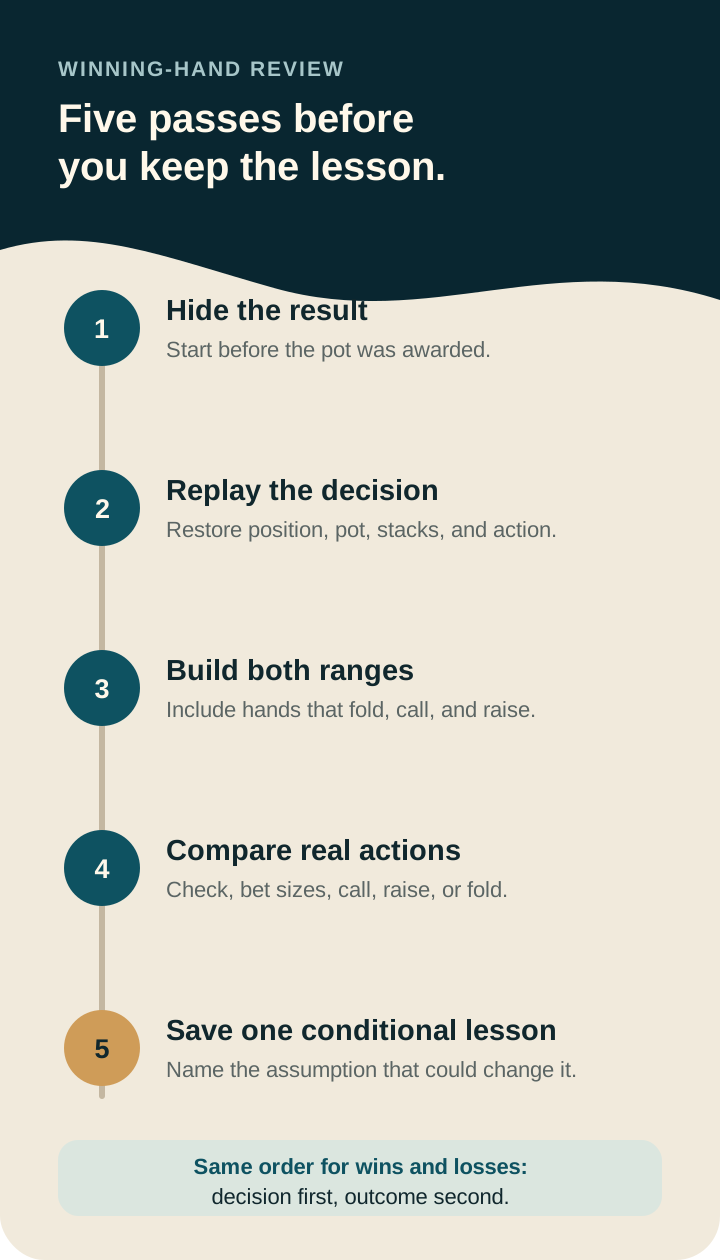
Use five passes. First, hide the result. Second, replay the hand to the decision and restore the positions, pot, effective stack, cards, action, and players still involved. Third, build both ranges from the action rather than from the showdown.
Fourth, compare realistic actions. For a river decision that may mean checking and two bet sizes; for a call it may mean folding, calling, and whether raising is credible. State what each option expects to happen instead of choosing an action only because it won.
Fifth, save one conditional lesson and the assumption that could change it. Then reveal the result. The outcome can update your view of one opponent or confirm a recorded fact, but it should not rewrite the first four passes.
What does a complete winning-hand review example look like?
Consider a constructed heads-up hand. You are on the button with A♣ J♣. The river board is J♦ 8♠ 4♥ 2♣ 6♦, the pot is 40 BB, and the big blind checks. You bet 30 BB with top pair and an ace kicker. The big blind folds, so you win without a showdown.
The win does not settle the size. Build the checking range and divide it by response. Which worse jack-x hands, eights, or pocket pairs call 30 BB? Which call 15 BB but fold to 30 BB? Which better hands check-raise or call? Which missed draws fold to every bet and therefore add no value to the larger size?
Now compare checking, betting 15 BB, and betting 30 BB. Checking guarantees showdown but misses every worse call. The smaller bet risks less and may keep more medium hands in. The larger bet earns more when called but needs a continuing range that still contains enough worse hands. Without response frequencies, the review should identify that dependency rather than announce a perfect size.
A useful takeaway is: “When I river top pair after the opponent checks, I will name the worse hands that call each size before choosing the largest value bet.” The actual fold is one observation. The transferable lesson is the response-range check.
How do you review a winning call at showdown?
Return to the call price and the full betting range. A bluff catcher that beats the hand shown may still lose too often to the value region you assigned. List the value combinations and bluff combinations that reach the bet, apply relevant blockers, and ask whether the call clears the required equity under that model.
Do not remove plausible value hands because the opponent happened to show a bluff. Likewise, do not assume every missed draw bets. The showdown confirms one hand was present and used one action; it does not reveal the frequency of the entire range.
If the call works only under an aggressive bluff assumption, save that condition. The lesson might be opponent-specific rather than a general river rule. A conditional note keeps the useful read without pretending one showdown proved a population tendency.
How do you review a bluff that worked?
Name the better hands the bluff was trying to fold and check whether those hands reached the decision. If the opponent folded a missed draw that your hand already beat, the bluff won the pot but did not accomplish the target you used to justify it.
Compare the risk with a smaller size. If 20 BB and 35 BB are expected to fold the same region, the extra 15 BB may not buy anything. If the larger size credibly pressures additional one-pair hands, name them and keep the conclusion tied to that response assumption.
Also check whether your hand had enough showdown value to prefer checking. A successful bluff can still turn a hand that sometimes wins at showdown into an unnecessary risk. Grade the target, candidate, and size before celebrating the fold.
Can a value bet be weak even when it wins the pot?
Yes. A value bet can win immediately because every worse hand folds, but that does not mean it earned more than a smaller bet or a check designed to induce action. The central question is which worse hands call the chosen size often enough to justify it.
A value bet can also be too small. If a range contains many worse hands that would call more, the hand may win while leaving value behind. Compare at least two sizes and write the expected caller groups next to each one.
Do not judge the bet by one fold or call. The response is useful opponent evidence, especially when it contradicts your expectation, but the review still needs the full response range you believed was available at the decision.
How do you avoid hindsight when the winning cards are known?
Write the range before looking at the showdown, or reconstruct it street by street if you already saw the cards. Keep the final holding outside the first draft. Then check whether that holding fits the range instead of making it the center of the range.
Use two columns in your notes: facts and assumptions. Cards, positions, sizes, and action can be facts when recorded accurately. The opponent's opening range, bluff frequency, and response to another size are assumptions. The result can add one fact without turning the assumptions into certainty.
If a missing detail changes the conclusion, preserve both versions. A review that says “the turn call is supported if the bet was one-third pot, but uncertain if it was three-quarters pot” is more honest and useful than choosing the remembered size that flatters the win.
What should you save after reviewing a hand you won?
Save the decision point, the action you compared, the range or response assumption that mattered most, and one cue for the next similar spot. Keep the note small enough to recognize during later study, not during active play.
A useful cue has a trigger and a checkpoint: “When a river value bet wins by folding out the range, compare which worse hands call a smaller size.” Avoid result-based cues such as “keep betting big because it worked.”
Return to the lesson when a similar hand appears. If a new example contradicts it, refine the condition instead of protecting the original conclusion. A study note is a working model, not a trophy from a pot you won.
How can Tells Poker support a winning-hand review?
After the hand is complete, save it in Tells Poker through Quick Capture or Guided Entry. In Hands, you can narrow saved hands by time, month, position, or an exact two-card holding. Choose a won hand because the decision felt uncertain, not only because the pot was large.
Open Replay and move action by action to the checkpoint before the result. Replay keeps the seats, board, pot, wagers, folds, and remaining stacks together, which helps you restore the information that existed when you chose the action.
The Analysis tab can organize street feedback, deterministic spot math when supported, range reasoning, and an alternative line. Use it as a structured second opinion for post-session study, never perfect or definitive play and never real-time assistance. Compare its assumptions with your own before saving the lesson.
Frequently asked questions
Should you review poker hands you won?
Yes. Review won hands that contained uncertainty, unusual sizes, thin value, bluff catching, or a line you want to repeat. A win can contain a strong process, a weak decision that worked, or missed value.
Does winning a poker hand mean the decision was correct?
No. The result is one observed branch. Decision quality depends on the ranges, price, objective, size, alternatives, stacks, and future action that existed before the result was known.
Should you look at the showdown before reviewing a won hand?
It is usually better to hide the showdown until you rebuild the decision and range. Reveal it afterward as evidence of one holding and one response, not proof of the opponent's complete range.
What is the best lesson to save from a winning hand?
Save one conditional trigger-and-checkpoint cue, such as naming the worse hands that call each river size. Include the assumption that could change the conclusion.