

A backdoor draw in poker is a hand that needs favorable cards on both remaining streets to complete a flush, straight, or another made hand. On the flop, a backdoor flush draw needs the turn and river to bring the required suit. A backdoor straight draw needs a useful turn card and then a compatible river card.
Backdoor draws are also called runner-runner draws because they require two cards in sequence. They are weaker than direct draws, which can complete on the next card. Their value is usually a secondary path: a small amount of extra equity, a useful set of turn cards, or additional support for a bet or call that already has a sound main reason.
Review backdoor draws after the hand is complete. Start with the exact flop, list the turn cards that keep the path alive, and then list the river cards required after each useful turn. Keep completion probability separate from winning probability, and do not let a small backup path justify an otherwise poor decision.
What does backdoor draw mean in poker?
A backdoor draw is an incomplete draw that cannot become a flush or straight with only the next community card. It needs the next card to create or preserve a direct draw, then the final card to complete it. If either stage misses, the original backdoor path ends.
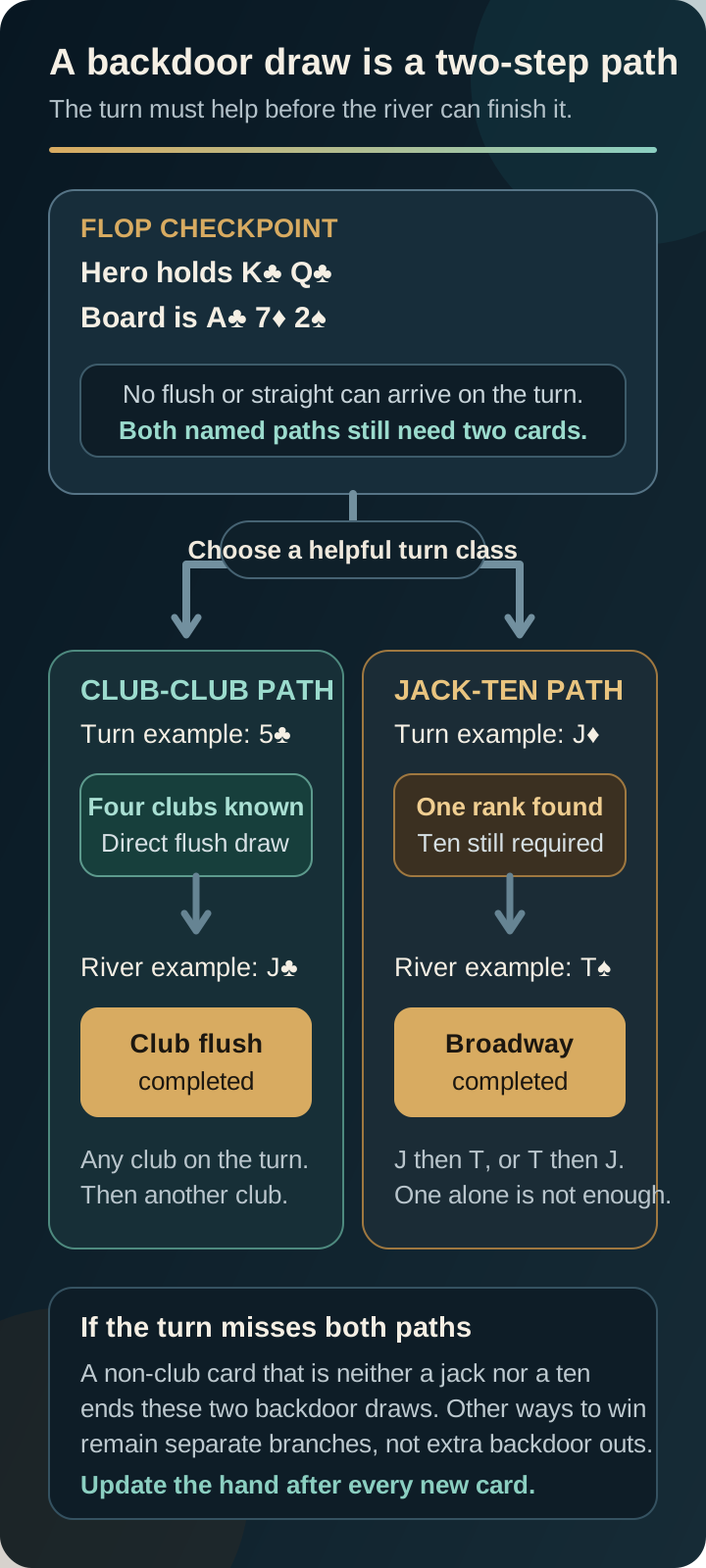
Suppose you hold K♣ Q♣ on A♣ 7♦ 2♠. You have three clubs among your hole cards and the flop. One more club on the turn would give you a four-card flush draw, but it would not yet make a flush. You need a club on both the turn and river to finish the five-card club flush.
The same hand also has a backdoor Broadway path. A jack on one remaining street and a ten on the other would make A-K-Q-J-T. A jack alone or a ten alone is not enough. The exact two-card sequence is what makes the draw backdoor.
How is a backdoor draw different from a direct draw, runner-runner draw, and redraw?
A direct draw can complete on the next card. Four cards of one suit form a direct flush draw because any remaining card of that suit can complete a flush on the turn. Four connected ranks with two open ends can form a direct straight draw because the next card can finish the straight.
Runner-runner draw is another name for a backdoor draw. Both terms describe a path that needs help on each remaining street. Players may also say “backdoor clubs” or “runner-runner straight” to identify the particular completion route.
A redraw is different. A redraw is a way to improve after a hand is already made or after another player may improve. For example, a made straight can have a redraw to a flush. A backdoor draw begins farther away: the hand still needs two coordinated future cards to reach the named made hand.
Which cards does a backdoor draw need?
Work from the flop in two stages. First list the turn cards that keep a specific completion possible. Then, for every useful turn class, list the river cards that finish it. Do not jump straight to a total number without showing the dependency between the streets.
With K♣ Q♣ on A♣ 7♦ 2♠, any of the ten unseen clubs keeps the flush path alive on the turn. After one club arrives, nine unseen clubs remain for the river. For the Broadway path, any jack creates a direct gutshot to a ten, while any ten creates a direct gutshot to a jack.
A non-club turn that is neither a jack nor a ten ends both backdoor paths in this example. The hand may still have other ways to win, such as pairing a king or queen, but those are separate branches. Calling every possible improvement part of one “backdoor draw” makes the label too broad to review.
How do you calculate the probability of a backdoor flush draw?
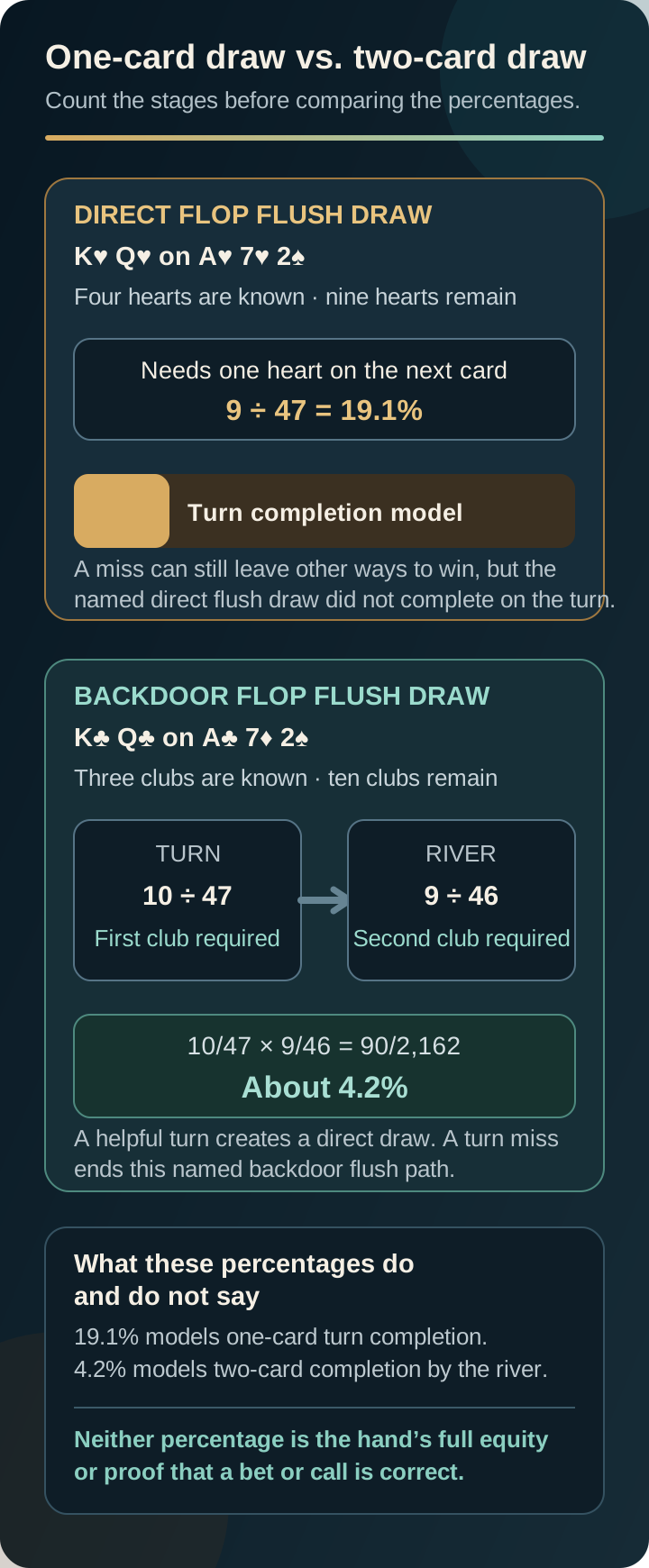
For a standard hold’em flop with two known hole cards and three known board cards, 47 cards are unseen. If your two hole cards and one flop card share a suit, ten cards of that suit remain. The chance of receiving that suit on both remaining streets is ten divided by 47, multiplied by nine divided by 46.
The calculation is 10/47 × 9/46 = 90/2,162, or about 4.2%. The second numerator falls from ten to nine because one of the remaining suit cards was used on the turn. This is the probability of completing that flush by the river under the stated known-card model, not the probability of winning the hand.
A direct flop flush draw starts with four known cards of one suit, leaving nine of that suit among 47 unseen cards. It can complete on the turn with one card, so the next-card probability is 9/47, or about 19.1%. Comparing 19.1% with 4.2% shows why a backdoor draw should not be treated like a direct draw.
How does a complete backdoor-draw example work?
Return to K♣ Q♣ on A♣ 7♦ 2♠. Count ordered turn-river sequences so the dependency stays visible. There are 47 × 46 = 2,162 possible ordered two-card sequences before considering opponent cards that have not been exposed.
The club-club route contains 10 × 9 = 90 ordered sequences. The Broadway route needs one of four jacks and one of four tens in either order. That creates 8 choices for the first helpful rank and 4 complementary cards for the second, or 32 ordered sequences.
Two sequences are in both groups: J♣ then T♣, and T♣ then J♣. Each makes both a club flush and Broadway, so adding 90 and 32 without adjustment would count those paths twice. The union is 90 + 32 − 2 = 120 sequences. That is 120/2,162, or about 5.6%, to finish at least one of those two named backdoor paths.
That 5.6% is still not the hand’s full equity. A king or queen may make a winning pair. Some completed hands can tie or lose, especially when the board pairs or an opponent’s range contains a stronger made hand. Opponent holdings also remove unseen cards even when you do not know which ones they are. The calculation is a transparent completion model, not a verdict on betting or calling.
How should a backdoor draw affect a flop bet?
A backdoor draw can improve a marginal bluff or semi-bluff candidate because some turn cards add real equity. It can also create natural follow-through cards: when the first required suit or rank arrives, the bettor may continue with a direct draw rather than with no backup plan.
That does not mean every backdoor draw should bet. Start with the bet’s main purpose. Which better hands might fold? Which worse hands might call? How does the board meet each range? Then use the backdoor path as a secondary comparison between otherwise similar candidates.
For example, two unpaired hands may have equally little showdown value, but one has two overcards plus a backdoor nut-flush path while the other has no coordinated improvement. The first hand may retain more useful turns. Position, sizing, blockers, and the opponent’s response range still decide whether that difference matters.
Can a backdoor draw justify a flop call?
Usually not by itself. A path that needs two favorable cards is a small part of the hand’s total value. A flop call still needs a credible main case from current showdown value, overcards, direct draws, price, position, implied action, or a later opportunity to win the pot.
Ask what happens on the turn. Which cards turn the backdoor path into a direct draw? What will you do when the bettor continues? Can you realize both remaining cards, or will another wager force a new decision? The chance of completing by the river does not mean the current call purchases both cards without further cost.
Multiway pots deserve extra caution. More opponents can reduce the chance that a modest made hand wins, and a helpful-looking card may improve another range more strongly. Review each active range rather than using the backdoor label as an all-purpose reason to continue.
What happens when the first backdoor card arrives?
Once the helpful turn arrives, stop using only the flop label and update the hand. K♣ Q♣ on A♣ 7♦ 2♠ 5♣ now has a direct club flush draw with nine unseen clubs among 46 unseen cards. The river completion probability for that named draw is 9/46, or about 19.6%, before checking whether every completion is a clean winning card.
The turn can also change ranges and the purpose of an action. A club may improve the caller’s continuing range, create new semi-bluffs, or make existing one-pair hands less comfortable. A jack or ten gives KQ a direct gutshot to Broadway while also changing which pairs and two-pair hands are available.
Rebuild the decision on the new board. The flop backdoor path explains how you arrived there; it does not prescribe a turn bet, check, call, or raise.
Which backdoor-draw mistakes are most common?
The first mistake is treating a backdoor draw like a direct draw. Needing two cards makes the path much less likely than needing one. The second is adding turn and river percentages instead of multiplying dependent stages. The third is counting overlapping paths twice when one two-card runout completes both a straight and a flush.
Another mistake is confusing completion probability with equity. Making a flush or straight does not guarantee the pot, and the current hand may win on runouts that do not complete the named draw. Range, ties, redraws, and future betting remain part of the decision.
Finally, do not judge the flop choice by whether runner-runner cards arrived. Hitting a 5.6% modeled path does not prove the earlier call or bet was sound. Missing it does not prove the action was wrong. Grade the decision using the price, purpose, ranges, and plan available at the time.
How should you review a backdoor draw after the hand?
Use five passes. First, pause on the flop and hide the later cards. Second, record the exact hole cards, board, pot, effective stack, and action. Third, name each backdoor path separately. Fourth, list useful turns and the required rivers, removing overlap. Fifth, compare the path with the action’s main reason and with a version of the hand that has no backdoor support.
Keep the lesson conditional. “Call with backdoors” is too broad. “When the flop call already has enough current value and position, count the backdoor path as extra support, then plan which turns can continue against another bet” is more useful.
Link the review to the exact card work: count the useful cards, separate completion from equity, update the board texture, compare semi-bluff candidates, and keep the whole hand in the same post-session checklist.
How can Tells Poker support a backdoor-draw review?
After play has ended, capture the completed hand in Tells Poker with step-by-step entry, typed text, or voice. Open Replay and move through the saved action to the flop. Verify the suits, board, pot growth, and remaining stacks before counting a two-card path.
When available, Analysis can organize the key decision, deterministic spot numbers, conditional range reasoning, a street-by-street debrief, and an alternative line. Compare that structured second opinion with your own useful-turn list and with a version that removes the backdoor path. It is not perfect or definitive play.
Tells Poker is for post-session review, not assistance during an active hand. The goal is a faithful record and a clearer question: did the backdoor possibility add useful support to an otherwise sound decision, or did it become the excuse for one?
Frequently asked questions
Is a runner-runner draw the same as a backdoor draw?
Yes. Both terms describe a draw that needs favorable cards on both remaining streets. A runner-runner flush needs the required suit on the turn and river; a runner-runner straight needs two compatible ranks.
How many cards does a backdoor draw need?
From the flop, it needs two coordinated cards: one on the turn and one on the river. After the first helpful card arrives, the hand may become a direct one-card draw on the turn.
Can a backdoor flush draw justify a flop call?
Rarely by itself. Treat it as extra support for a call that already has a reasonable price, current hand value, direct improvement, position, or later-street plan. Another bet may prevent you from seeing both cards.
Does every backdoor flush draw complete 4.2% of the time?
The 4.2% calculation applies to the standard model with two suited hole cards, one flop card of that suit, and 47 unseen cards: 10/47 × 9/46. Exposed cards or a different known-card setup change the count, and completion is not the same as winning.