

A redraw in poker is an additional way for a hand to improve after it has already made a hand or after the opponent may improve. For example, a made straight can also hold a flush draw. The straight is the current hand; the remaining cards that could make the flush form the redraw.
A redraw can matter whether you are currently ahead or behind. When ahead, it can help your hand remain strong on later streets. When behind, it can provide a path to a better category. The label describes that extra path; it does not prove the hand is favored or prescribe a bet, call, or fold.
Use redraws during post-session review. Name the current best five-card hand first, list the physical cards that create the second improvement, and then test those cards against the opponent range. A precise redraw count can still be misleading when some candidates create a tie, a higher opposing hand, or another redraw for the opponent.
What does redraw mean in poker?
A redraw is a secondary improvement path attached to a hand that already has a made holding or meaningful current value. The word is relative to the present street: first identify what the hand is now, then identify the later cards that can move it to a stronger five-card category or a stronger version of the same category.
Suppose you already have a straight on the turn and four spades are visible between your hole cards and the board. You do not need the river to make a straight, but any remaining spade would make a flush. That flush possibility is a redraw layered on top of the made straight.
The term is also used when a currently weaker made hand can catch up. A set facing a range that contains straights may have redraws to a full house or four of a kind. In both cases, the useful question is not merely ‘Do I have a redraw?’ but ‘Which exact future cards improve me against the range I am reviewing?’
How is a redraw different from a draw or backdoor draw?
A direct draw describes a hand that is not yet complete in the named category but can complete on the next card. Four cards of one suit on the turn are a direct flush draw. A redraw starts from a hand that already has another made hand or improvement layer, such as a straight plus that flush draw.
A backdoor draw needs two coordinated future cards from the flop. If only one card remains to come, a backdoor path no longer exists. A redraw does not require two cards; it describes the extra improvement route in relation to the hand already made, so it can be present on the flop or turn.
One hand can therefore carry several accurate labels at once. ‘Made straight’ describes the current category. ‘Flush draw’ describes the next-card improvement. ‘Flush redraw’ explains the relationship between them. Keep the labels separate so the made hand and the extra path are not counted as two independent piles of equity.
What are common redraws in poker?
A made straight can redraw to a flush when the same hand also has four cards of one suit available. A straight can also redraw to a higher straight when a future rank changes which five-card sequence the player can use. In each case, write the exact final five cards instead of assuming every attractive river improves the hand.
A set can redraw to a full house or four of a kind. On 9♣ 8♦ 7♣, holding 8♠ 8♥ gives you a set of eights. A later eight makes four of a kind, while a later nine or seven pairs the board and can make a full house. Those paths matter against straight-heavy branches, but range and card-removal checks still determine their quality.
Two pair can redraw to a full house, and a lower flush can sometimes redraw to a higher flush when a later suited board card upgrades the five ranks used. These labels are useful only when tied to exact cards. ‘I could improve again’ is not a count; a review needs the rank, suit, and resulting five-card hand for every candidate.
How does a complete straight-with-a-flush-redraw example work?
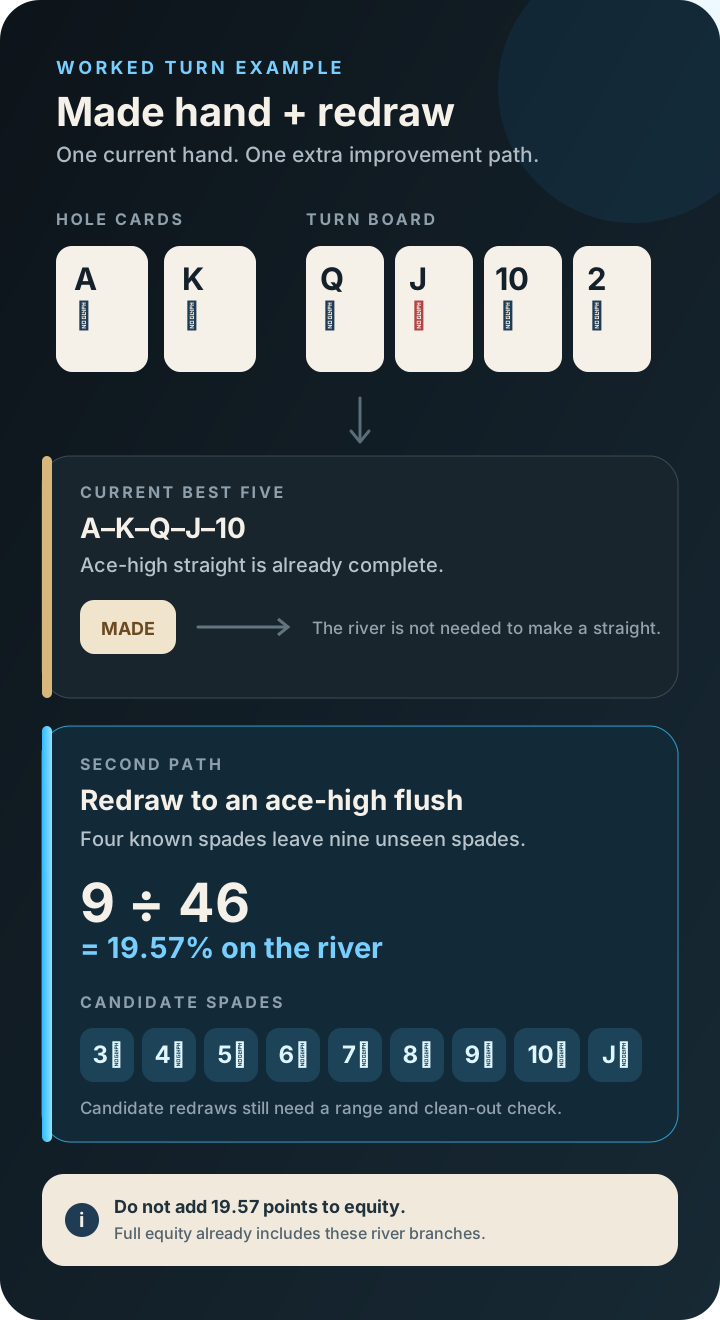
You hold A♠ K♠ on a turn board of Q♠ J♦ 10♣ 2♠. Your current best five cards are A-K-Q-J-10, so you already have an ace-high straight. You also have four spades among your two hole cards and the board: A♠, K♠, Q♠, and 2♠.
Nine spades remain unseen because a suit contains 13 cards and four are known. Any of those nine spades on the river would let you use five spades for an ace-high flush. The flush is the redraw; the nine remaining spades are candidate redraw cards before you test the opposing range.
The distinction matters because a non-spade river does not erase the made straight. The hand still reaches showdown with its current category unless the runout and action produce a different best five. The redraw adds river branches; it does not replace the value the straight already has.
How do you calculate the probability of a redraw?
On the turn, six cards are known: two hole cards and four community cards. That leaves 46 unseen cards. In the straight-and-flush example, nine unseen spades make the flush, so the baseline river arrival probability is 9 divided by 46, or about 19.57%.
Call those nine cards candidates before calling them clean outs. The opponent range may contain hands that are already ahead, hands that make a full house when certain spades pair the board by rank, or hands that can tie or improve again. Hidden-card assumptions can also change the conditional count you use for a specific range branch.
Do not add 19.57 percentage points directly to the hand’s current equity. Equity already averages all river outcomes against an assumed range, including the spade rivers. Adding the redraw probability again would double-count those branches. Use the redraw count to understand where the equity comes from, then calculate or estimate the full range-versus-range outcome once.
Are redraw outs always clean?
No. A redraw card is clean only when it is likely to produce the winning result against the range being reviewed. A card can improve your hand category and still be dirty or false because it also completes a full house, a higher straight, a higher flush, or a tie for a plausible opposing holding.
Board pairing deserves special attention. In the turn example, J♠ or 10♠ would make your flush but would also pair a board rank. Your flush remains a real improvement, yet the paired board can open full-house branches for parts of an opponent range. That does not automatically make those spades bad; it means the range test cannot stop at the word ‘flush.’
The same discipline applies to set redraws. A board-pairing card may fill your hand while improving another holding to a larger full house. Write the resulting best five for both sides, remove known cards, and count one physical card only once even if it completes several named paths.
Does a redraw matter when you are already ahead?
Yes, because current hand strength and future resilience are different questions. A made hand can be ahead of the opponent’s range now while still being vulnerable to later cards. A redraw creates some runouts where your hand improves again instead of relying only on the strength it already has.
That extra resilience can change equity, but it does not make the hand invulnerable. The opponent can have their own draws and redraws, and the same river may help both players in different ways. Compare complete runout branches rather than treating your redraw as insurance that always pays.
Position, stack depth, and future action still matter. A hand with a strong redraw may realize its river more easily when it can check behind, while a hand facing a large turn bet must compare the price and range now. The existence of a redraw is one input to the decision tree, not a shortcut around it.
Can you have a redraw when you are behind?
Yes. A set can be behind a made straight and still have full-house or four-of-a-kind redraws. A smaller straight can be behind a larger straight while retaining specific cards that create a different best five. In review, describe the current relationship and the improvement path separately.
Being able to catch up does not make a call profitable by itself. Compare the amount to call with the pot after calling, use a probability horizon that matches the cards you are actually buying, and account for future bets. If a turn call only guarantees the river, use next-card branches rather than a two-card flop shortcut.
Also consider times the range is not actually ahead. If only one part of the opponent range has a straight, your set may already beat bluffs, pair-plus-draws, and two-pair hands. Full equity includes those current wins as well as the redraw branches, so a narrow ‘outs when behind’ count is informative but incomplete.
How should a redraw change a poker decision?
Start with the current decision, not the label. For a call, calculate the price and identify the betting range. Then ask how often your made hand is already ahead, which future cards improve it, whether those cards are clean, and whether another wager can arrive before showdown.
For a bet or raise, separate current value, fold equity, and redraw equity. A made hand with a redraw may be able to bet for value against worse hands, semi-bluff against stronger branches, or check to preserve a medium-strength showdown path. The best line depends on which hands fold, call, and raise—not on the redraw alone.
Keep the conclusion conditional. ‘This hand has nine candidate flush redraws on the turn’ is a card fact. ‘Betting is best’ requires additional assumptions about ranges, sizes, position, stacks, and future responses. Good review keeps that boundary visible.
Which redraw mistakes are most common?
The first mistake is naming the redraw before building the current best five-card hand. If the hand is not actually a straight, set, or two pair, the improvement path may be an ordinary draw rather than a redraw layered on a made hand.
The second mistake is double-counting. One river card is one outcome even when it completes a flush and also extends a straight. The third is calling every attractive card clean without testing paired boards, higher categories, ties, and the opponent’s own redraws.
Players also add redraw probability directly to an equity estimate, judge the decision by whether the redraw arrived, or assume a strong redraw demands aggression. Hide the result and grade the ranges, price, and action tree that existed at the decision. A missed redraw can support a sound choice, and a hit can rescue a poor one.
How should you review a redraw after the hand?
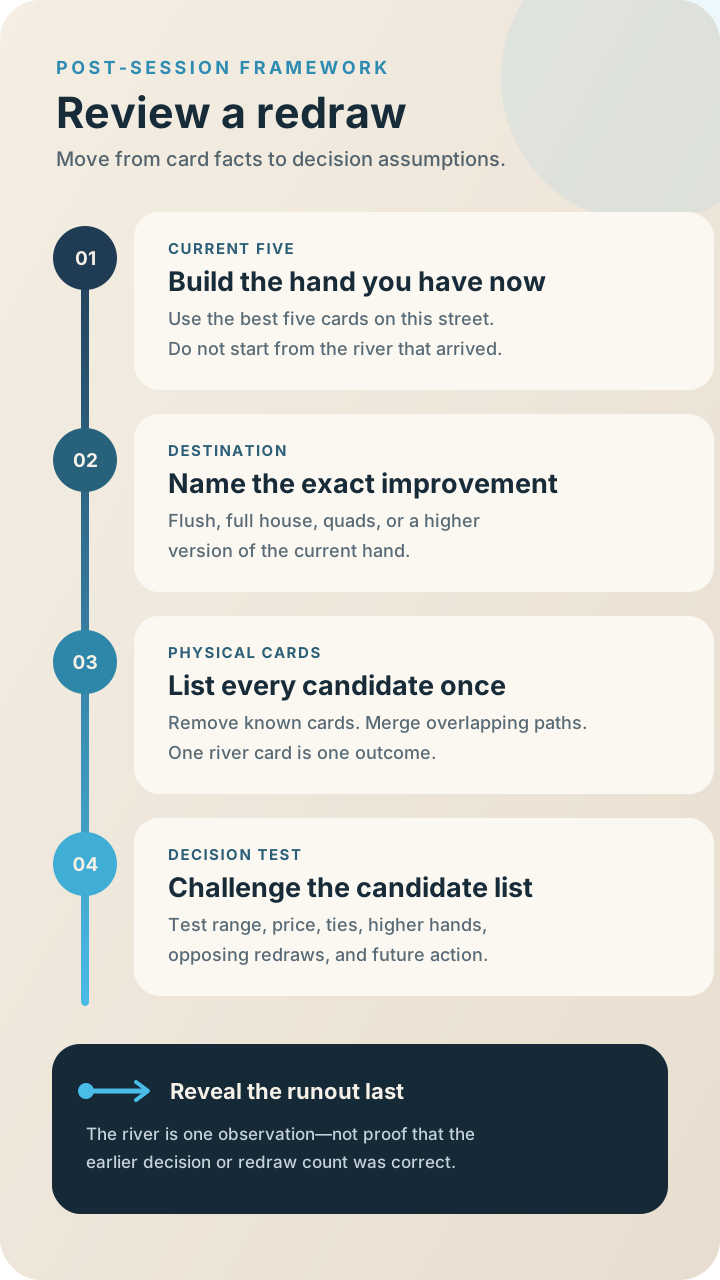
Use four passes. First, stop at the decision and build the current best five-card hand. Second, name the stronger category or higher version the redraw could make. Third, list the physical candidate cards without overlaps. Fourth, test every candidate against the opponent range, price, and remaining action.
Keep the runout hidden until the list is complete. If you saw the river first, it is easy to promote the card that arrived and ignore the rest of the distribution. Review the full set of possible rivers, then reveal the result as one observation rather than proof of the earlier choice.
Finish with a portable sentence tied to the assumption, such as: ‘When my made turn hand also has a flush redraw, I will count the suited rivers once and then test paired-board candidates against the continuing range.’ That lesson is more useful than ‘redraws are strong.’
How can Tells Poker support a redraw review?
After the hand is complete, save it in Tells Poker through Quick Capture or Guided Entry. Quick Capture lets you type or say what happened; Guided Entry records the details one question at a time. Verify the exact suits, board streets, positions, stacks, and action because a redraw can disappear when even one card is recorded incorrectly.
Open Replay and move to the frame before the decision. The saved hand keeps the board, seats, pot, remaining stacks, wagers, and action together, so you can name the current five-card hand before revealing the later card. Use the redraw sequence above to list candidates from that checkpoint.
The Analysis tab can organize the key decision, deterministic spot math when supported, range reasoning, street-by-street feedback, and an alternative line. Treat it as a structured second opinion for post-session study, never perfect or definitive play and never real-time assistance. Challenge any range assumption that changes whether a redraw card is actually clean.
Frequently asked questions
Is a redraw the same as a draw?
Not exactly. A draw describes a path to a named hand that is not complete yet. A redraw is an additional improvement path layered on a hand that already has a made holding or other current value.
Can a made straight have a redraw?
Yes. A made straight can redraw to a flush or, on some boards, to a higher straight. Identify the exact future cards and resulting best five instead of relying on the label alone.
Does a flush redraw always have nine outs?
No. Nine is the usual candidate count when exactly four cards of the suit are known and no other cards are exposed. Known cards, range assumptions, paired boards, higher flushes, ties, and opposing redraws can change how many candidates are clean.
Should you always continue with a redraw?
No. Compare the price, current range-based equity, candidate quality, cards still to come, future betting, position, and stack depth. A redraw improves some branches but does not select an action by itself.